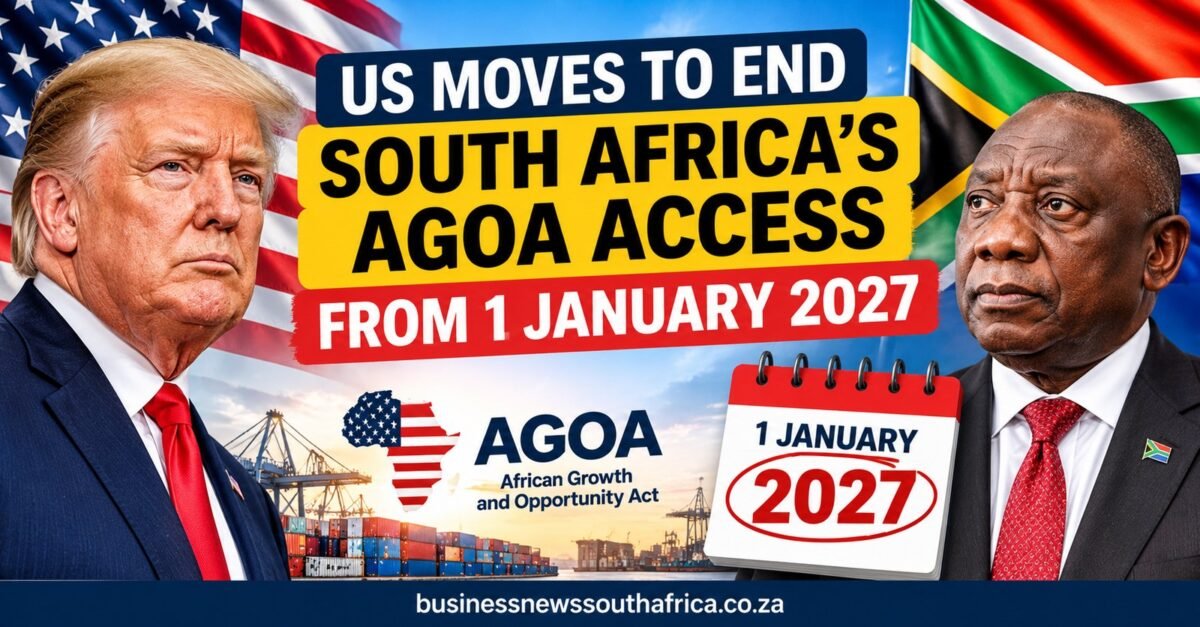
The United States has told Congress and the governments of South Africa and Rwanda that it intends to terminate both countries from the African Growth and Opportunity Act (AGOA) trade preference programme as of 1 January 2027, the US Trade Representative (USTR) said on 2 November 2026. It is a notice of intent, not yet a completed removal: the South African government says the notice gives it 60 days.
What it means for your business
If you export to the United States, check now whether your products enter duty-free under AGOA. From 1 January 2027, those goods would face the ordinary US tariff instead. If you do not export to the US, the direct effect is small, but suppliers and customers in AGOA-linked value chains such as citrus, autos, and boat building may feel it. Pricing, contracts and cash flow for 2027 are the things to review first.
What the US said
According to the USTR statement, President Donald Trump notified Congress and both governments after an annual interagency review of sub-Saharan African countries’ eligibility, led by the USTR. Ambassador Jamieson Greer said the review found that the governments of Rwanda and South Africa “are engaging in practices that are inconsistent with AGOA’s eligibility criteria”. He added that the practices include barriers to American trade and investment and practices that pose a threat to US national security and foreign policy interests in the region.
In its background section, the USTR lists its concerns about South Africa as barriers to US trade and investment, corruption, and threats to US national security and foreign policy interests.
The USTR’s 3 February 2026 statement on the programme’s reauthorisation says AGOA was extended through 31 December 2026, with retroactive effect to 30 September 2025.
South Africa’s response
The South African government said in a statement, as reported by IOL, that it had noted the US decision and that the notice gives the country 60 days’ advance notice of the withdrawal of its AGOA benefits from 1 January 2027. It said it recognises the concern the decision may create for workers, exporters, businesses and communities linked to AGOA-supported value chains. It is working with affected industries to assess the implications and to provide support on a company-by-company basis.
The statement also said South Africa had tabled additional concessions, going beyond those made in 2015, and called it unfortunate that the US was now raising new issues that were not the basis of the negotiations that began in 2025. Trade, Industry and Competition Minister Parks Tau said the decision does not define the broader relationship between the two countries, but that a solution depends on the willingness of both parties. SABC News reported that Tau said government will keep accelerating the diversification of South Africa’s export markets, pursuing opportunities in Africa, India, the European Union and China, among others.
How big is the exposure?
According to the government statement as reported by IOL, about 10% of South African exports to the US entered under AGOA in 2025, down from 28% in 2024. About 89% entered on ordinary World Trade Organization most-favoured-nation terms. AGOA exports were valued at about US$1.7 billion in 2025, against US$4 billion in 2024, roughly 1% of South Africa’s total global exports. Bilateral trade reached US$28.8 billion in 2025, and more than 600 American companies operate in South Africa, supporting about 134,600 jobs, the statement said.
Sector effects will differ. Daily Maverick quoted Citrus Growers Association chairperson Gerrit van der Merwe saying a citrus grower cannot simply divert a crop to another market, because markets have different phytosanitary requirements and consumer tastes. The association said exporters of mandarins, lemons and grapefruit would face the applicable US duty, generally 1.5 to 2.5 US cents per kilogram, on top of an additional 12.5% Section 301 tariff, and would be at a disadvantage to Peru and Chile.
Others were less alarmed. According to the same Daily Maverick report, Wandile Sihlobo, the President’s envoy on agriculture and land, said removal is not a complete ban from the US market. He estimated an additional most-favoured-nation tariff of around 3.4%, so that products now entering at 12.5% would face 15.9%.
What to do now
- List your US-bound products and their tariff codes, and find out which currently enter duty-free under AGOA.
- Model the 2027 landed cost for US customers with the standard duty added, and talk to buyers early about who absorbs it.
- Ask your industry body or the dtic about the company-by-company support the government says it is preparing.
- Look at the alternative markets government is pursuing, including the African Continental Free Trade Area, and the export support options in our earlier report on Ramaphosa’s call to prepare.
- Watch the 60-day notice period, which runs up to the 1 January 2027 effective date, for any change in the US position.
Earlier coverage
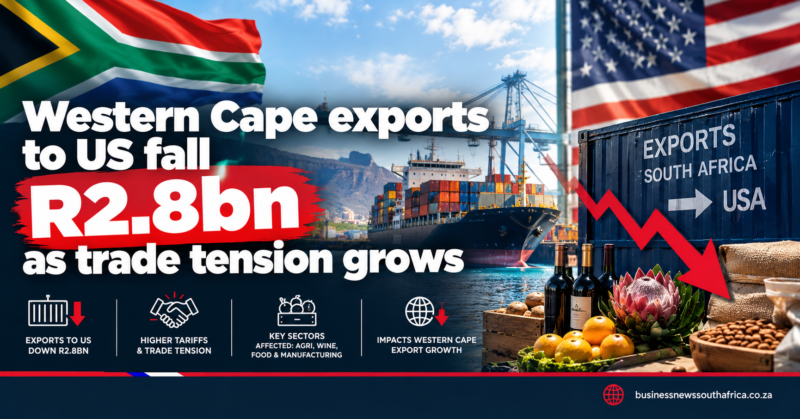
We reported before the announcement that South Africa was awaiting the US verdict, and on the US tariffs that cost Western Cape exporters R2.8 billion in 2025.