South African farmers receive far less state support than their competitors, and almost all of what they do receive is of the kind that economists consider most likely to distort markets. That is the picture in the OECD’s Agricultural Policy Monitoring and Evaluation 2026, published on 2 November 2026, which covers 56 countries and carries a full chapter on South Africa. The findings are on the OECD’s South Africa chapter, and they matter well beyond the farm gate, because food processors, retailers, lenders and input suppliers all price their risk off the state of local farming.
The headline numbers
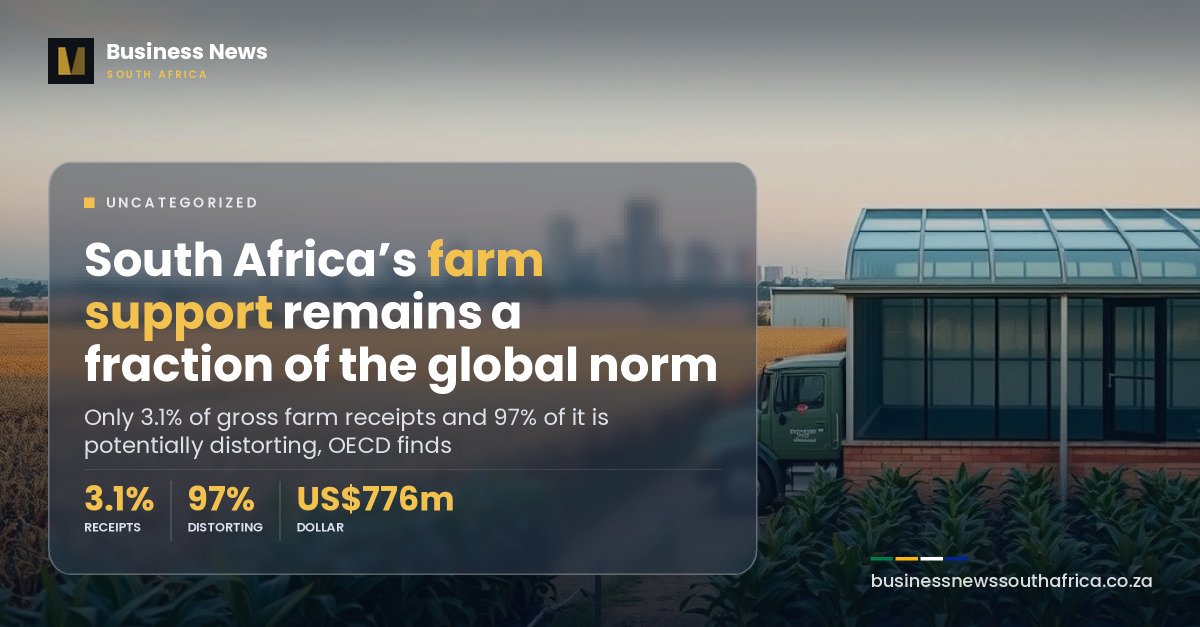
According to the OECD, South Africa’s Producer Support Estimate (PSE) was 3.1% of gross farm receipts on average in 2023 to 2025, down from 7.4% in 2000 to 2002. The PSE measures transfers to farmers that result from policy, including direct payments and measures that lift or lower domestic prices. In dollar terms the report puts the 2023 to 2025 average at US$776 million, against an average farm-gate production value of US$24.6 billion.
The yearly path is uneven. The table in the chapter shows the PSE at 1.55% of receipts in 2023, 3.87% in 2024 and a provisional 3.82% for 2025. Across all 56 countries, the executive summary says support to individual farmers averaged about 13% of farm revenue over 2023 to 2025, with Norway and Switzerland near 50%, Egypt at 12.6% and Peru at 6.4%.
Total support to the sector, which includes spending on shared services, fell from an average 0.6% of GDP in 2000 to 2002 to 0.3% in 2023 to 2025, with more than three-quarters going to individual producers.
Little support, but mostly the distorting kind
The OECD says 97% of South African producer support in 2023 to 2025 came in forms it classes as potentially most distorting. Market price support and support for variable input use without constraints are the two largest components. For most commodities, it says, domestic prices line up with border reference prices, so the support is concentrated in a few places.
Sugar is the clearest case. Import duties, set through a dollar-based reference price currently at US$680 per tonne, give sugar support worth 27% of gross receipts, according to the report. Milk also benefits from market price support. On the budget side, most direct payments are input subsidies, in the form of the fuel tax refund, or investment subsidies aimed at small-scale farming.
The OECD also reports that the average applied tariff on agricultural products is 8.3%, against 7.4% for non-agricultural goods. Maize has carried a zero import tariff since 2007, while poultry tariffs range from zero to 82%.
Spending on the shared foundations is shrinking
The General Services Support Estimate, which covers research, extension, infrastructure and inspection, averaged 1% of the value of agricultural production in 2023 to 2025, down from 3.9% in the early 2000s. The OECD says that is less than half the average of the countries it covers. Globally, the same measure fell from 4.6% to 2.4% over the period, so South Africa is starting from a lower base and falling faster. The report warns that persistently low investment could constrain productivity growth.
The chapter also records the 10-year foot-and-mouth strategy launched in January 2026, whose first two-year phase aims to vaccinate 80% of the national cattle herd by December 2026 and cut outbreak incidents by at least 70%. Those are government targets, not results.
What the OECD recommends
The chapter’s recommendations are specific. The OECD calls for gradually lowering the sugar reference price, paired with investment support for small-scale growers, and for phasing out the diesel rebate because it takes a large share of budgetary support, with the money redirected to rural infrastructure that links farmers to markets. Other items include more transparency on the Agricultural Land Holding Account, stronger traceability and veterinary services for foot-and-mouth disease, and better emissions measurement ahead of any decision on the agriculture exemption from the carbon tax.
The report also notes that the revised Raw Water Pricing Strategy began in 2026 and, citing AgriSA, that commercial farmers should expect higher raw water tariffs.
What it means for business
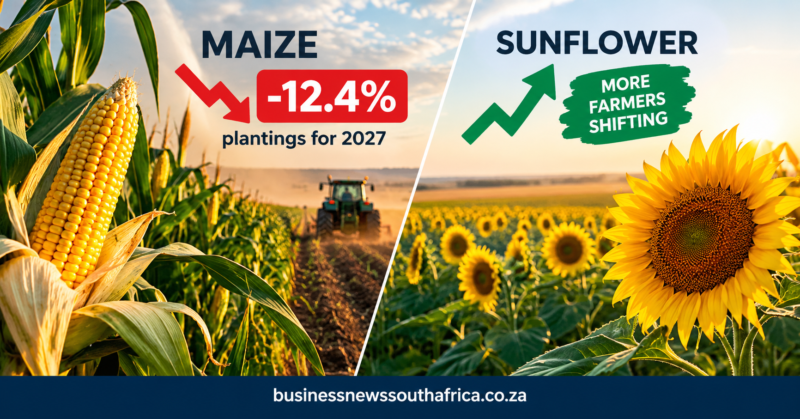
For buyers of farm produce, the finding that domestic prices mostly track border prices suggests local costs follow world markets more than policy. For lenders and insurers, thin public support means weather, disease and price shocks fall largely on the farmer’s own balance sheet. Our reporting on 2027 maize plantings falling 12.4% and on planting intentions as El Nino builds shows how little cushion many growers have going into the season. On tariffs, see our report on how long ITAC takes to decide them.
What is not yet known
The OECD makes recommendations; it does not set policy, and nothing in the report commits the government to change the sugar duty, the diesel rebate or any budget line. The 2025 figures are provisional, no government response has been announced, and the report does not say what a lower sugar reference price would cost the industry.