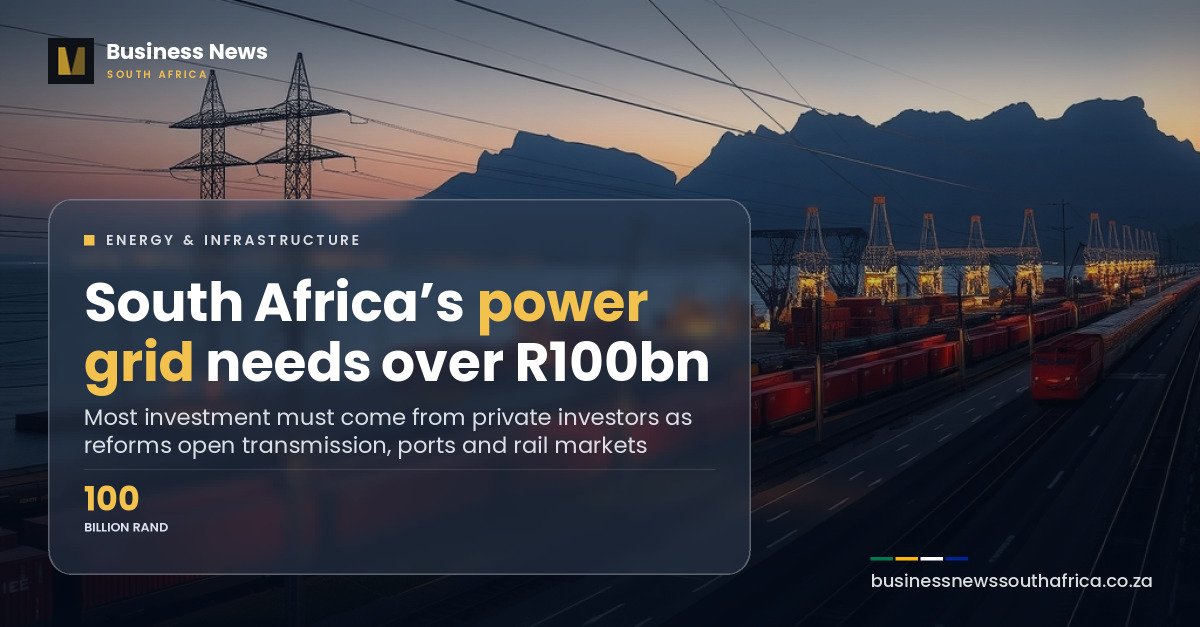
National Treasury Director General Duncan Pieterse told investors on Wednesday that South Africa’s electricity grid needs more than R100 billion of investment to expand and modernise, and that most of it will have to come from private investors, according to a SAnews report of his address at the Old Mutual Investment Group “Tomorrow” Investment Summit in Cape Town on 11 November. He was updating the room on Operation Vulindlela, the joint reform programme of the Presidency and National Treasury.
The constraint on new power has moved from generation to the grid
Pieterse pointed to the 2022 decision to lift the licensing requirement for new private renewable generators, which he said brought a surge of investment and substantial new capacity and helped end the electricity crisis. His message now is that generators are no longer the bottleneck. The grid is. New private producers need equal access to the network, and he said that requires a transmission and system operator that dispatches private power on competitive terms with Eskom power, so prices can fall over time.
He said the National Transmission Company of South Africa already exists as an Eskom subsidiary. The next step is to make it a fully independent, state owned Transmission System Operator that owns and controls the transmission assets and gives open, non discriminatory access. Our earlier reports cover the Treasury deadline for the transmission split and the delay to the independent transmission tender.
Ports and rail are next in line for open access
On logistics, Pieterse said Cabinet recently approved the approach to unbundling the ports authority from Transnet, and that opening the market and levelling the field for terminal operators should reduce the cost of trading and improve competitiveness. In freight rail, he said the market has been opened to private operators and that the first privately owned trains have started testing the lines. He added that government also needs a fully independent Rail Infrastructure Manager so private operators and Transnet compete on equal terms.
Transnet has also issued a request for qualifications for a strategic partner for the multibillion rand Manganese Export Corridor. Our report on the port backlog and the private terminal deal shows why ports matter to freight costs.
Visas, water and digital reforms were part of the update
Pieterse listed other items. The Electronic Travel Authorisation system was officially launched in August, which he said will improve tourist visa processing and ultimately work and study visa processing. Phase two of the Trusted Employer Scheme is meant to speed up the hiring of highly skilled staff.
On water, he said a revised pricing strategy is in place, new raw water use charges have been approved, and progress has been made on the National Water Action Plan and on establishing the National Water Resources Infrastructure Agency. On digital public infrastructure, he said Home Affairs has unveiled a digital ID prototype and that MzansiXchange, a governed data exchange between departments, is being piloted inside government. Our report on the digital identity prototype and its 2028 deadline has the detail.
The progress report gives the numbers behind the speech
The speech sits alongside the quarter two progress report that SAnews covered on 30 October. That report said key decisions were taken on the vertical separation of Eskom and Transnet, and that Transnet announced a profit of R4.6 billion for the year ended 31 March 2026, against a net loss of R1.9 billion the year before. It also said Cabinet approved the approach to an independent National Ports Authority and that a revised Network Statement is a step towards open access to the rail network. The National Treasury site is the place to look for the full programme documents.
What this means for business
This is a statement of direction, not a set of new rules. Its value for managers is in the order of events it describes. Private generators will need grid access before they can sell more power, and the cost of that access will depend on how independent the operator is. Importers and exporters should expect port charges and terminal competition to change as the authority separates from Transnet. Companies planning to hire skilled foreign staff will want to track phase two of the Trusted Employer Scheme.
The investment figure also tells you who is expected to pay. Pieterse said most of the grid money must come from private investors, which suggests tendering and tariff decisions will carry weight over the next few years. That is our reading, not something the speech spelled out.
What is not yet known
The SAnews account gives no dates for the independent transmission operator, the ports authority or the Rail Infrastructure Manager, and it does not say how the R100 billion would be split between Eskom, private investors and the state. We worked from SAnews’s account of the address and did not find the full speech text on a Treasury page.