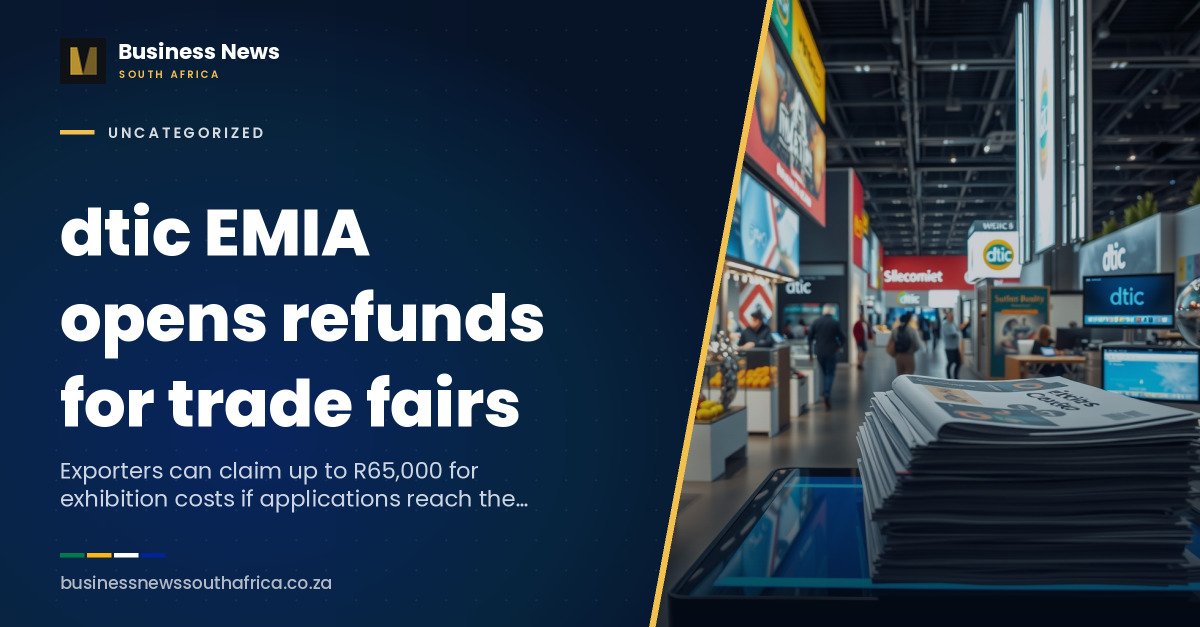
Status as at 15 November 2026: open, with no closing date. The dtic’s Export Marketing and Investment Assistance (EMIA) individual offerings take applications all year, mostly through the department’s online portal, which loaded today. The catch is timing: each application must reach the dtic three to six months before the event it covers. Approval is at the department’s discretion and depends on available funds, so an application is not a guarantee of money. The separate 2026/27 National Pavilion list is a different story: every application closing date on it has already passed.
EMIA refunds costs; it is not a loan. According to the dtic’s EMIA page, it partially compensates existing and potential exporters for qualifying costs of developing export markets for South African products and services, and of recruiting foreign direct investment. You pay first, then claim back the approved items. It sits with the other incentives in our guide to dtic incentives, and it is one of the routes listed in our running list of business funding that is open now.
Firms of every size can use it, but small firms get more
The dtic’s pages set out one list of support for small, medium and micro enterprises and historically disadvantaged businesses, and a shorter list for “other size entities” above the small business turnover limits. A large manufacturer can still claim exhibition costs and marketing materials. Travel and subsistence support is reserved for the smaller group.
Four kinds of applicant qualify, according to the department’s pages: businesses that make products or provide services in South Africa in the dtic’s priority sectors; businesses that outsource their manufacturing within South Africa in those sectors; export trading houses and commission agents representing at least three local firms; and export councils, industry associations and joint action groups representing at least five members.
Exhibiting abroad carries the largest single amount
The Individual Exhibitions page covers recognised international trade fairs, physical or virtual, where the dtic is not running a National Pavilion. For small and historically disadvantaged firms it lists:
- economy class return airfare, up to R20 000;
- subsistence of R3 000 a day for the event, up to ten days;
- transport of samples, up to R20 000;
- physical or virtual exhibition costs, up to R65 000;
- extra support for persons with disabilities, up to R35 000.
Larger firms get the R65 000 exhibition costs line and the marketing materials support only. Marketing materials are capped at R7 000 an event, plus R3 000 a year for digital listings, for businesses at least 51% owned by women, youth or persons with disabilities and for first time applicants. Everyone else gets R3 500 an event and half of digital listing costs, capped at R1 500 a year.
Market research trips and product registration are covered too
The Primary Market Research offering supports trips to meet foreign buyers or investors. Small and historically disadvantaged firms can claim airfare up to R20 000, R3 000 a day in subsistence for days with at least two appointments (up to ten days), samples up to R1 500 and marketing materials up to R5 000. A detailed itinerary and letters confirming the appointments must go in with the application. Speaking at a foreign conference qualifies only if the talk promotes exports, the FAQ says.
The Product Registration in Foreign Markets page pays half of the actual cost of international patents, trade marks, quality registration, copyright, product certification, and packaging and labelling, up to R300 000 a year. That page does not restrict this line to small firms.
The rules that most often trip applicants up
The dtic’s EMIA FAQ and its exhibition guidelines set conditions that rule many businesses out before the money question arises:
- The business must have been trading for more than one financial year, whatever its turnover, the FAQ says.
- Exported goods and services need at least 40% local content or value added, including raw materials and packaging.
- A B-BBEE level one to eight status and a valid SARS tax compliance pin are required at application and again at claim stage.
- Only one representative per business is funded at an event.
- A business and its related entities are limited to four successful individual applications a calendar year, plus two more for events in Africa.
- No support for physical events between 15 December and 5 January.
- Payments made through third parties, coordinators or consultants are not reimbursed, nor are cash payments.
Applications go through the online portal
Individual exhibitions, market research and product registration applications go through the dtic’s Online Incentive Solution at oisportal.thedtic.gov.za. The department stopped taking emailed or hand delivered applications for these from 1 September 2022.
Have these ready as PDFs: certificate of incorporation, B-BBEE certificate or affidavit, SARS tax compliance pin, financial statements, a brochure or website printout, an exporter registration certificate (service firms and industry bodies are exempt), an export marketing plan with two years of sales objectives, and three quotes each for flights, freight and marketing materials, or a letter explaining why you do not need that item.
Claims are due within two months after the event, with invoices, bank statements, boarding passes and freight documents. A report on results is due six months after the event; firms that skip it are barred from EMIA for six months. Rejected applicants can appeal within 30 days.
This year’s National Pavilion deadlines have passed
The dtic also takes exporters to selected fairs under a shared South African stand. Its National Pavilions list for 2026/27 names 12 events running to March 2027, including InnoTrans in Berlin, SIAL Paris and Gulfood in Dubai. The last application closing date on the list was 15 October 2026, for Gulfood 2027. Exporters aiming at a pavilion now need to watch for the 2027/28 list. Getting goods out matters as much as finding buyers, as our report on the Durban port backlog showed, and market access matters too, as with the AGOA extension.
What we could not confirm
The dtic’s pages do not publish EMIA’s budget for 2026/27, how much is left, how many applications are approved, or how long approvals and claim payments take. They do not say whether the fund is under pressure this year. The exhibition guidelines document linked from the dtic’s site is dated 2021; its amounts match the web pages read today, but we could not confirm on the funder’s own site whether a newer version exists. Applicants should check the current priority sectors and SIC codes with the dtic before booking travel. The dtic call centre is 0861 843 384.