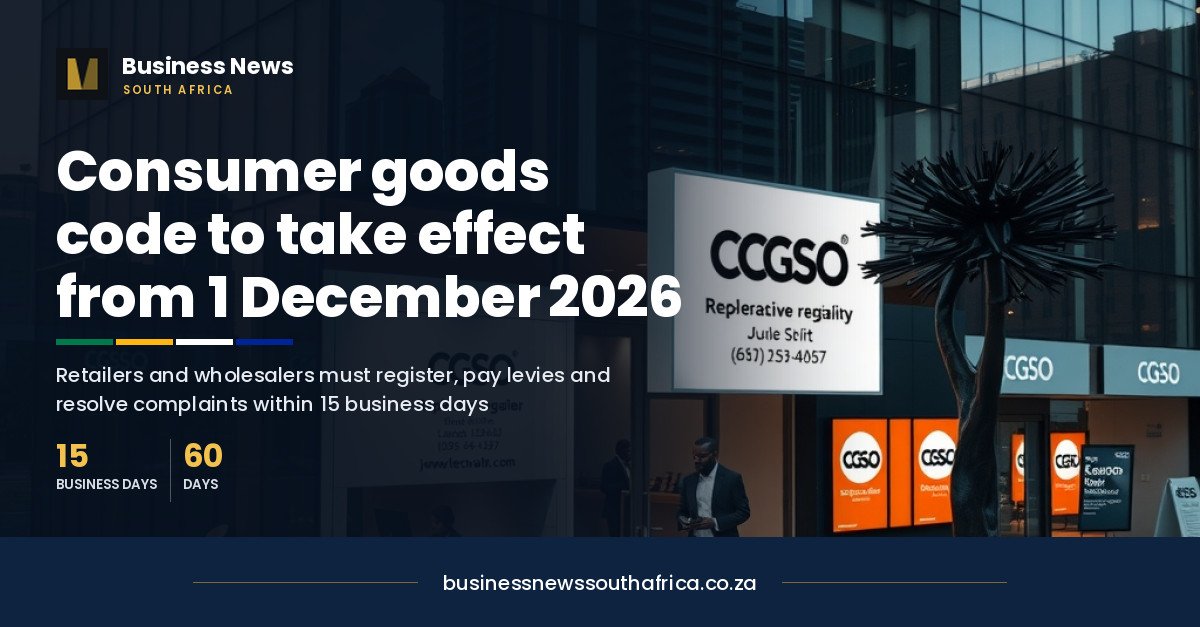
A new industry code covering anyone who makes, imports, distributes, wholesales or sells consumer goods and services to the public takes effect on 1 December 2026. The Minister of Trade, Industry and Competition prescribed the Consumer Goods and Services Industry Code of Conduct, 2026 in Government Notice 4264, published in Gazette 55719 dated 11 November 2026, and accredited the Consumer Goods and Services Ombud (CGSO) as the industry ombud. The notice states: “This Notice will come into effect on 1 December 2026.” We found no other coverage of it so far. This reading is taken from the gazetted notice and code.
The code binds the whole supply chain, not only shops
Clause 1.3 says the code is enforceable against participants, “which includes a Retailer, Manufacturer, Producer, Distributor, Supplier, Importer, Wholesaler and Service Providers as part of the Supply Chain, as defined by the CPA”. The notice withdraws, “in its entirety”, the code published as Notice 271 in Gazette 38637 on 30 March 2015, which you can still read as the 2015 notice.
Clause 1.4 attaches a legal consequence: “Failure to comply with this Code amounts to a contravention of section 82 (8) of the CPA.”
Registering and paying the levies is compulsory
Clause 4.2 makes it “mandatory for all Participants” to comply, “to register with the CGSO” and to contribute to its funding. Clause 6.2.1 names a joining fee, an annual levy and, if needed, a special levy, all set by the CGSO board, which may have regard to “the relative market share of the Participants” and the cost of running the scheme. Clause 6.2.6 says the CGSO “is entitled to take legal action to recover any outstanding fees or levies”. Under clause 14.3, a firm that falls under more than one accredited ombud pays each of them, with contributions reduced in line with the overlap.
What a participant must have in place
Clause 5.1 lists the duties. A participant must:
- run an internal complaints process that is “accessible and understandable to all Consumers”;
- display the prescribed notice, with the CGSO decal, on all trading premises and on its website, with the contact details of the CGSO and of the business;
- tell consumers they may take unresolved complaints to the CGSO;
- where practically possible, keep complaint records for a minimum of three years, covering the nature of the complaint, the branch or brand, how fast it was resolved and the remedy given.
The complaint clock runs in business days
A consumer must first take the complaint to the business. If it is not resolved within 15 business days, or a longer period the parties agree, the consumer may go to the CGSO (clause 15.2.1). The CGSO acknowledges the complaint within two business days. The business must acknowledge within two business days and has 15 business days to try to resolve it or give reasons for rejecting it (clauses 15.2.7.7 and 15.2.7.9).
The CGSO says it will “make every effort” to resolve complaints within 60 days of starting an investigation, failing which it closes the file and refers it to the National Consumer Commission (clause 15.2.5.1). Recommendations are not binding. But where a business refuses one the consumer has accepted, clause 15.9.4 says the details the ombudsman considers appropriate will be published in the CGSO annual report. Clause 4.2 warns that failure to co-operate “may result in harsher administrative fine” if the Commission takes a case to the Tribunal.
Who is outside the code
Clause 4.4 excludes “transactions that are not covered by the CPA and transactions with organs of state”. Clause 4.1 also carves out participants already regulated elsewhere where that regulation covers all prohibited conduct under the Act. A company whose asset value or annual turnover equals or exceeds the Minister’s threshold cannot use the CGSO as a consumer (clause 13.3.1).
What it means for businesses
This section is analysis, not part of the notice. The practical risk for a firm that has never dealt with the CGSO is a short runway of about three weeks. The first test is whether it is registered, shows the decal and can answer a complaint inside 15 business days. A manufacturer or wholesaler selling only to other businesses should check whether its end customers are consumers under the Act.
Firms in an industry with its own scheme should ask in writing which ombud claims them and whether contributions will be reduced, because clause 4.1 gives a way out only where the other regulation covers every prohibited conduct. See our coverage of the National Consumer Commission’s draft guidelines on shelf prices, labels and receipts and its opt-out registry guidelines.
What is not yet known
The notice gives no joining fee, annual levy or special levy; clause 6.2.5 says the method and current levels “must be published on the CGSO website”. We could not open that site from our systems, so we have not seen whether they are up. The notice does not say how firms registered under the 2015 scheme are carried over, how the overlap reduction between ombuds will be worked out, or what the turnover threshold is today, which the Minister sets separately.
The full text is on the gov.za notice page, alongside the draft published for comment in May 2025, and the National Consumer Commission is the regulator the code reports to.