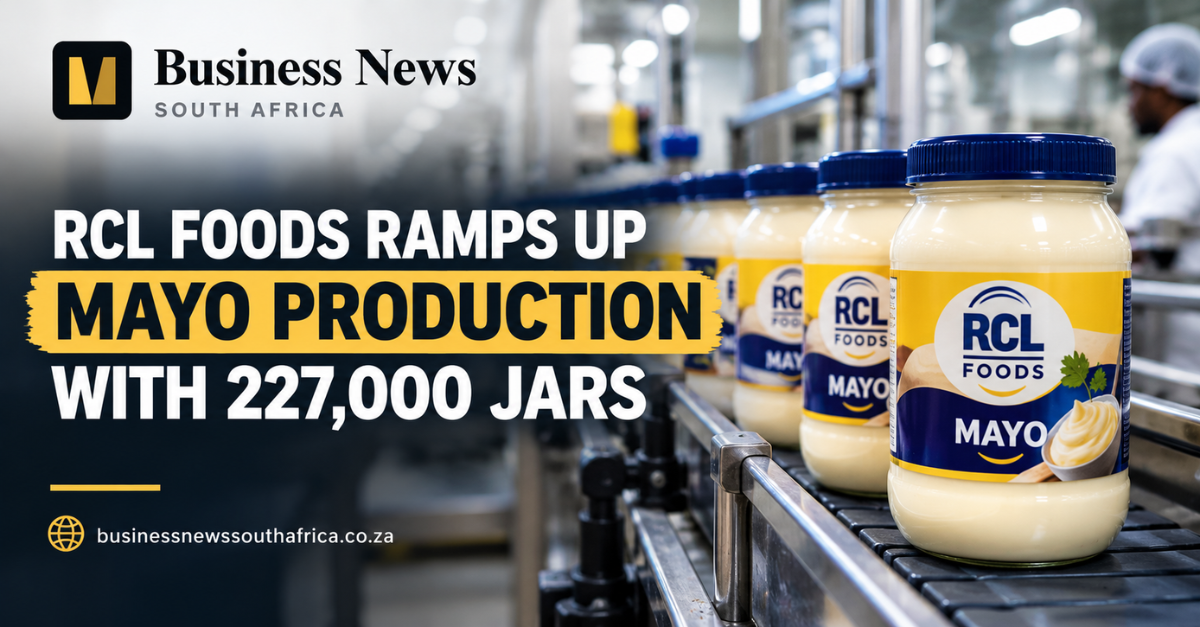
According to a brief note on Billionaires.Africa, RCL Foods, the South African food group controlled by billionaire Rupert, has produced 227,000 jars of mayonnaise. The company did not give further details about the size of the jars, the flavour profile or the intended market segment.
RCL Foods is best known for its meat and poultry brands such as Rainbow Chicken and the Steers fast-food franchise. Its entry into the condiment market is a clear diversification move. For a company that already operates a large manufacturing footprint, adding a mayonnaise line could make use of existing processing facilities, packaging lines and distribution networks.
Why the move matters to small-scale suppliers
Mayonnaise production requires a steady supply of eggs, vegetable oil, vinegar and packaging material. Those inputs are often sourced from small and medium-sized enterprises (SMEs) in South Africa. If RCL Foods plans to scale the product beyond the initial 227,000 jars, the demand for these inputs could rise, offering new contracts for local egg producers, oil refineries and bottle manufacturers. For an SME owner, the announcement signals a potential buyer with a national distribution reach.
At the same time, the condiment market in South Africa is highly competitive, with established brands such as Hellmann’s and local players like Mayco. RCL Foods will need to position its mayo on price, taste or convenience to win shelf space in supermarkets that already carry a range of options. The company has not disclosed whether the product will be sold under an existing brand or a new label, which leaves the branding strategy open.
From a financial perspective, the batch size, 227,000 jars, is modest compared to the volumes that large condiment producers move each year. It suggests a pilot run rather than a full-scale launch. If the trial proves successful, RCL Foods could increase production, which would amplify the impact on its supply chain and on revenue streams outside its core meat business.
Industry observers note that South African consumers have shown a growing appetite for ready-to-eat and convenience foods, a trend that accelerated during recent load-shedding periods when households looked for easy meal solutions. Mayonnaise fits that pattern, as it is a staple for sandwiches, salads and quick sauces. By adding mayo to its portfolio, RCL Foods may be trying to capture a slice of that convenience market.
It is also worth noting that the South African food sector has been under pressure from rising input costs, especially for feed, fuel and packaging. Diversifying into higher-margin products like condiments could help RCL Foods offset some of those pressures, provided the new line can achieve economies of scale.
RCL Foods has not released a statement confirming the exact purpose of the batch, nor has it announced any pricing or distribution plans. The claim that 227,000 jars have been made remains a company-provided figure, and independent verification of the production run has not been reported.
For entrepreneurs watching the development, the key question is whether RCL Foods will open its procurement process to local SMEs or rely on existing multinational suppliers. A transparent tender process could create opportunities for smaller firms, while a closed supply chain would limit the upside for local businesses.
In summary, the announcement of 227,000 jars of mayonnaise marks a tentative step by RCL Foods into a new product category. The real impact will depend on how the company scales the operation, which suppliers it partners with and how the product is received by South African shoppers.
The move also fits a broader pattern among large South African food producers: entering an adjacent, higher-margin condiment category using existing meat and poultry infrastructure is a lower-risk way to diversify revenue than building an entirely new production line from scratch, since the core cold-chain, packaging and retail-distribution relationships a company like RCL Foods already has with major grocery chains can largely be reused rather than rebuilt.