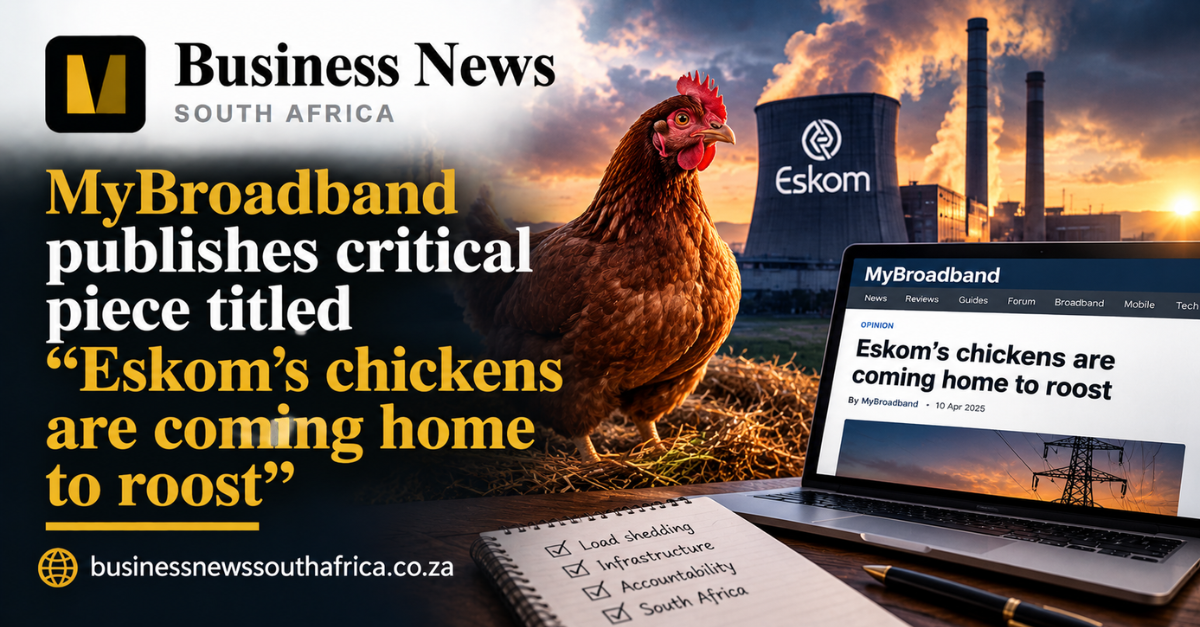
MyBroadband, a South African technology news site, ran a story on 6 September 2026 with the headline “Eskom’s chickens are coming home to roost”. The phrasing uses a common idiom, that the consequences of one’s actions are now arriving, to suggest that Eskom is facing the fallout of recent decisions.
Eskom, the state-owned electricity generator and distributor, has been under intense pressure for several years. Load-shedding schedules, a debt burden exceeding R400 billion and ongoing governance concerns have kept the utility in the public eye. The utility’s recent attempts to stabilise the grid, including procurement of new generation capacity, renegotiation of debt and restructuring of its workforce, have drawn both praise and criticism.
While the MyBroadband article’s full content is not available in the source, the headline alone signals that the outlet believes Eskom is now confronting the results of its own policies or operational choices. For SME owners and entrepreneurs, any shift in Eskom’s load-shedding schedule or tariff structure can directly affect operating costs and production uptime.
Without the article’s body, the specific issue being highlighted, whether it is a new procurement contract, a regulatory sanction, or a performance shortfall, remains unclear. Readers are advised to seek the complete MyBroadband piece for details.
Reading a headline-only story for what it actually tells you
A story built entirely around a headline, with the underlying article’s substance unavailable, is still informative in a narrower sense: it tells you how a specific, credible technology outlet is currently framing Eskom’s position, which is itself a data point about sentiment even before the specifics are known. MyBroadband covers South African infrastructure and technology closely, so a headline this pointed signals the publication sees a specific, identifiable failure behind the idiom rather than using it as generic commentary. For SME owners, the practical response to a signal like this is the same regardless of which specific issue turns out to be behind it: treat it as an early warning to revisit contingency plans rather than wait for the full story, since by the time every outlet has confirmed the details, any window to act ahead of a tariff or supply change has usually already closed.
What can be said with more confidence is the underlying financial picture the idiom is almost certainly referencing. Eskom’s debt load, its history of tariff increases running ahead of inflation, and its dependence on National Treasury guarantees have been well documented for years, and any of those threads could plausibly be what a headline like this is pointing toward. Until the full piece is available, the safest reading is that this is commentary on a known, longstanding vulnerability resurfacing, rather than evidence of an entirely new problem at the utility.
South African readers who follow Eskom coverage closely will recognise the rhetorical move MyBroadband is making here, framing a familiar institution’s troubles through a sharper, more memorable idiom than a standard news headline typically allows. That framing choice is itself a signal that the outlet believes its audience already understands the broader Eskom story well enough to fill in the specifics from the phrase alone.
Whatever the specific trigger turns out to be, the idiom itself, that consequences long deferred are now arriving, is rarely applied loosely by a technology outlet covering infrastructure this closely, which is reason enough to treat the headline as more than a passing turn of phrase.
Readers who want the full picture rather than the headline’s signal should look directly to MyBroadband’s own site for the complete piece, since the specifics, whatever they turn out to be, are what will actually determine any practical response.