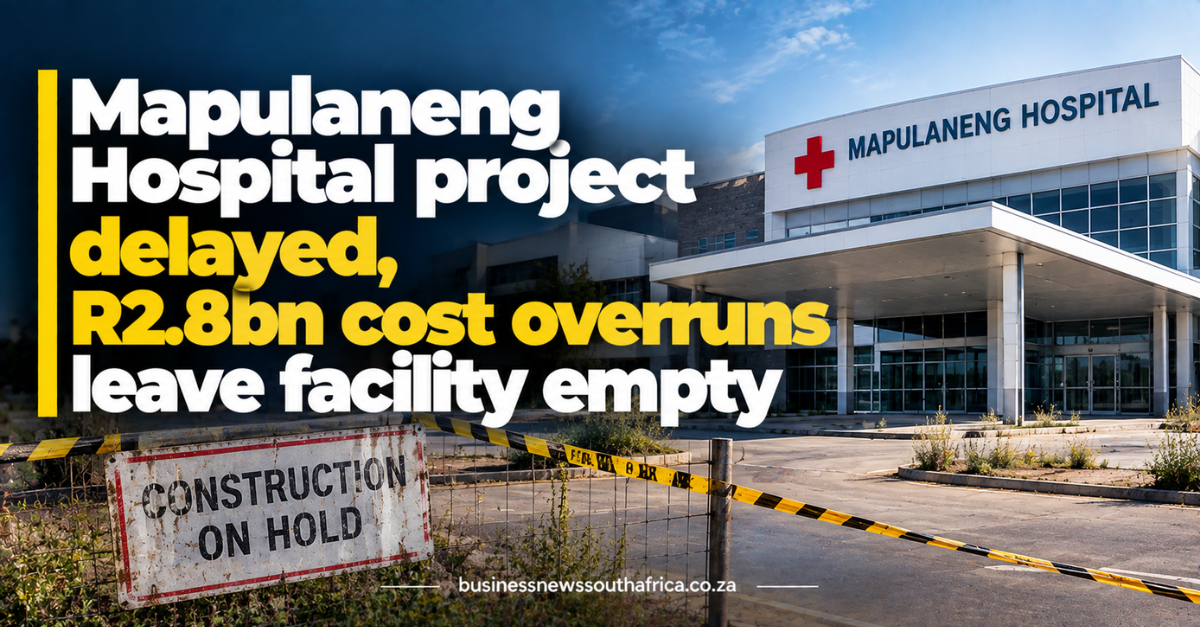
Empty corridors echo through the half-finished Mapulaneng Regional Hospital, a building that was supposed to open its doors in July 2026 but remains sealed off as contractors sort out liquidation and community unrest.
Health Minister Aaron Motsoaledi told parliament that the project, now costing R2.835 billion, has been pushed back indefinitely. The original budget was R2.5 billion and the work was reported at 78 % physical progress in December 2025. The delay is “attributable to the liquidation process of the contractor on Phase 3A, as well as the prolonged community-related disruptions,” the minister said, citing the closure of the construction site as the immediate cause.
Phase 1, bulk water, sewer, electricity and an access road, finished in September 2019. Phase 2, retaining walls and earthworks, wrapped up in July 2018. Phase 3, the main hospital build, was split into three sub-phases. Phase 3B, which includes the Emergency Medical Services building and several wards, reached practical completion in January 2026, missing its July 2025 deadline. Practical completion means the building can be used for its intended purpose, but finishing touches and testing may still be required. Phase 3A, which houses the operating theatres, radiology, and central sterile services department, and Phase 3C, which contains staff residences, a gym, library and parking, are still on hold.
The minister warned that the delay will have financial repercussions. Variation orders, contract changes that increase the price, already total R187 million, and further costs related to outstanding works, extension claims, security and appointing a new contractor are still being assessed. No final figure has been confirmed, and no consequence management measures have been taken against the project team.
For the 90-year-old Mapulaneng Hospital that the new facility is meant to replace, the impact is immediate. Residents of Bushbuckridge and the wider Ehlanzeni District Municipality must continue to rely on a dilapidated building that struggles to meet modern health standards. The delay also stalls the creation of jobs that the construction phase would have generated, a concern for local small-business contractors hoping to win sub-contracts.
This setback mirrors a pattern seen in South Africa’s public-sector infrastructure: large health projects often run over budget and past schedule, putting pressure on already stretched public finances. The Department of Health has been under scrutiny after similar overruns on other hospital builds, prompting calls for tighter project governance.
Motsoaledi said a new completion date will be announced once the Extension of Time claims are finalised. In the meantime, the government must decide whether to re-tender the unfinished phases or find a way to revive the liquidated contractor, a decision that will affect both the final cost and the timeline for delivering much-needed health services.
For businesses tracking public-sector spending, the evolving cost picture underscores the importance of monitoring tender opportunities and the fiscal health of large-scale projects. The Department of Health’s procurement portal and the Treasury’s infrastructure budget updates are useful sources for staying informed.
Read more about the challenges facing South Africa’s health infrastructure in our Retail & Consumer coverage.
Source: BusinessTech
Public hospital construction delays and cost overruns of this scale have recurred across multiple South African provinces, generally traced to a combination of contractor underperformance, changes to project scope after construction has begun, and provincial health departments’ own capacity constraints in managing large infrastructure projects rather than any single cause. A delayed hospital project carries a direct human cost beyond the budget overrun itself, since the community the facility was meant to serve continues relying on more distant or more strained existing healthcare infrastructure for the duration of the delay. The Department of Health’s own infrastructure delivery reports track project timelines and cost overruns across the province. For related coverage, see this site’s Energy and Infrastructure coverage.