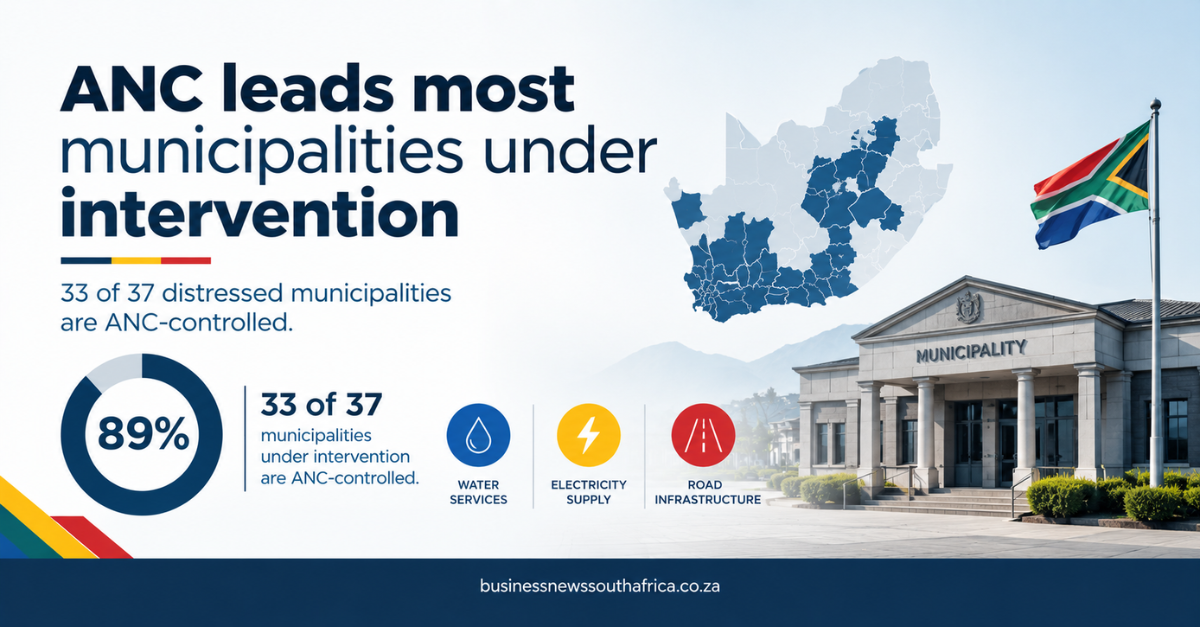
According to newsday.co.za, the African National Congress (ANC) governs in 89% of the worst municipalities in South Africa.
Municipalities are ranked as “worst” based on the national service-delivery index, which measures water, electricity, sanitation and road maintenance performance, as well as financial health such as debt levels. The index is compiled by the Department of Cooperative Governance and Traditional Affairs, which regularly flags those authorities that fall below acceptable standards.
For small and medium-sized enterprises, municipal performance matters. Poor service delivery can mean unreliable electricity, water shortages and delayed road repairs, all of which increase operating costs and disrupt supply chains. Local tax rates may also rise if municipalities struggle to meet revenue targets, squeezing profit margins for businesses that rely on a stable tax environment.
The ANC’s near-total control of these under-performing councils suggests policy continuity, but it also means that any attempts to overhaul fiscal management or improve service delivery will have to navigate the same political structures that have overseen the current shortcomings. Investors watch municipal bond ratings closely; a concentration of ANC-led authorities in distress could affect credit ratings and the cost of borrowing for local projects.
Business owners should therefore keep an eye on upcoming municipal budgets and any statements from the Department of Cooperative Governance. Changes in funding allocations or new service-delivery initiatives could either alleviate or exacerbate the challenges faced in these areas. For broader market context, see our Markets & Finance coverage.
Municipal financial distress in South Africa has been tracked closely by the Auditor General’s own annual local government audit outcomes, which have repeatedly found that a majority of municipalities, across party lines, fail to achieve a clean audit, suggesting the underlying capacity and governance problems are broader than any single party’s track record in the municipalities it controls. Poorer municipalities in particular tend to have a smaller own revenue base and rely more heavily on national government grants, which makes them more vulnerable to any disruption in intergovernmental transfers than a wealthier, more rates-and-taxes-funded metro. The Auditor General’s own local government audit reports track these patterns in detail across every municipality nationally. For related coverage, see this site’s Regulatory and Policy coverage.
Opposition parties governing similarly poor municipalities have made comparable claims about service delivery failures, suggesting the underlying fiscal constraints facing under-resourced municipalities cut across party lines even as the specific political framing of blame differs depending on who is making the argument.
Ratings agencies assessing South Africa’s overall sovereign credit profile have flagged local government financial distress as a contributing risk factor, since a pattern of municipal fiscal failure across many jurisdictions simultaneously raises the probability that national government will eventually need to step in with additional support, adding to the country’s broader contingent liabilities.
Coalition instability at metro level has compounded the challenge for municipalities of any political composition, since frequent changes in council leadership disrupt continuity in financial management and capital project delivery regardless of which parties are involved.
Civil society organisations monitoring municipal performance have called for a standardised, publicly accessible dashboard tracking service delivery indicators by municipality, arguing that the current audit-based reporting cycle is too infrequent to hold councils accountable in real time.
National Treasury’s own equitable share formula, which determines how much funding each municipality receives from national government, has faced periodic calls for reform to better account for the specific poverty and infrastructure backlogs facing the most under-resourced municipalities.
Ratepayers in wealthier municipalities have periodically raised concerns about cross-subsidisation, where their own rates and service charges help fund grants to poorer municipalities, a politically sensitive fiscal transfer debate that resurfaces whenever municipal distress makes national headlines.