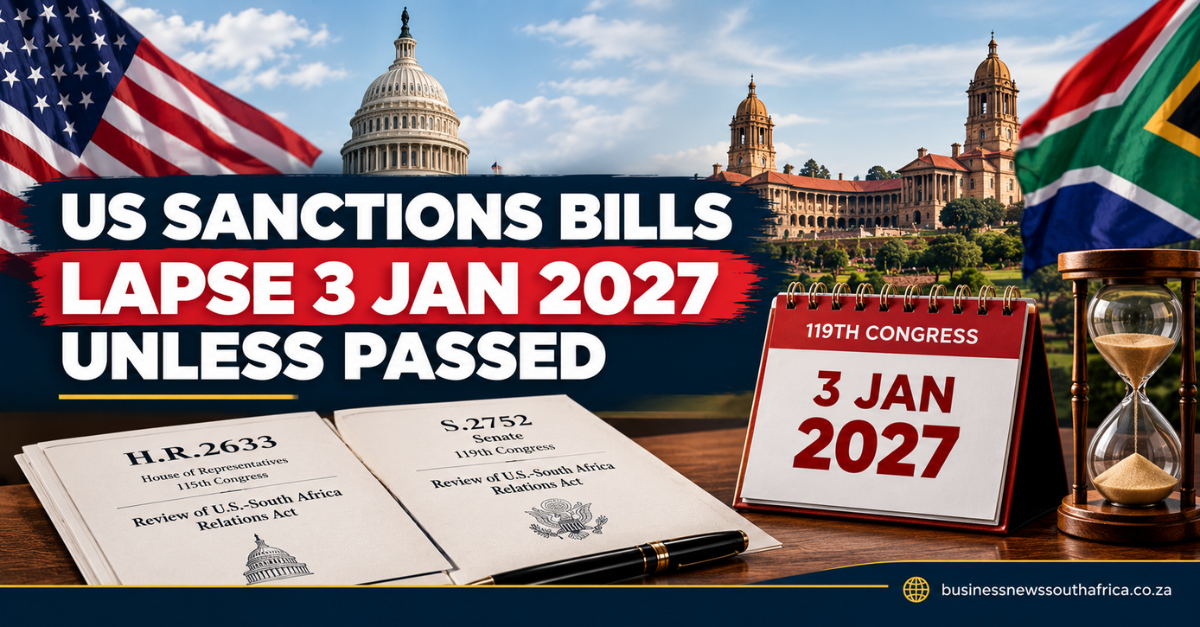
Two US bills that would force a review of relations with South Africa, and could lead to further sanctions, expire on 3 January 2027 if Congress does not pass them first, according to a briefing from the Institute for Security Studies (ISS), covered locally by BusinessTech. ISS analysts say both have stalled, with the last recorded action on either bill dating back a year, and rate them unlikely to become law before they lapse.
The first, the US-South Africa Bilateral Relations Review Act (H.R.2633), was introduced in the House of Representatives in April 2025 by Representative Ronnie Jackson. The second, a Senate companion bill (S.2752), was introduced in September 2025 by Senator John Kennedy and mirrors the House version. Both call for a review of South Africa’s participation in the African Growth and Opportunity Act (AGOA), the programme that gives qualifying African countries duty-free access to the US market.
The timing is what makes the expiry date matter. The US mid-term elections fall on 3 November 2026, the same week Washington is expected to announce which countries keep their AGOA eligibility, a decision we reported on when the extension to AGOA was signed in September. ISS says 2025 bilateral trade grew just over 10% to under $29 billion, with US foreign direct investment holding stable, which is the trade relationship a lapsed AGOA eligibility would put at risk independently of whether either bill ever passes.
What is actually at stake for exporters
AGOA has driven export growth for South African SMEs in apparel, automotive components and agro-processing. If the US removed South Africa from the programme, ISS says those exporters could face tariffs of 0% to 20% depending on the product, eroding margins and pushing US buyers toward other suppliers. For an exporter that relies on duty-free shipments, losing AGOA means higher landed costs for the buyer, pressure to re-price, or a search for markets that do not carry the same tariff risk. Trade-policy uncertainty also shows up in financing: lenders price political risk into credit decisions, so an exporter’s cost of working capital can rise even before any tariff actually changes.
The bills under review sit alongside a separate, already-active measure: visa restrictions Secretary of State Marco Rubio imposed on named South African officials and entities in September, which we covered when DIRCO summoned US ambassador Leo Brent Bozell over his public criticism of the government. Those restrictions can limit which officials and executives can travel for in-person meetings, complicating joint ventures and trade missions that depend on being in the room.
ISS’s own assessment is that the commercial relationship has stayed “surprisingly buoyant” despite the political noise. That does not make the risk theoretical: a bill does not need to pass for an AGOA eligibility review to go the wrong way, and the review and the bills’ expiry both land in the same two-month window. An exporter with meaningful US exposure should use that window to model what a tariff shift would do to margins on its specific product lines, rather than wait for an announcement to find out.
Neither bill has a scheduled vote, and ISS gives no indication that one is coming before the January deadline. That makes the bills themselves a low-probability event. The AGOA eligibility review landing in the same window is the part with no expiry date of its own, and it is the one a South African exporter cannot simply wait out. A business that ships to the US on AGOA terms today has no guarantee that the same terms still apply by the first week of November.