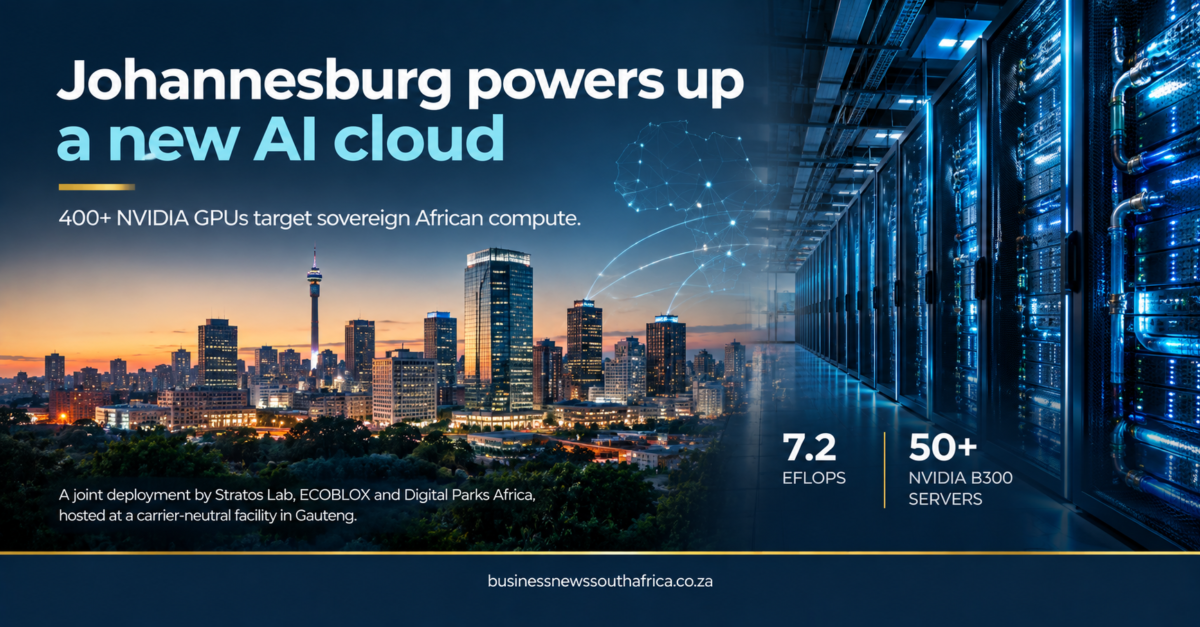
Three companies have partnered to switch on what they are calling Africa’s most powerful AI cloud, a Johannesburg facility built around more than 400 NVIDIA B300 GPUs, according to a joint announcement covered by Lifestyle and Tech. The launch pairs a local GPU-cloud operator, a global AI infrastructure integrator, and a South African data centre provider, each handling a different layer of what it actually takes to stand up large-scale AI compute on the continent.
Stratos Lab, the South African neocloud provider behind the deployment, is running the GPU-as-a-service orchestration and managed platform layer, on top of more than 50 NVIDIA B300 HGX GPU servers sourced from Gigabyte. “Deploying Africa’s most advanced AI Cloud powered by NVIDIA B300 GPUs represents a quantum leap for regional innovation,” said Stratos Lab chief executive Chris Mostert. ECOBLOX, described as a global AI compute infrastructure innovator and an NVIDIA Preferred Partner, handled the system integration: GPU cluster design, procurement and installation, plus the data centre infrastructure management and high-performance computing software stack running underneath it. “Solving the AI scaling bottleneck requires a fundamental shift in how compute environments are deployed,” said ECOBLOX chief executive Doug Makishima. Digital Parks Africa supplied the physical shell all of it sits inside, a carrier-neutral, Tier-3-plus rated colocation facility built for the power density and cooling loads a GPU cluster of this size demands. “Digital Parks Africa is proud to provide the carrier-neutral, highly resilient data center facility required,” said its chief executive, Menno Parsons.
Why the GPU count is the whole story
Four hundred GPUs sounds like a specific, almost trivial number until it is set against what training or running a large AI model actually requires. A single large language model training run can occupy hundreds of high-end GPUs continuously for weeks, and inference at scale, serving millions of user queries against a deployed model, needs sustained, reliable compute rather than a short burst. Until now, African enterprises, government bodies and research institutions wanting that kind of capacity have generally had to rent it from a hyperscale cloud provider based in Europe, the Middle East or the United States, paying for the round-trip latency and data-sovereignty compromises that come with sending sensitive workloads overseas to be processed.
A facility of this scale physically located in Johannesburg changes that calculation for a specific slice of customers: the target list named in the announcement, enterprise, sovereign government and research organisations needing model training, inferencing and what the companies call “Agent-as-a-Service” capability, is a direct pitch at exactly the institutions most sensitive about where their data and compute actually sit. A government department wary of processing citizen data on a foreign hyperscaler’s infrastructure, or a bank whose regulator expects sensitive financial models to stay within South African borders, now has a genuine local alternative rather than a compromise.
The partnership structure itself is worth noting as a template. None of the three companies could have built this alone in a reasonable timeframe: Stratos Lab brings the software orchestration layer that actually lets customers rent GPU time flexibly, ECOBLOX brings the specific hardware integration expertise NVIDIA’s own preferred-partner programme vouches for, and Digital Parks Africa brings the unglamorous but essential physical infrastructure, power, cooling and network carrier neutrality, that a GPU cluster this dense cannot run without. That division of labour mirrors how hyperscale AI infrastructure gets built globally, and its appearance in Johannesburg is itself a signal that African AI infrastructure is starting to follow the same specialised, multi-party build pattern rather than one company trying to do everything in-house.
What happens next matters more than the launch announcement itself. Whether this facility actually fills up with paying enterprise and government workloads, rather than sitting under-utilised as a proof of concept, will be the real test of whether South Africa has a genuine domestic market for AI compute at this scale, or whether demand still skews toward the familiar convenience of an established international hyperscaler despite the sovereignty and latency trade-offs. This site’s earlier reporting on South Africa’s AI market found strong weekly AI usage already outpacing the infrastructure meant to support it, which is exactly the gap a facility like this is now betting it can close.