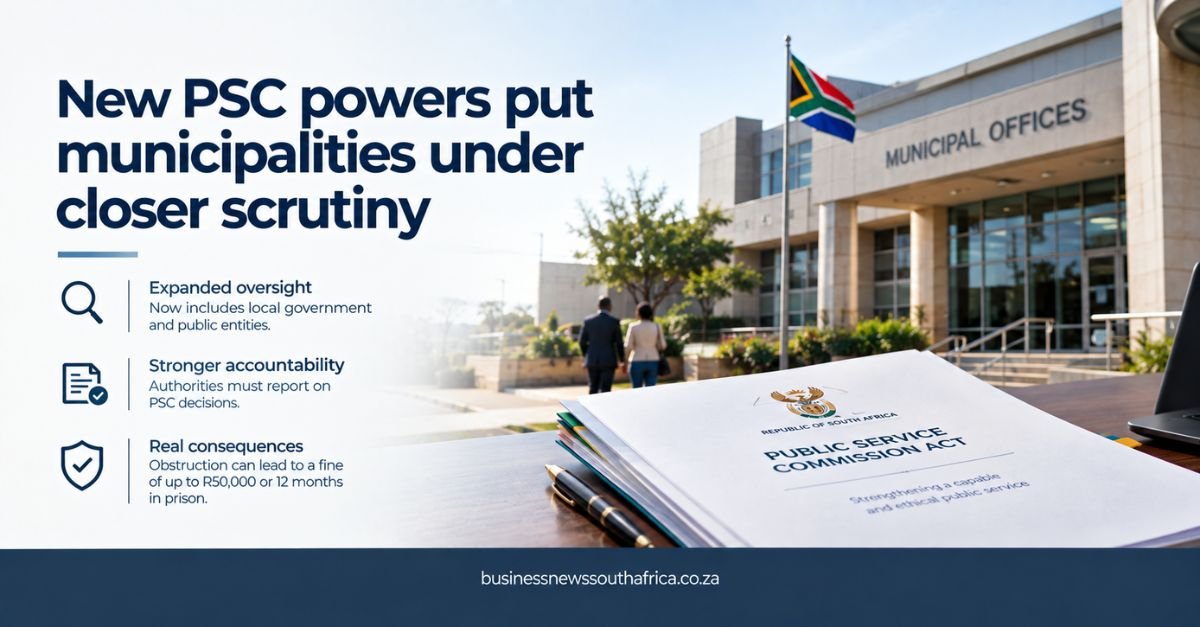
President Cyril Ramaphosa signed the new Public Service Commission Act into law on 16 September 2026, extending the commission’s mandate to municipalities and public entities and making it a criminal offence to obstruct its work. The Presidency said the Act replaces the 1997 legislation.
Busi Mavuso, chief executive of Business Leadership South Africa, welcomed the new powers in a column carried by BusinessTech, but warned that they will only mean something if the commission is funded and the courts follow through. She wrote that the commission now has “real teeth” and that she cannot see it “becoming effective without meaningful increases in its budget”.
What the Act changes
The commission is an independent body established under section 196(1) of the Constitution, which requires it to act “without fear, favour or prejudice”. Its powers had been governed by the 1997 Act, which the new law repeals. The Presidency said the signing reinforces the government’s focus on building a capable and ethical state.
According to the Presidency’s statement, the Act lets the commission monitor administrative practices, investigate failures and evaluate service delivery across government. It can direct the executive authority, or anyone else against whom it makes a decision, to report on progress in implementing that decision. A person found guilty of obstructing the commission faces a fine of up to R50 000, up to 12 months in prison, or both.
Until now the commission’s findings were recommendations that officials could set aside. Commission chairperson Somadoda Fikeni told Business Day that its directives are now legally binding and can only be overturned by a court on review. “You can no longer ignore them,” he said.
Commissioner Gxoyiya told the Sowetan that the Act also separates the commission from government. Previously its commissioners were supported by an office structured as a government department.
The commission must now oversee 257 municipalities as well as national and provincial administrations, according to Mavuso. Business Day reported that the municipal part of the mandate is suspended for 12 months, so the commission can prepare before it takes effect. Mavuso said the commission’s budget was cut while its responsibilities grew.
The funding gap
Fikeni said the commission will ask Treasury for R435 million in additional money over four years. Business Day listed the request as R28 million more in 2026/27 on a current budget of R354 million, R98 million more in 2027/28 (current budget R368 million), R150 million more in 2028/29 (current budget R380 million), and R159 million more in 2029/30.
Mavuso also pointed to the prosecution side. The commission can only refer obstruction cases, so the National Prosecuting Authority has to act on them. She said the legal architecture is now stronger, but the test is whether it can make a difference in service delivery.
The Act comes with two related laws mentioned in her column, the Public Service Amendment Act and the Public Administration Management Amendment Act, which deal with the appointment and conduct of civil servants.
Where small businesses come in
The commission’s remit covers unpaid invoices to contractors, according to the Sowetan’s explainer. Citizens and businesses can lodge complaints through the provincial offices of the commission or through the National Anti-Corruption Hotline on 0800 701 701.
Ramaphosa said the Act should be welcomed by public servants and citizens alike, as “a means to improve the lives of all South Africans and to enable growth through ethical and efficient conduct”, according to SAnews. He also said public servants should embrace the Batho Pele (People First) principles. Because of the 12-month suspension, the commission’s new powers over municipalities are not expected to be exercised immediately.
More coverage of new laws and regulators is in our regulatory and policy section, and coverage of how service failures affect shops and suppliers is under retail and consumer and SME and entrepreneurship.