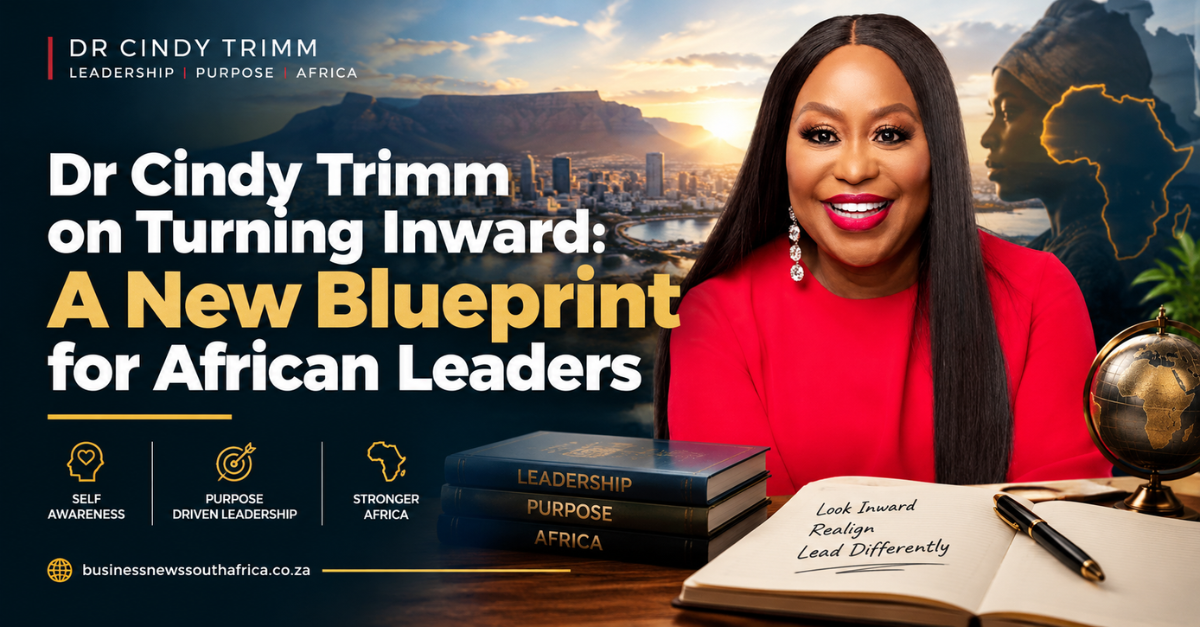
Dr Cindy Trimm, the author and leadership coach, told the Ideas That Matter podcast that scarcity can be a launch pad rather than a wall. Her argument, which we can call Cindy Trimm on turning inward, is that people who lack resources on the outside are pushed to find them on the inside, and that owners who do this early build more than owners who wait for capital. Her advice is personal and often spiritual, and it is offered as her own philosophy, not as research. What follows is what she said, and where it might be useful to a small business.
Poverty as a launch pad
Asked what in her upbringing shaped her ideas, Trimm answered “Poverty.” She described it as “a launch pad” that “puts enough pressure on you to go within to look for the resources that you don’t have without”. She said she started her first business at eight because the family lacked resources. Most people, she said, “turn without rather than turn within”, and those who turn without risk undermining their potential.
The practical reading for an owner is modest. A tight budget forces choices about what the business really needs. It does not make money unnecessary, and Trimm did not claim that it does.
Every decision is an appointment with the future
Trimm said the discovery at eight was that she was a creator of her own future, and that “every decision that I made was an appointment with my future”. If you land in that future, she said, you should not be surprised by what is there, because you created it. For a business owner this is a prompt to judge a hire, a supplier contract or a price change by where it leaves the business in a few years, not only by this month’s cash.
She linked this to long planning horizons. Trimm said an individual should have a life plan of at least 20 years, a corporation a plan of at least 50 years, and a nation a plan of at least 100 years. Few small businesses will plan for 50 years, but a written three to five year plan is a reasonable place to begin, and the Small Enterprise Development Agency offers support for owners drawing one up.
Self-mastery and what you repeat about yourself
Trimm said self-mastery starts with self-awareness, and that “the first, I think, law of dominion is to have mastery over what you are not”. She also warned against rehearsing what others say about you. “Never ever repeat an untruth about yourself,” she told the host. “Because you’re programming yourself to become it.” She said she stops people who recite what social media says about them.
She described a childhood in which her mother never answered a request with “I don’t have money”. Her mother would say “okay”, and Trimm said that response left her taking full responsibility for her education and her financial health. Because there were few “no’s”, she said, the yes was an affirmation that she could create what she wanted herself.
Being “the only”, and birthdays as a reset
On competing, Trimm said many people try to be the best, but “you have no competition if you are the only”. Her advice was to stop trying to qualify, fight and compete, and to show up as the only person who can be her. For a small business the parallel is positioning: a firm that is clear about what only it offers has less need to win on price alone.
She also said she treats each birthday as the arrival of a new version of herself, and that she has to let the old version go however successful it was. Before registering a new venture with the Companies and Intellectual Property Commission, a similar yearly review of what to keep, drop and change is a useful habit.
A note on the rest of the episode
Trimm grounded her view of creating her own reality in her faith, saying the first thing she learned about God in Genesis is that God is a creator, which “makes me a creator”. Readers who do not share that framing can still take the practical points: plan long, choose deliberately and be careful what you repeat about yourself. The episode also carries a promotional segment for Odoo’s business software and its Africa event in Nairobi on 3 and 4 September. That event has already taken place and it is not part of Trimm’s argument, so we have left it out.