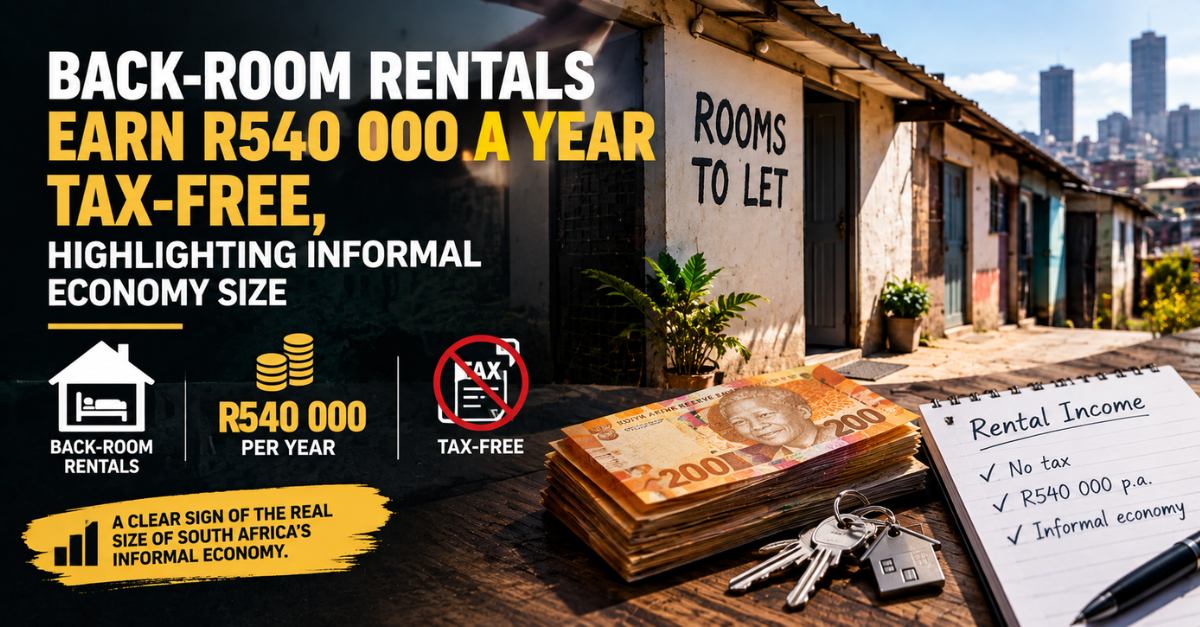
A woman who used her retirement pension to build 15 back rooms on her township property earns R540 000 a year from rent and pays no tax on it, according to informal economy specialist GG Alcock. He told Standard Bank Talks, in comments reported by BusinessTech on 29 September 2026, that South Africans renting out back rooms collectively make about R30 billion a year.
The rental example
Alcock said the story came from someone who told him about their mother. She “took her formal retirement pension from working her whole life and built 15 amarum,” he said, using the Zulu term for back-room rentals. At R3 000 a room she collects R45 000 a month, or R540 000 a year. He described it as “a great business, making her R45,000 a month by investing her pension.”
The story is second-hand, and neither the woman nor her tax position has been independently checked. “Pays zero tax” describes what the woman is reported to pay, not what the law requires. In a March 2021 media release about property owners who let to paying guests, SARS said that rental income received must be declared in the income tax return, and that non-compliance can bring penalties, interest and criminal action.
What the tax rules say
On the SARS 2026/27 rates for individuals (1 March 2026 to 28 February 2027), a person under 65 pays no tax on income up to R99 000. The first bracket taxes income up to R245 100 at 18%, and income between R530 201 and R695 800 falls in the 36% bracket, with a primary rebate of R17 820.
On R540 000 of taxable rental income, before any deductions or other income, that works out to roughly R111 000 in tax for the year (R125 599 plus 36% of the R9 800 above R530 200, less the rebate). The actual figure would be lower after allowable expenses. That is an illustration from the published rates, not a calculation of the woman’s liability.
SARS’s provisional tax guidance treats a person who earns income other than remuneration as a provisional taxpayer. A natural person who does not carry on a business is excluded if taxable income from interest, dividends, rent from letting fixed property and remuneration from an employer not registered for employees’ tax does not exceed R30 000, or if taxable income does not exceed the tax threshold.
The size of the informal economy
Alcock said executives often dismiss the sector until they hear it described. “One thing they don’t get is the scale of it,” he said. “They might know of a bakery here or a trader there, but they never add it all up.”
His other estimates, all given in the same conversation, were these. Spaza shops generate more than R200 billion in annual turnover. Most informal traders are not VAT-registered, so “they pay VAT and don’t claim it,” which he put at a net benefit to the fiscus of about R85 billion a year. The taxi industry generates more than R50 billion a year in revenue, and taxi drivers collectively pay R6 billion a year in fuel levies. These are Alcock’s own estimates, not official statistics.
What SARS is doing about it
Finance Minister Enoch Godongwana said SARS has identified the informal economy as an area with significant potential for additional tax revenue. In a written parliamentary reply reported by EWN on 10 September 2026, he named taxi and e-hailing operators as priority targets, and said SARS uses risk assessments, third-party and transactional data and taxpayer education to lift registration.
SARS is developing an Informal Economy Response Strategy to bring unregistered businesses into the system gradually, by helping them register, understand their obligations, file returns and pay. Priority sectors include spaza shops, informal retailers, food services, personal services, construction and digital micro-enterprises. Since the 2024/25 financial year, SARS data triggers have led to 21 890 previously unregistered informal-economy taxpayers being registered, generating R314 million in additional revenue, according to IOL. The programme is to be expanded.
More on tax and compliance rules is in our regulatory and policy coverage, on small-business finance in SME and entrepreneurship, and on spending trends in retail and consumer news.