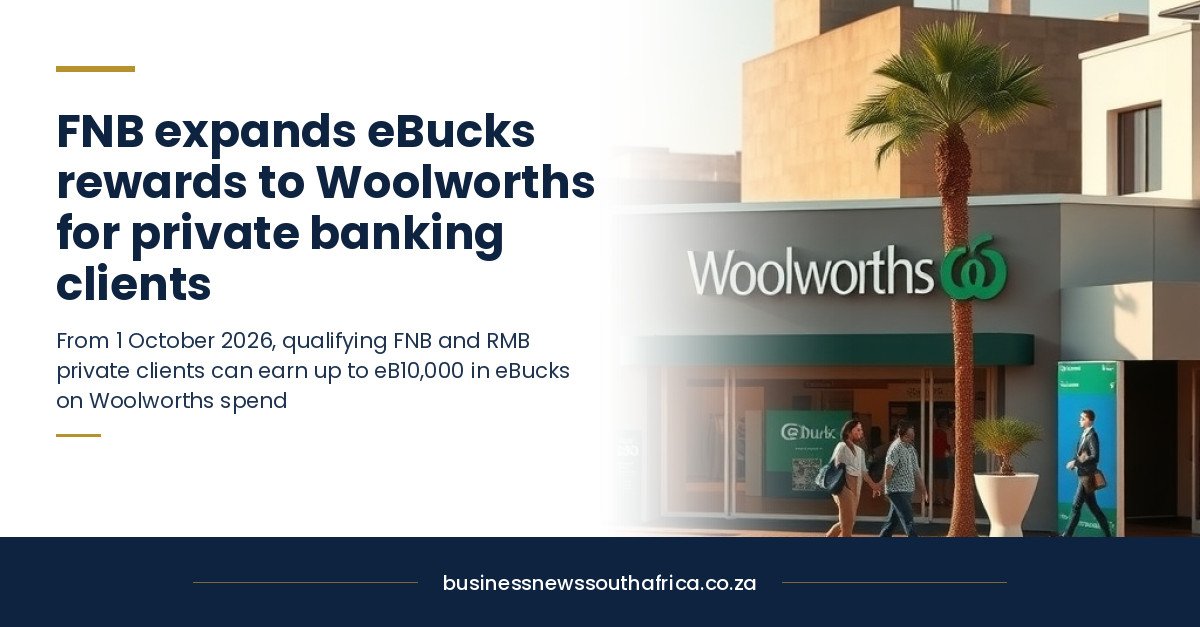
First National Bank (FNB) announced that, from 1 October 2026, its private banking and Rand Merchant Bank (RMB) private clients will earn eBucks on selected Woolworths purchases. The benefit is limited to clients who hold qualifying private-bank virtual cards.
eBucks is FNB’s rewards programme that converts spend into eBucks points, which can be redeemed for goods, services or cash equivalents. The expansion means that all spend at any Woolworths format, supermarkets, food-to-go outlets and department stores, will be pooled each month and converted into points according to the client’s eBucks tier.
According to the bank, qualifying clients can earn up to eB6,000 or eB10,000 in eBucks each month, equivalent to roughly R600 or R1,000. The exact amount depends on the client’s banking proposition and eligibility level.
FNB private banking and wealth management CEO Sizwe Nxedlana said the partnership “strengthens our offering by giving qualifying clients another practical way to earn rewards on purchases that already form part of their monthly spend”. Bathandwa Mbovane, head of eBucks rewards, added that the change “responds to client needs and spending behaviour, ensuring the rewards experience stays clear and relevant”.
The move is aimed at high-net-worth individuals who use FNB’s private banking services, which bundle banking, borrowing, investing, insurance and lifestyle benefits. For most small-business owners who are not private-bank clients, the change has little direct impact, although some entrepreneurs who hold private accounts may see a modest boost to personal cash flow from the additional eBucks.
Woolworths is a major South African retailer with a strong presence in the grocery and apparel segments, making it a frequent destination for affluent shoppers. By aggregating spend across all Woolworths stores, FNB differentiates its eBucks programme from other bank reward schemes that often limit points to specific categories or transaction types.
While the expansion adds value for a niche client group, it does not alter the broader competitive landscape for rewards programmes in South Africa. It simply reflects FNB’s strategy of tailoring benefits to the spending patterns of its private-bank clientele.
For more coverage of banking product updates, see our Markets & Finance section.
Where this fits among bank rewards
Banks have been pushing further into retail loyalty rather than competing only on interest rates and fees. We reported in September on how Clicks added Absa and Standard Bank rewards to its ClubCard programme, pairing a retailer’s loyalty points with a bank’s own rewards currency from the other direction. FNB’s move works the same trade from the bank’s side: a single qualifying spend category, Woolworths, now feeds the bank’s own eBucks system rather than a separate retailer scheme.
For a business owner who holds a qualifying private-banking account personally, the practical step is checking which eBucks tier applies and whether existing Woolworths spend, groceries, food-to-go or department-store purchases, already clears the threshold for the higher eB10,000 monthly cap. For most small-business owners who bank on a standard business account rather than private banking, this specific benefit does not apply, and the more relevant move to watch is whether FNB extends a similar Woolworths-linked reward to its business banking tiers.
eBucks itself is one of the older loyalty currencies in South African banking, predating most retailer-bank tie-ups now common in the market. FNB has steadily widened where points can be earned and spent rather than redesigning the programme outright, and this Woolworths expansion follows that same pattern: a new earning category bolted onto an existing tier structure, rather than a new rewards product.
Neither FNB nor Woolworths disclosed how many private-banking clients hold the qualifying virtual card, or what the expected cost of the expanded benefit is to either company. Both firms have an incentive to keep affluent spend inside their own ecosystem rather than losing it to a competing bank’s card, which is the underlying commercial logic for this kind of tie-up regardless of how it is marketed to the client.