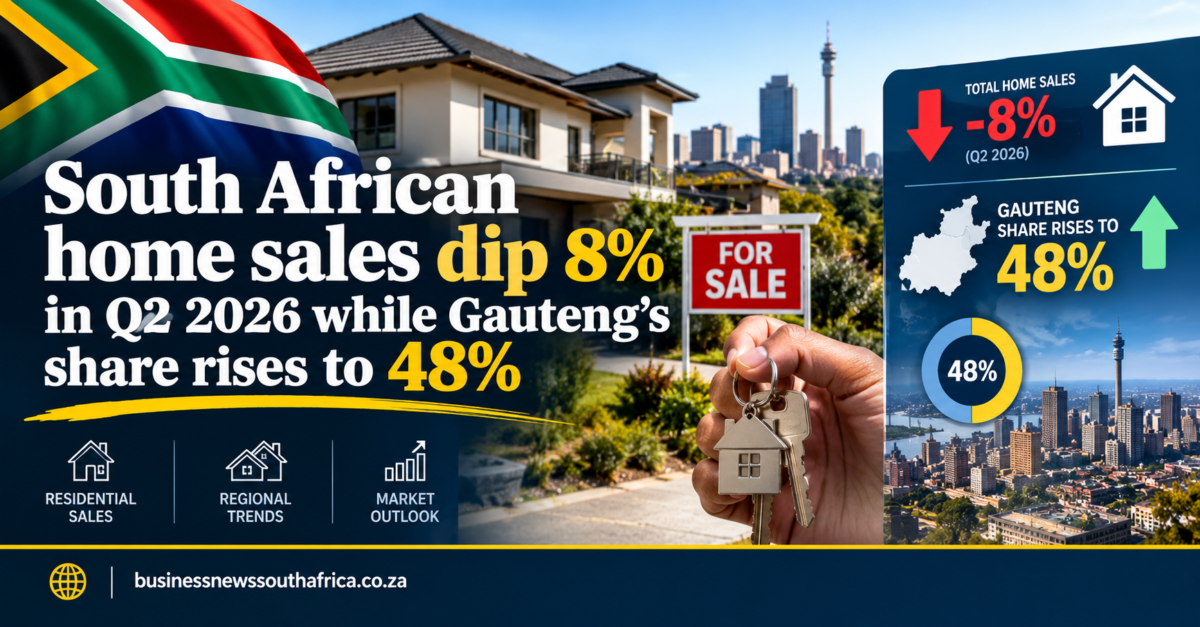
South Africa’s residential property market recorded an 8% year-on-year decline in transaction volumes in the second quarter of 2026, according to the Remax National Housing Report Q2 2026 published by the national deeds office. At the same time, Gauteng’s share of sales within the Remax network rose to roughly 48% of all transactions, up from 38% in 2024, suggesting a possible regional rebound.
The drop in sales reflects the pressure of elevated borrowing costs and lingering global economic uncertainty. Higher interest rates make mortgage repayments more expensive, reducing the pool of buyers who can afford to move. For small-business owners in the property sector, from independent agents to construction firms, fewer transactions mean tighter cash flow, but the price increase in limited-stock areas can offset lower volumes.
Despite the volume contraction, the total financial value of residential sales grew by about 3.9% year-on-year. Within the Remax Southern Africa network, activity rose 6.4% compared with the same period last year, with reported sales up 5.06% and registered sales up 6.03%. The average active listing price climbed to R3 313 646 in Q2 2026, a 12% rise from the first quarter, illustrating how constrained inventory can lift prices even when fewer homes change hands.
Adrian Goslett, CEO and regional director of Remax Southern Africa, said: “Lower transaction volumes do not necessarily mean that demand for property has disappeared. There are simply fewer properties changing hands, which can translate into limited stock in certain areas, and in areas where there is not enough stock to meet demand, prices can increase sharply.” This comment is a company statement and has not been independently verified.
The Western Cape, Gauteng and KwaZulu-Natal together account for roughly 85% of national residential activity, with the Western Cape generating the highest total market value. Gauteng’s growing share is reinforced by search data on remax.co.za, where the province featured in four of the five most-searched suburbs nationwide. Goslett added: “Gauteng remains a market worth watching. The province continues to account for a significant share of property transactions, and the level of buyer search activity we are seeing suggests that there is still strong interest in the market. These could be early signs of renewed momentum in Gauteng’s residential property sector.” Again, this is a statement from the company.
The broader housing context remains challenging. South Africa is estimated to be short of 2.6 million homes, a shortfall that fuels demand even as affordability tightens. For developers and suppliers, the combination of high demand and limited stock can create opportunities, but financing remains a hurdle. Mortgage lenders are navigating the same high-rate environment that is curbing buyer appetite, while real-estate agents are tasked with guiding clients through a market where price growth can outpace income growth.
Small-business owners in related fields should monitor Gauteng’s performance closely. A sustained increase in buyer searches and transaction share could translate into more listings, higher commissions for agents, and greater work for builders and renovators. Conversely, the national decline signals that caution is still warranted in provinces where activity is falling.
The data points to a market in transition: national sales volumes are down, but price levels and regional dynamics are shifting. Buyers and agents will need to balance the risks of high borrowing costs against the potential upside of a tightening supply base, especially in Gauteng where early signs of momentum are emerging.
Data from the national deeds office show that the drop in transaction volumes was not confined to a single region; sales fell in almost every province during the second quarter, underscoring the breadth of the slowdown. While Gauteng bucked the trend, provinces such as the Eastern Cape and Limpopo recorded the steepest declines, according to the Remax National Housing Report. This geographic spread suggests that macro-economic pressures are being felt nationwide, even as pockets of activity remain resilient. The pattern aligns with the broader 8% year-on-year contraction reported for the country’s residential market.
Within the Remax Southern Africa network, the total financial value of residential sales rose by roughly 3.91% year on year, a slight uptick on the 3.9% figure cited earlier. This increase reflects higher average prices rather than higher volumes, as the average active listing price stood at R3 313 646 in Q2 2026. The figure is derived by aggregating the asking prices of all properties listed on the Remax platform at the quarter’s end and dividing by the number of active listings, a method that captures market-wide price trends despite fewer transactions.
Goslett highlighted that “experienced real estate professionals play an important role in helping buyers and sellers understand the risks, identify opportunities and navigate the realities of their local market.” This comment points to the advisory function agents now provide, guiding clients through high borrowing costs and volatile macro conditions. By offering market intelligence, agents can match limited inventory with buyer demand, potentially smoothing price volatility in provinces where stock remains scarce.
The filing process for a residential transaction continues to require submission of the deed of transfer to the deeds office, followed by registration and the issuance of a title deed. Once the deed is lodged, the office verifies the parties, checks for encumbrances and, upon approval, records the change of ownership. The timeline from lodgement to registration typically spans several weeks, depending on the office’s workload and any outstanding compliance issues, meaning that even after a sale is agreed, the finalisation can be delayed in a high-volume environment.