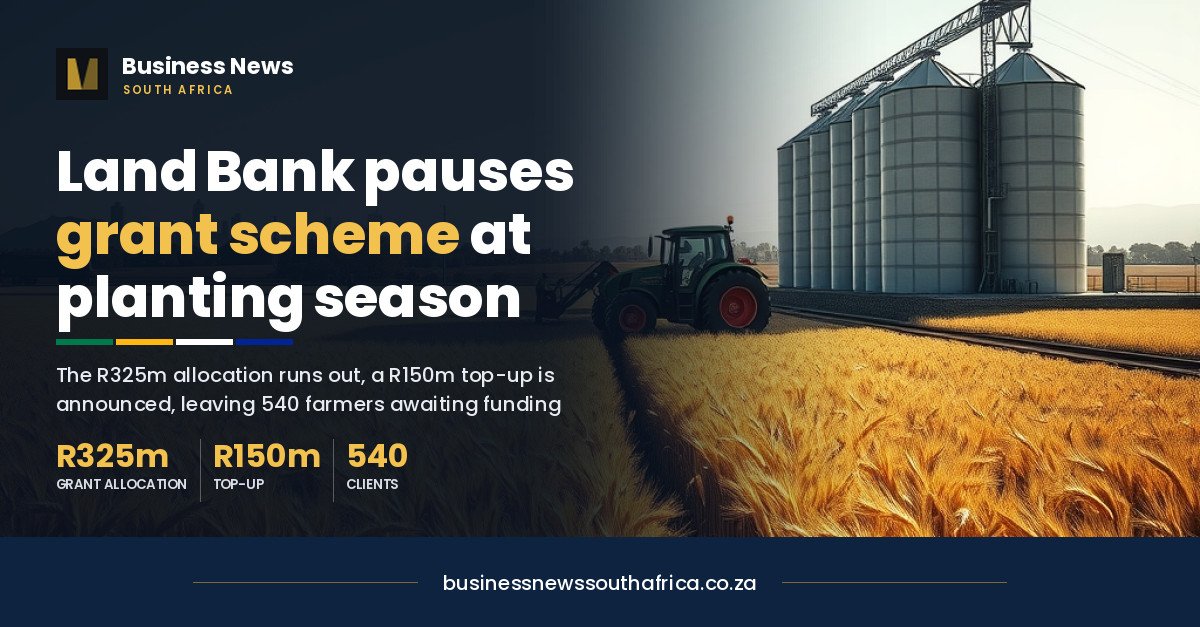
The Land Bank has paused new applications to its Blended Finance Scheme, a grant-and-loan programme for emerging and Black commercial grain farmers, right as planting season opened, after exhausting the R325 million grant allocation set aside for the 2026/27 financial year. The pause drew an immediate warning from AFASA Grains, the grain division of the African Farmers’ Association of South Africa, which asked how affected farmers were supposed to secure “seed, fertiliser, chemicals, diesel and other essential inputs at such short notice.”
The scheme has supported about 540 clients since it launched in 2022/23, according to the Land Bank. AFASA Grains’ concern was not only the immediate funding gap but what it does to a farmer’s financial standing: how would affected growers service existing loans if they could not plant and generate income, and how would they protect their credit records and remain eligible for future agricultural finance.
Government moves to add funding, but not resolve it entirely
President Cyril Ramaphosa raised the issue directly with Agriculture Minister Willie Aucamp at a meeting on 29 September, after Aucamp received several letters of concern about the funding gap, according to a government update published by SAnews. “DoA has already committed additional funding of R150 million; this is in addition to the R325 million grant allocation already transferred to the Land Bank for the 2026/27 financial year,” the Ministry of Agriculture said.
Aucamp was direct about what the new money is for. “Our focus is currently to ensure that farmers receive funding that will enable them to start planting,” he said, adding that “the Department of Agriculture is engaging with DLRRD, National Treasury and the Land Bank to address this situation as an urgent matter.” As an interim measure while that engagement continues, the Land Bank says it is open to offering 100% loan funding to agriculture sector applicants, meaning full debt finance rather than the blended grant-and-loan structure the scheme was built around.
Aucamp also clarified that the scheme itself has not been discontinued, only that the grant portion ran out faster than budgeted, a point African Farming’s follow-up report also confirmed. At the tabling of the Department of Agriculture’s budget vote in May, the department said the Blended Finance Scheme had supported over 14,000 jobs, including about 7,869 through the Industrial Development Corporation and more than 6,480 via the Land Bank.
Why the timing matters for small and emerging farmers
The scheme was designed specifically to lower the barrier to entry for emerging and Black commercial grain farmers, the group of growers least able to absorb a funding gap during planting season without turning to more expensive, fully-debt-financed alternatives. A farmer who has budgeted around a grant-and-loan blend and is then offered 100% loan funding instead faces a materially different repayment burden for the same inputs.
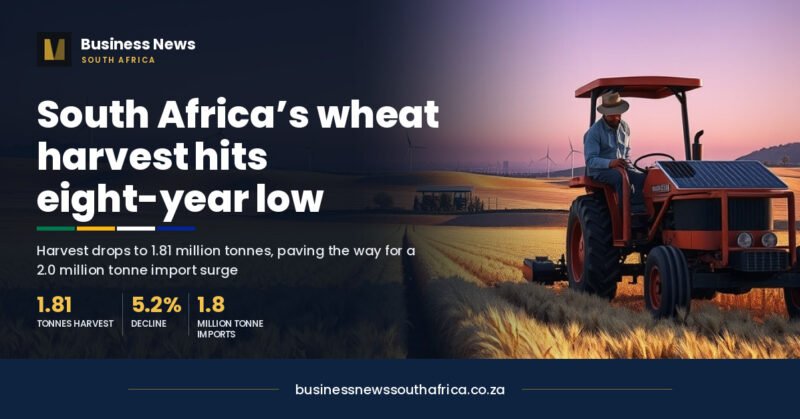
We reported last week on South Africa’s wheat harvest coming in at its lowest level in eight years, with planted area down and import dependence rising, a reminder that the country’s grain output is already under pressure before a funding dispute affecting emerging grain farmers specifically. The same farmers this scheme targets are the ones least able to expand planted area to offset a weak season, and a funding pause landing in the exact window they need to buy seed and diesel adds a second, avoidable constraint on top of the weather-driven one.
Whether the R150 million addition, taking total commitments to R475 million, actually clears the backlog of paused applications in time for this planting season is not yet confirmed. The government’s own language, “engaging… to address this situation as an urgent matter,” describes a process still under way, not a resolution. A farmer whose application is currently paused should treat the 100% loan option Land Bank is offering as the real interim choice available now, and weigh its higher repayment burden against the cost of missing the planting window entirely.
The Blended Finance Scheme is one of several government-backed funding routes aimed specifically at emerging and black-owned businesses, alongside programmes such as the R100 million National Youth Fund the NYDA and NEF launched together in September. Both share the same underlying design problem this pause exposes: a fixed annual allocation competing against demand that does not pause for a budget cycle, which leaves eligible applicants waiting on a top-up rather than drawing down funding they were told was available for the season.