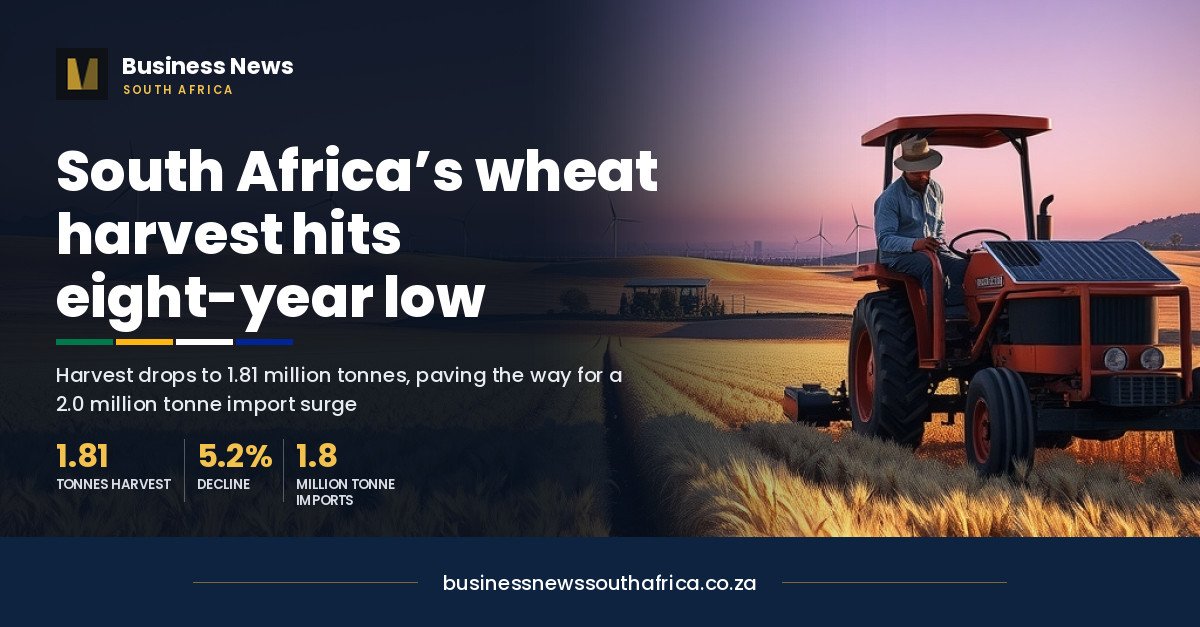
South Africa’s 2026/27 winter wheat harvest is estimated at 1.81 million tonnes, down 5.2% on the 1.91 million tonnes produced last season and the lowest in eight years, according to the Crop Estimates Committee’s second production estimate, released on 29 September. It is also the fifth straight annual decline, Agbiz agricultural economist Wandile Sihlobo wrote in African Farming, a drop corroborated by Ecofin Agency’s own reporting on the same CEC release.
Farmers planted about 479,500 hectares to wheat in 2026, down 7% from 517,300 hectares the year before, Ecofin Agency reported. That is the lowest planted area since 2015, when the figure was 482,150 hectares. Dry conditions in parts of the Western Cape, the province that grows the majority of South Africa’s wheat, are behind both the reduced area and the prospect of weaker yields on what was planted.
Imports set to rise again
Sihlobo expects South Africa to lean more heavily on imports as a result, likely around 2.0 million tonnes, up from 1.8 million tonnes last season. “We are more convinced the 2026-27 season will remain challenging for wheat, and the country’s import requirements will be higher going forward,” he wrote, while cautioning that the CEC’s second estimate is one of ten rounds for the season and the number could still shift.
The timing adds to the pressure. Ecofin Agency reported that the International Grains Council’s wheat price index rose 6% in September alone, driven by disruption to Black Sea shipping routes tied to the Russia-Ukraine war, even as the IGC’s own 2026/27 global wheat production forecast, at 820 million tonnes, sits well above the long-term average of about 790 million tonnes. A bigger world harvest has not stopped prices rising, because the immediate problem is getting grain out of the Black Sea, not a shortage of grain itself.
Why a smaller South African crop matters beyond the farm gate
A country that imports a larger share of its wheat is more exposed to a currency move or a shipping disruption on top of the global price itself. For millers, bakeries and the many small and informal bread resellers who work on thin margins, a weaker rand against a rising import bill compounds quickly: wheat is priced in dollars on the way in, and South Africa’s own harvest is not growing to offset that exposure.
This sits on top of the wider cost pressure we reported on in September, when Agbiz flagged rising fertiliser, diesel, electricity and labour costs for the 2026/27 season generally. Wheat’s own production numbers are the sharpest version of that squeeze: a smaller harvest, a weaker planted area and a widening import gap, all in the same season that input costs were already rising. It is a different story from South Africa’s other crops. Maize, sunflower and sorghum area is up notably on the back of a good 2025/26 season, Sihlobo noted, and we have separately reported on new openings for South African growers, including when a zero-tariff deal opened the Chinese market to South African cherries. Wheat is the one crop moving in the opposite direction, and it is the one that shows up fastest in the price of a loaf of bread.
The CEC’s next estimate is still to come, and Sihlobo’s own figures could move as the season progresses. For now, a business that depends on wheat, whether as a miller, a baker or a retailer pricing bread on thin margins, should plan for higher input costs and a weaker rand to matter more this season than usual, not less.
The broader cost environment is not working in wheat’s favour either. A manufacturing sector that includes food processing has just shown new signs of life, with the Absa Purchasing Managers’ Index returning above the neutral 50 mark in September after three months of contraction, but that same survey flagged input cost pressures reaccelerating and fuel prices adding to the strain, the same combination a miller or bakery is now facing on wheat specifically.