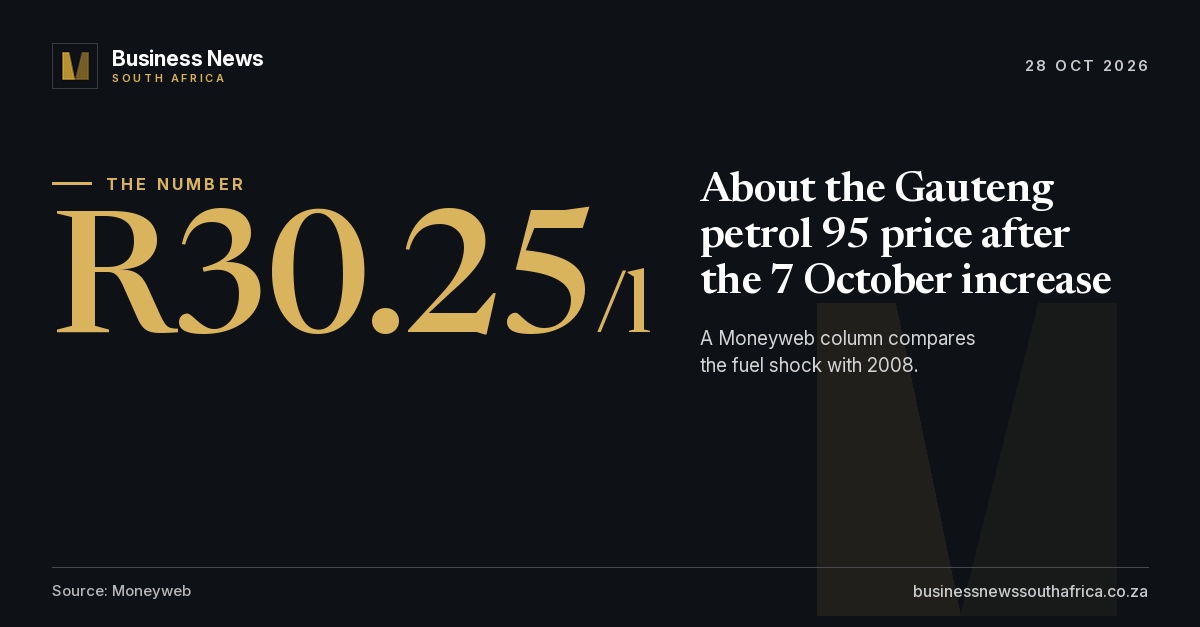
According to a Moneyweb column, the Department of Mineral and Petroleum Resources announced a R3.33 increase for 95 octane petrol from 7 October, taking the Gauteng price from R26.92 to about R30.25 a litre. The department blames higher international oil prices and shortages of petrol and diesel abroad.
For businesses that run vehicles or buy diesel, the column’s point is that the pump price has more than one driver, and several of them are domestic: the exchange rate, the fuel levy and how much fuel the country refines and stores.
Weaker rand and a higher levy than in 2008
In March 2008 Brent crude averaged $104 a barrel and 95 octane petrol cost R8.25 a litre in Gauteng, rising to R10.70 by July that year. Those prices are not adjusted for inflation. Around mid-2008 the rand traded near R8 to the dollar, according to the column, citing the Reserve Bank, while the latest fuel price review uses about R16.21. A $100 barrel therefore costs about R1,621 now against about R800 then, and South Africa buys its oil in US dollars.
The general fuel levy on petrol was R1.27 a litre in April 2008, according to published SARS tariff amendments, and is now R4.10, an increase of about 223%. The levy did not cause the latest increase, but it raises the base from which the oil price shock lands. The column says removing it would give relief of R4.10 a litre if passed on in full, bringing R30.25 down to about R26.15 with the Road Accident Fund and carbon levies still in place. Applying today’s levy rates to 2024 petrol and diesel sales suggests roughly R89 billion a year, before refunds and other adjustments, that the fiscus would give up.
Fewer refineries, smaller reserves
South Africa once had six major fuel-production refinery facilities and now has three: Natref, Astron’s Cape Town refinery and Sasol‘s Secunda operations. According to the column, their combined operating capacity in 2024 was roughly half the peak of 2016 to 2019, leaving the country more reliant on imported finished fuel.
The column’s illustration assumes local production saves 50c on each litre replacing an import. On that assumption, regaining the lost capacity would give about 28c of average relief across the petrol and diesel market, and one additional refinery producing 150,000 barrels a day about 12c. These are examples, not promised discounts. The column puts an initial cost for such a refinery at R81 billion to R130 billion, based on international comparisons, and says a South African feasibility study would be needed.
The column also says Minister of Mineral and Petroleum Resources Gwede Mantashe recently told parliament that the Strategic Fuel Fund holds 6.9 million barrels of oil, about 96% below the 1988 peak of 158.5 million barrels. The reported estimate of about 30 days of crude cover refers to what refineries can process, not all the petrol and diesel the country needs. Government has proposed 60 days of net-import cover, rising to 90 days over time.
The column’s conclusion is that a weaker rand, higher levies and reduced production and reserves together explain why the same oil price now costs South Africans more at the pump.
We reported on early CEF data that pointed to a further petrol increase for November, since followed by a Treasury announcement of a temporary levy cut, and on petrol hitting R30 per litre as government warned against panic buying.