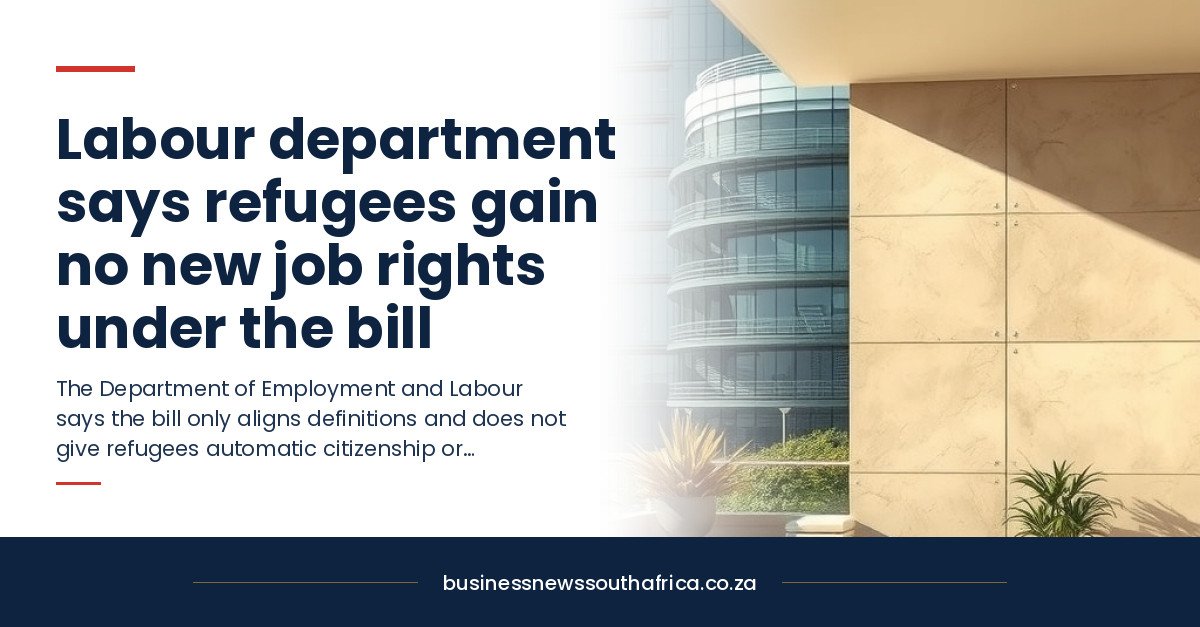
The Department of Employment and Labour says proposed changes to the Employment Services Amendment Bill do not give refugees or asylum seekers new employment rights, and do not grant automatic citizenship. The department said the amendments do not change existing immigration requirements or employment regulations, after claims on social media suggested otherwise.
What the department says the bill does
The department’s position is that the amendments align definitions in the Employment Services Act with existing law. “The purpose of the amendments is to ensure that definitions contained in the Employment Services Act are aligned with existing South African legislation, including the Immigration Act and the Refugees Act,” said Minister Nomakhosazana Meth. “The amendments seek to provide greater legal clarity and consistency in the administration of labour market policies and services.”
According to the department, the amendments do not change a person’s immigration status, grant citizenship, permanent residence or any immigration benefit, or remove obligations under immigration law. They also do not require employers to prefer refugees, asylum seekers or other non-citizens over South African citizens. Refugees, asylum seekers and permanent residents remain subject to the laws that govern their status and rights.
What the claims got wrong
Social media posts suggested that refugees and asylum seekers would stop being treated as foreign nationals, or would automatically enjoy the same labour market rights as South African citizens. The department called these claims “incorrect” and said they “do not reflect the purpose or effect of the proposed amendments”. The department said the changes “simply clarify the definitions of categories already recognised in South African law, such as refugees, asylum seekers, and permanent residents.”
The debate matters for employers because it can affect how they recruit and what they put in writing. Hiring rules for foreign nationals are set by immigration law and existing labour regulation. The department’s account is that nothing in the bill shifts those rules, so a business that already follows them has no new step to take on the strength of the bill alone.
The power that does change
The bill does give the Minister a new power. It creates a framework for the Minister to set specific measures for certain jobs. The department says this is intended to protect job opportunities for South African citizens and to address skills shortages. No such occupation measure had been published in the material reviewed, so the occupations that could be affected are not yet known.
A business that depends on foreign skills, for example in engineering, health, or technology roles, should therefore watch the regulations rather than the bill alone. Once a measure is published for a particular occupation, it will be the detail that matters for recruitment.
Where the bill has been
The initial draft was published in February 2022 for public comment. It focused on foreign nationals and digital labour platforms. Cabinet approved the bill in May 2025, and it was formally introduced in the National Assembly in May 2026. In August 2026 the Portfolio Committee on Employment and Labour received a formal briefing from the department. The bill is still before Parliament, so the wording can change.
The department’s stated aims are to strengthen the domestic labour market, protect employment opportunities for South African citizens, especially young and vulnerable job seekers, and improve the Public Employment Services system. That system matches job seekers with vacancies, supports skills matching and tracks workforce trends. “The Bill does not seek to exclude any person from lawful employment,” Meth said. “Rather, it seeks to ensure that employment practices are properly regulated and that employers comply with applicable legislation.”
What to do now
For most employers the practical step is to keep checking that each hire’s right to work is documented, as current immigration and labour law already requires. Anyone drafting or updating employment contracts and hiring documents can use the HR and labour relations generator, and the Department of Employment and Labour’s own pages are at labour.gov.za.
Sources: BusinessTech, 8 October 2026; gov.za; Department of Employment and Labour.