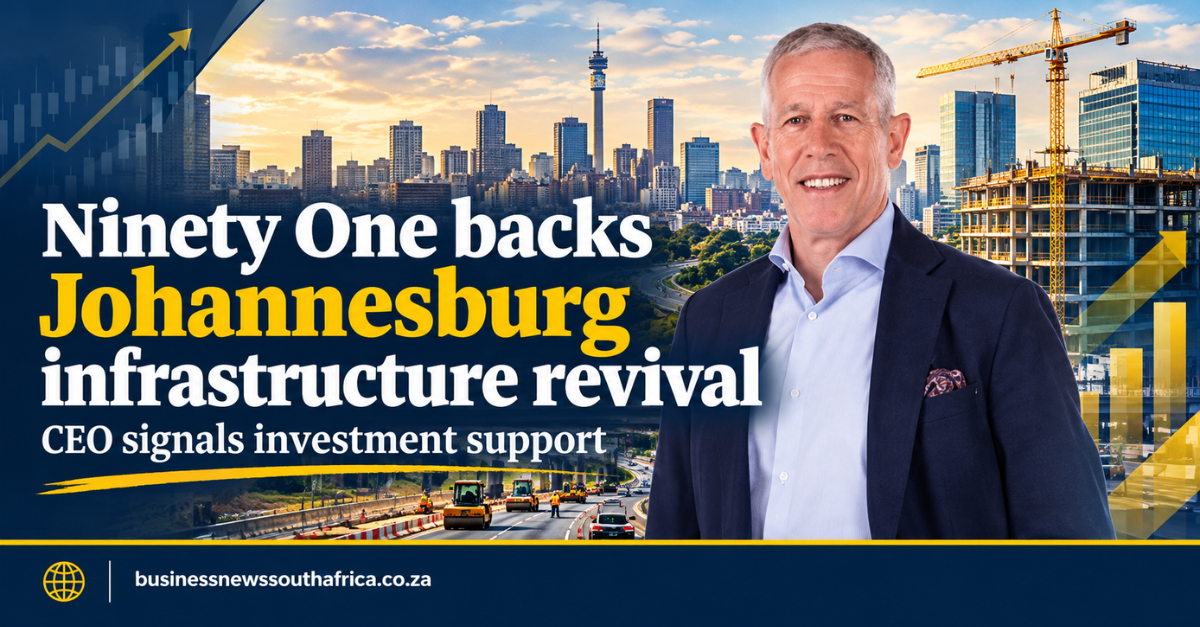
Global asset manager Ninety One plans to financially back infrastructure projects to reverse the decay of Johannesburg, the continent’s financial capital, according to a Bloomberg report published by Moneyweb. The firm has South African origins and manages about $240 billion.
“The major city in the country needs to be turned around,” chief executive Hendrik du Toit said in an interview on Bloomberg Television. “It has been appallingly managed”, and his firm is “making plans to help”, working not only on its own but within what he called its ecosystem. The report does not give an amount or name any projects.
The backdrop: municipal elections
Municipal elections are due on 4 November. Years of political instability and mismanagement have left Johannesburg owing hundreds of millions of dollars to service providers and unable to provide consistent services, Bloomberg reported. A coalition led by the African National Congress currently runs the city, but polls identify veteran opposition politician Helen Zille as the front-runner to become the next mayor. A News24/SABI Strategy Group survey published on 4 October showed her favoured by 36% of voters, ahead of the 27% backing an ANC candidate, but below the 50% threshold needed to govern outright.
Du Toit tied the city’s fate to the retention of senior staff. “If that city doesn’t turn around, the retention of executive talent would be an issue because people don’t want to live in places where the water is just cut off and where the roads have too many potholes,” he said. “I think it could be turned around relatively quickly, although it’ll be a huge job.”
Corporate spending
Bloomberg noted that the economy has expanded by less than 1% a year for more than a decade. Companies have consequently been reluctant to invest and are “hoarding cash on their balance sheets”, according to du Toit, who sees signs that corporate spending is starting to recover. The Reserve Bank’s most recent Quarterly Bulletin showed that private-sector fixed investment fell in the three months through June, even as corporate bank deposits grew.
Models for the plan
Du Toit pointed to the private-sector boom in renewable energy and a corporate partner modernising Pier 2, the biggest container gateway in the sub-Saharan region, at the port of Durban, as models for involving “the best in the world” in other infrastructure projects. “The investment dollars will start following the results,” he said. “There’s a lot of opportunity to deploy money, as long as we can do it at the right price, and we are going to move domestic dollars first, and then bring in international dollars once the proof points are there.”
Du Toit helped found Investec’s asset-management unit in 1991. The business eventually became Ninety One, which the lender spun off in 2020 as an independently listed company.
For more coverage of how capital meets South African infrastructure, see our Markets & Finance section.