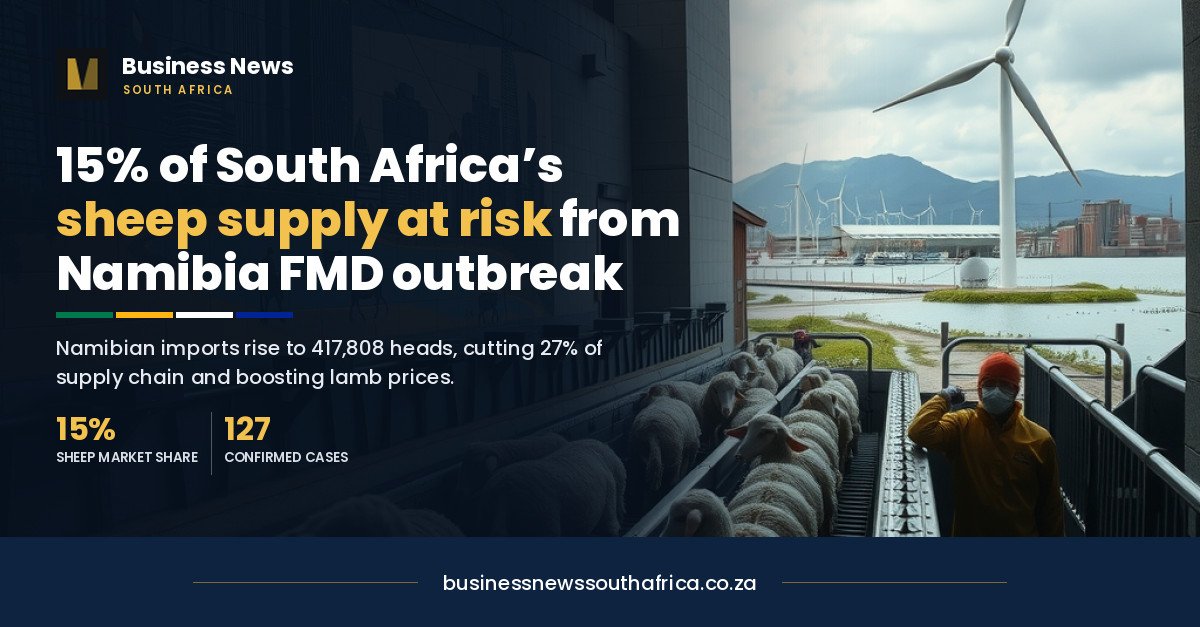
Namibia’s foot-and-mouth disease (FMD) outbreak, which sits close to the South African border, has stopped that country’s exports of cattle, sheep and meat, and South Africa’s red meat chain is more exposed than the headline numbers suggest. Namibian sheep made up 15% of the South African market so far this year, according to Dr Frikkie Maré, CEO of the Red Meat Producers’ Organisation, in Farmer’s Weekly.
South Africa is fighting foot-and-mouth of its own, as our September report on 23 million imported vaccine doses showed, which is why a second outbreak next door matters for supply as well as for disease control.
How the outbreak unfolded
Namibia’s acting agriculture minister told parliament on 23 September that FMD had been found on a commercial farm in the Karasburg State Veterinary District, inside the country’s recognised FMD-free zone. Ten of 11 samples taken from cattle showing clinical signs tested positive, according to Farmer’s Weekly’s report of the statement. Namibia suspended all movement of cloven-hoofed animals and their products, along with imports and exports of them, and its red meat exports to every market, South Africa included, stopped immediately.
The picture has worsened since. President Netumbo Nandi-Ndaitwah said on 6 October that there were 127 confirmed cases across 15 farms, up from 79 positive samples across 11 farms three days earlier. Twenty surveillance teams and 10 roadblocks are working in the ǁKharas Region, and by 5 October the teams had inspected 29 313 animals on 68 farms, Farmer’s Weekly reported.
Where South Africa is exposed
Maré’s figures show two very different trades. South Africa’s imports of Namibian weaner calves have already shrunk, from 259 566 in 2024 to 36 821 so far in 2026, and weaners’ share of the South African market fell from 9% to 2%. Because the 2026 number is a year-to-date count, the real gap is narrower than those two figures suggest, but the direction is clear.
Sheep are the opposite. Imports of Namibian sheep rose from 379 959 in 2024 to 417 808 so far this year, which is already more than the whole of 2024, and their share of the South African market climbed from 12% to 15%. In other words, South Africa has become more dependent on Namibian slaughter sheep in the same year that the supply line has been cut. Maré noted that Namibian exports have long formed part of the local market under the Southern African Development Community free trade agreement, and that some South African feedlots and abattoirs were built with the capacity to take these imports and now rely on them.
That is why he expects the effect on mutton and lamb to be more severe than on beef. He drew a line between two phases: an initial shock reaction driven by fear of shortages, which pushes prices up very fast, and a longer-term, market-adjusted price. Consumer demand may cap prices if the meat does not sell further down the value chain, he said.
What Namibia is doing, and what it stands to lose
Namibia’s FMD-free-without-vaccination status has underpinned its access to export markets, and the detection inside the free zone has suspended that status. The European Union has temporarily stopped the entry of fresh cattle, sheep and goat meat from the previously free zone, although fresh meat certified by Namibia’s veterinary authority before 23 September may still enter during a 90-day transition period, which runs to about 22 December, subject to individual border posts. Thinus Pretorius of the Namibia Agricultural Union said two-thirds of Namibian red meat is exported, and that the country is the only one in Africa with beef export access to the EU, US, China and Norway at the same time.
The stakes were high before the outbreak. Namibian beef exports rose 52.7% in the first half of 2026 compared with the same period of 2025, according to figures Farmer’s Weekly cited from New Era, and the country earned N$2.1 billion from beef exports in 2025.
Cabinet has approved a containment plan that includes a buffer zone in the Karasburg district, repairs to sections of the Namibia-Botswana border fence and veterinary cordon fencing in high-risk areas along the border with South Africa. The government had earlier estimated that about R190 million is needed for its critical containment response, including about R47 million for roughly 290 km of new fencing from Ariamsvlei through Karasburg to Ai-Ais. Vaccination of eligible livestock inside the containment zone, targeted culling and tighter movement controls are also planned. Pretorius pointed to one positive: Namibia’s traceability system tracked animals that had been in contact with infected livestock within days, some of them hundreds of kilometres away, and all tested negative.
What to watch
None of the reports gives a date for exports to resume, so the next signals are the case count in Karasburg, whether the containment zone holds, and how South African buyers price lamb in the coming weeks. For businesses that buy, process or retail red meat, the exposure is concentrated in sheep rather than cattle. More agri-business coverage is in our Agri-Business section.