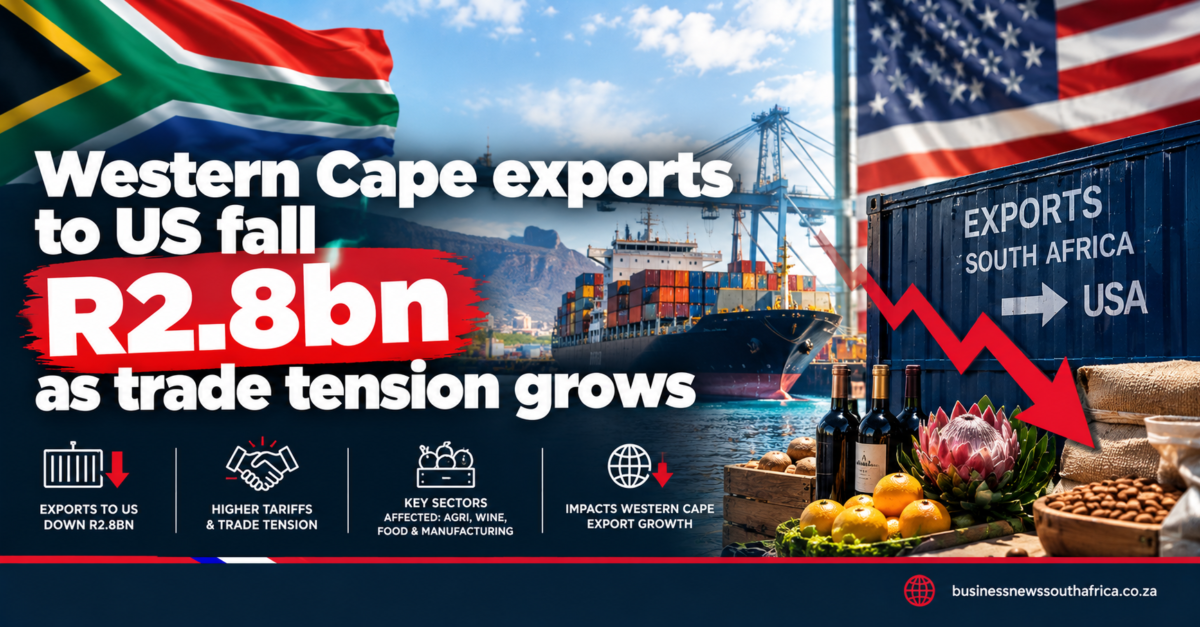
Western Cape exports to the United States fell by about R2.8 billion in 2025, and the province’s exporters body says the damage could grow. Terry Gale, chairman of Exporters Western Cape (EWC), told BusinessTech that the losses could run into the billions of rand, though he said he could not give an exact figure.
Gale blamed the additional US tariffs imposed by President Donald Trump, saying “We have already seen a massive fall-off in trade” between the province and the US. A tariff is a tax charged on imported goods, which makes them dearer for the buyer in the importing country.
The numbers behind the R2.8 billion
The figure comes from a memo by Gale reported on 7 October by Business Day, based on a TimesLIVE report. Western Cape exports to the US fell from about R17.31 billion in 2024 to R14.51 billion in 2025, a drop of 16.2%. Provincial reporting shows the US slipped from the province’s second-largest export market to its fourth-largest.
The memo itself puts the decline in a wider frame than tariffs. According to FreshPlaza, Gale said public exchanges between International Relations Minister Ronald Lamola and US Ambassador Brent Bozell III were deepening uncertainty. Tensions stem from disagreements over South Africa’s land reform and broad-based black economic empowerment policies, and in September Washington announced targeted visa restrictions. Pretoria rejected the US characterisation of its domestic policies.
The reporting therefore ties the R2.8 billion to a mix of tariffs and the diplomatic standoff, and none of the sources breaks the drop down by cause.
Jobs, sectors and shipping
BusinessTech reports that some manufacturers have closed their export operations. Gale cited factories in Atlantis that employed 700 to 1 000 people each, and said the number of affected jobs runs into the thousands. Manufacturing is the most exposed sector, with furniture, automobiles and specialised manufactured goods also affected.
Cape Town has a direct weekly shipping service to the US with a transit time of about 21 days, but Gale noted that shipping costs were already high before the tariffs. He said some US companies still want to trade with South African businesses and that the province was close to securing new contracts, including for furniture. Continued tariff uncertainty could put those at risk.
How the tariffs have shifted
The US tariff position has changed several times. In February 2026, Business Day reported that the US Supreme Court struck down the tariffs Trump imposed in 2025, calling them unlawful, after which Trump announced a global tariff of 10% to 15%. Donald MacKay of XA Global Advisors said AGOA-eligible exporters were then at a flat 15%, because the African Growth and Opportunity Act (AGOA), which gives eligible African countries duty-free access to the US market, had been renewed for another year. Gale pointed out that exporters do not pay the 10% duty directly: “this is for the account of the importer.”
Since 24 July 2026 a new 12.5% tariff applies to South African products. The US Trade Representative imposed it after Section 301 investigations (the US trade law used to act against another country’s trade practices) into 60 economies, saying South Africa does not adequately prohibit imports made with forced labour. Bizcommunity, citing SAnews, reported that 41 economies including South Africa face 12.5%, while 19 with such laws face 10%. South Africa disputes the claim.
Products already hit by separate steel, aluminium and auto tariffs are exempt, as are macadamia nuts, oranges, limes, tea, cane sugar, citrus juices, critical minerals, platinum-group metals, civil aircraft and pharmaceuticals. Trade Minister Parks Tau said government will keep engaging the USTR “with a view to either eliminating or reducing the current tariff imposed on our country.” South Africa also plans to publish a Gazette notice seeking public comment on a regulation banning goods made with forced or child labour.
AGOA and what exporters want
Gale told BusinessTech that Trump has threatened to remove South Africa from AGOA, which he said would hurt exporters further. He also said shifting to other markets takes years, not overnight.
In the memo, Gale urged both governments to move beyond public confrontation. “Diversification takes time. Exporters cannot simply replace the US market overnight,” he said, adding: “Once a buyer moves to another supplier, winning that business back is no simple matter.” He called for “direct engagement at the highest level, backed by a clear commitment to resolving the outstanding issues.”
Source: BusinessTech.