Sugar cane growers say a higher import tariff has bought the industry time, not safety. On 8 October, two KwaZulu-Natal farmers told a panel hosted by Farmer’s Weekly at the Royal Agricultural Show that sugar industry protection has to come first, ahead of diversification into new products. The magazine published its report on 9 October.
The panellists were Brad O’Neill, a cane farmer and co-owner of the craft rum distillery Sugar Baron, and cane farmer Pratish Sharma. Their argument was simple: farmers must stay viable before anyone can build bioethanol or bioplastics businesses on top of them.
The tariff: a step up, with a warning attached
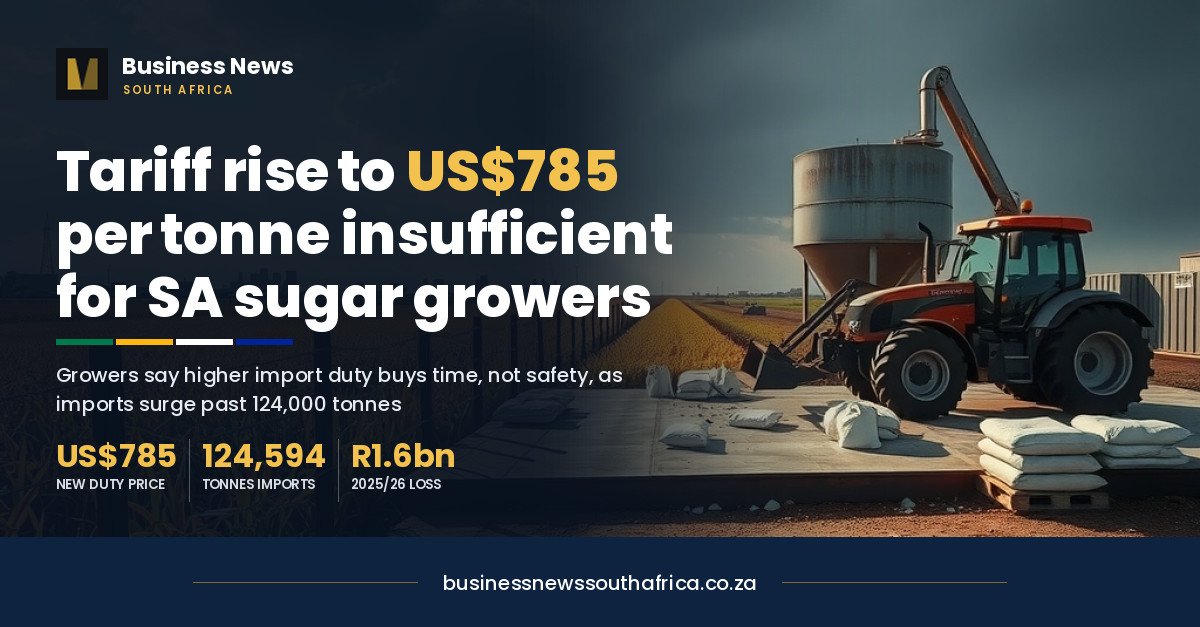
Sharma said each tonne of imported sugar displaces a tonne of local sugar. The relief he and O’Neill welcomed was a rise in the dollar-based reference price (the benchmark price used to calculate the duty on imported sugar, so a higher benchmark means a higher duty) to US$785 per tonne. O’Neill warned that imports could climb again within six months without further protection.
The decision came from the International Trade Administration Commission (ITAC, the trade regulator that sets tariff levels). According to a CNBC Africa report republished by AmCham SA, the price moved from US$680 to US$785 per tonne, an increase of about 15%. ITAC rejected both applications before it. The South African Sugar Association (SASA) had asked for US$905, while the Beverage Association of South Africa wanted a cut. ITAC chose what it called a middle ground.
SASA welcomed the increase but said it "fell short of the level needed to protect local producers from subsidised imports", according to the same report. Daily Investor reported that SA Canegrowers chairman Higgins Mdluli called the decision a critical step but said growers "need certainty, not another partial fix". Mdluli said the group would monitor whether imports actually fall. The same report notes that the tariff had last been updated in 2018.
What the imports have done
The numbers explain the urgency. Daily Investor, citing SA Canegrowers, reported that duty-paid sugar imports for January to June rose from 1,619 tonnes in 2022 to 124,594 tonnes in 2026. Domestic sugar sales fell by about 35%, or 188,000 tonnes, and grower proceeds dropped by R1.33 billion, largely because the share of production that had to be exported at lower prices rose from 22% to 37%.
Earlier in the year, Business Day reported that SASA figures put local sales for April to June at 255,015 tonnes, more than 45,000 tonnes down on the year before. The previous high for that quarter was 428,422 tonnes. Mdluli described the situation to the paper as "nothing short of a crisis". The industry says the imports come mainly from Brazil, India and Thailand, where subsidies and ethanol programmes support surplus sugar exports.
In a June article posted by SASA, the association put industry losses from cheap imports at about R1.5 billion and said it expected more than 330,000 tonnes of imports over 15 months, enough to displace the output of three South African mills. That is SASA’s own estimate. In a later statement reported by AmCham SA, SASA put its loss for the 2025/26 season at R1.6 billion.
Mills, the sugar tax and the Tongaat question
Sharma told the panel there has been significant underinvestment in sugar mills over the past 15 years, and that investment is essential if the industry is to thrive. The stakes are large. SASA says the sugar belt generates more than R25 billion in revenue a year, of which KwaZulu-Natal contributes R18.8 billion and Mpumalanga about R6 billion, and that it supports 65,000 direct jobs and at least one million people directly or indirectly. SA Canegrowers represents 28,000 small-scale and 1,250 large-scale growers in the two provinces, according to Daily Investor.
Both panellists also challenged the Health Promotion Levy, the sugar tax on sweetened drinks introduced in 2018. They said evidence of its health benefits is inconclusive and that its revenue goes to National Treasury rather than the industry. Sharma said the industry has prevented annual increases and that talks with government on reducing or repealing it continue. SASA attributes the closure of two KwaZulu-Natal mills partly to the tax. This report did not obtain a current levy rate or a response from Treasury.
The biggest name in the mill sector is in a separate fight. Business Day reported on 12 October that Tongaat Hulett, South Africa’s largest sugar producer, will be delisted from the JSE in the first week of November after 74 years, because the business rescue practitioners could not conclude that the going-concern basis was appropriate for preparing audited statements. The JSE said no value is expected to accrue to shareholders. Separate business rescue proceedings for Tongaat Hulett Sugar South Africa continue, so the delisting does not itself decide the fate of the mills.
Diversification, but later
The panel did discuss new markets: bioethanol, bioplastics, electricity generation and sustainable aviation fuel, which Sharma called especially promising. Both said viable markets would take time and significant investment. O’Neill said less than 2% of his farm’s production goes into rum and that marketing and selling it is his biggest challenge. Sharma added that growers must work out how revenue from new downstream products is shared between farmers and millers.
O’Neill also urged consumers to check labels and choose locally produced sugar. Without further tariff action, the panellists’ message was that cane farmers will be asked to diversify while still absorbing losses on the sugar they already grow.