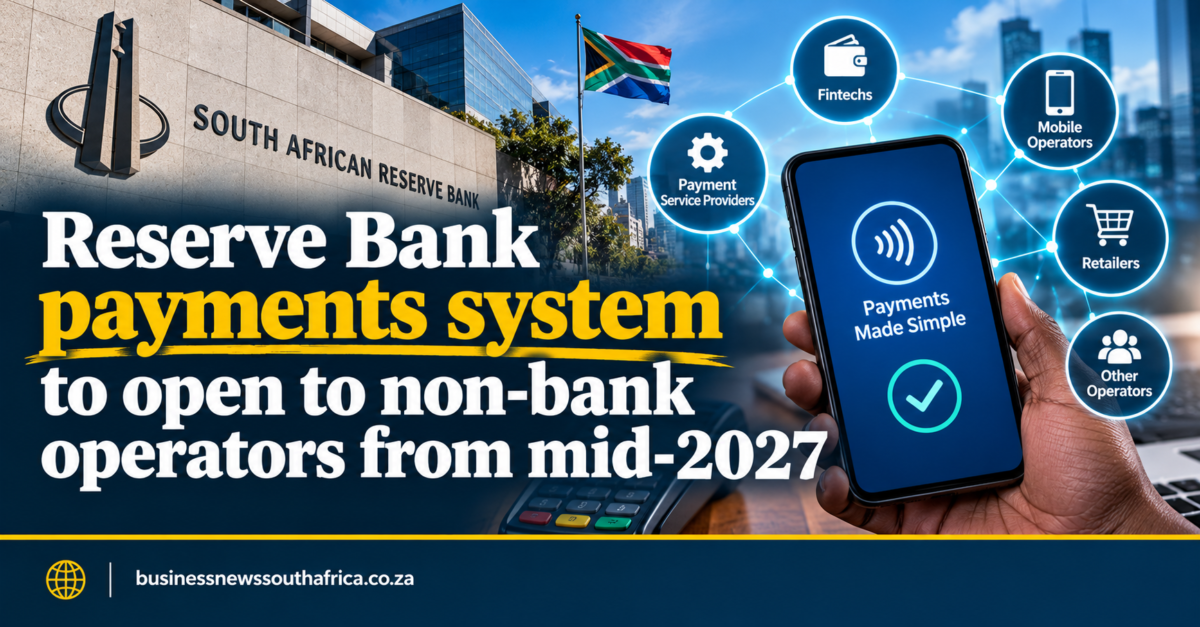
The Reserve Bank payments system will open to non-bank operators from mid-2027, a Reserve Bank official announced on Friday as part of a broad overhaul, according to a TechCentral report of 19 October 2026 that carries Reuters reporting. Telecoms companies, fintechs and retailers could connect directly to the national payments infrastructure, which clears and settles payments, instead of relying on banks as intermediaries.
What changes and when
The South African Reserve Bank (SARB) hopes the reform will increase competition, lower costs, broaden access to digital financial services and encourage innovation. TechCentral says the central bank cites pressure from fintechs and mobile money providers such as MTN. Initially, non-banks may carry out seven payment activities on their own. The report names three of them: issuing e-money, acquiring merchants and payment initiation.
The timeline is tight. Rules governing payment activities and exemptions are due to be published in November 2026. Non-bank participants are expected to go live around March 2027 once they are licensed, which leaves time for testing and systems integration ahead of the mid-2027 launch. The National Payment System Bill was released for comment in September 2026.
The groundwork was laid a year earlier. Business Day reported on 30 November 2025 that the Reserve Bank planned to exempt certain payment activities from the definition of the business of a bank, so that non-banks could reach the payments system before an amended National Payment System Act takes effect. That draft exemption also covered seven activities, of which Business Day named four: issuing electronic money and payment instruments, third-party payments, money remittances, and clearing and settlement. It described the measure as a draft.
Banks are not the target
Pradeep Maharaj, executive director of the Reserve Bank’s Payments Ecosystem Modernisation (PEM) programme, said banks are not the target of the changes. He said the aim is to let entrepreneurs serve sections of the economy that traditional banking leaves underserved.
Maharaj said banks built a world-class system but controlled its rules, applied them inconsistently and imposed conflicting limits. In his words as reported, the experience for users is not uniform, and that is the problem the programme is trying to fix.
Pricing, QR codes and PayShap
The PEM programme aims to reduce reliance on cash, speed up affordable digital payments, modernise payment infrastructure, strengthen security and improve digital identity verification. On pricing, TechCentral reports that transactions below a certain level should be free. A standardised QR+ payment code is due in November and would let small merchants accept digital payments without fees. The changes are intended to lower costs for businesses and consumers, reduce cash dependence and widen access for unbanked people.
Arif Ismail, head of the Reserve Bank’s national payment system department, supplied the figures for PayShap, the fast-payment service. It currently handles about 60 million transactions a month, and the target is 500 million transactions a month by 2029.
Cash and ATMs sit in the same programme
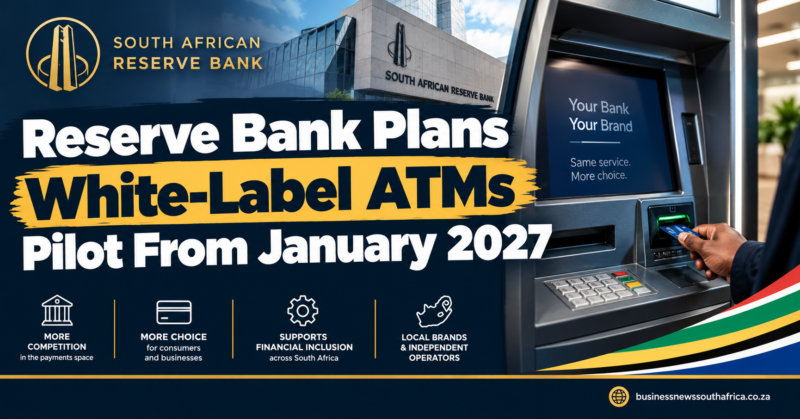
The same Friday briefing set out the central bank’s plans for cash: a white-label ATM pilot from January 2027 and a national cash utility due by March 2027, aimed at the R88.5 billion annual cost of cash. We covered that part of the briefing in detail in our report on the white-label ATM pilot and the national cash utility. The payments changes above are the other half of the same reform, and both depend on rules the Reserve Bank has not yet published.
What is still open
Several details remain unsettled. TechCentral names only three of the seven activities non-banks may perform, the rules are not yet published, and the SARB has yet to answer the banks’ alternative ATM proposals. The November publications should show how licensing works, which activities are covered and what the free-transaction threshold is.