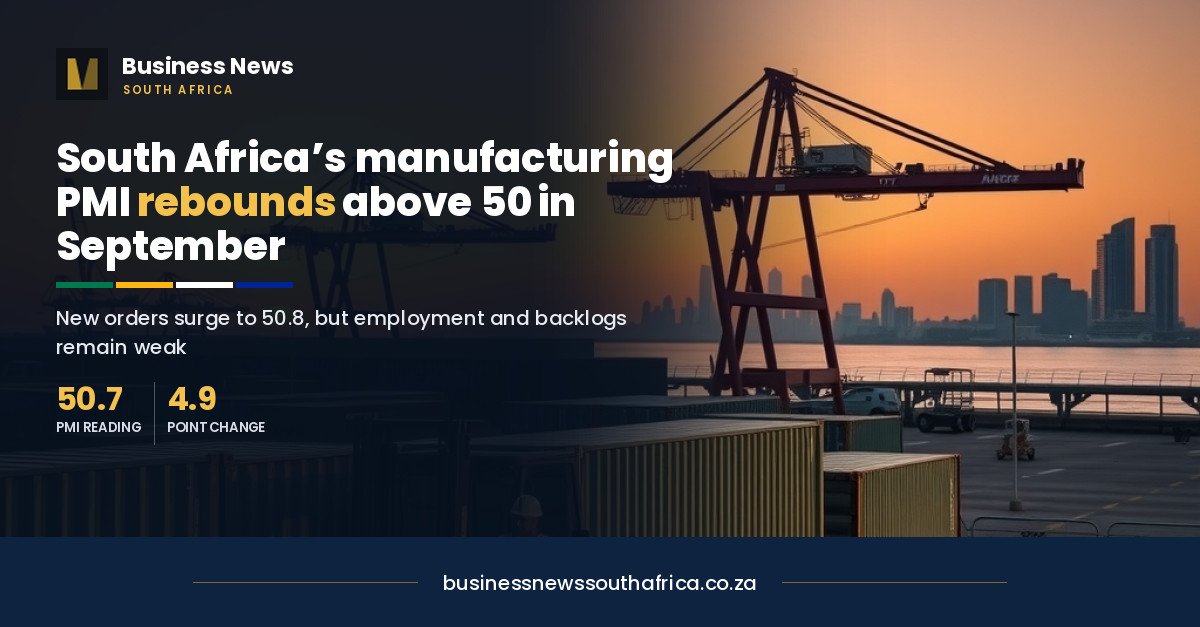
South African manufacturing activity moved back into growth in September, with the Absa Purchasing Managers’ Index jumping 4.9 points to 50.7, its first reading above the neutral 50 mark since May and the end of three straight months of contraction. Absa senior economist Miyelani Maluleke discussed the print with Business Day TV on 1 October, the same day IT-Online published the full sub-index breakdown.
New sales orders drove the rebound, surging from 40.3 to 50.8. Export sales reached their strongest level since early 2025, so the improvement was not only domestic demand. Business activity recovered most of August’s steep fall, climbing from 40.2 to 49.3, just short of the neutral mark but a sharp reversal from the prior month’s collapse.
The recovery is not uniform
Employment moved the other way, falling from 46.2 to 43.1, almost erasing August’s improvement. Manufacturers are rebuilding stock, with the inventories index up sharply from 43.6 to 52.2, but order backlogs stayed weak, which means the restocking is not yet confirmed by a broader pickup in demand. Firms appear to be waiting for clearer evidence that the recovery will hold before hiring again.
Input costs are also back under pressure. The purchasing price index rose 3.9 points to 71.1, still well below its May peak but moving the wrong way. Manufacturers cited higher transport and logistics costs, the fuel price increase at the start of September, higher supplier delivery charges, rising paper prices and shortages of some plastic inputs. Durban harbour delays remain a bottleneck: the supplier deliveries index held at 58.4, with respondents pointing specifically to port delays, longer shipping schedules and higher freight costs rather than strong demand.
Despite the mixed detail, manufacturers’ own outlook improved. The index tracking expected conditions six months out edged up to 55.3, comfortably above neutral.
What it means for smaller manufacturers
A single month above 50 is not yet a trend. The sector ended 2025 at its weakest level in five years, and IT-Online’s own assessment is that a sustained PMI reading above 50 over several months would be needed before calling this a durable recovery rather than a rebound.
For a small manufacturer or a supplier into a larger factory, the detail matters more than the headline number. New orders recovering is good news for revenue, but the weak employment index and still-subdued backlogs suggest larger manufacturers are not yet confident enough to commit to new hires, which is often where a small supplier feels the pressure first. The renewed rise in input costs, on top of what we reported when diesel prices jumped more than 58% since February and when electricity billing grew harder to read for SMEs, squeezes margins for smaller firms without the pricing power to pass costs on.
The September print also sits against a weaker employment backdrop generally. Stats SA’s own Quarterly Employment Survey, which we covered when formal employers cut 14,000 jobs in the second quarter, found manufacturing shed 20,000 jobs in that same quarter, the sector’s single biggest loss. A manufacturing PMI moving back above 50 is a genuine signal worth watching, but it arrives after a long stretch of job losses in the same sector, and the PMI’s own employment sub-index has not yet turned.
Durban port delays are worth tracking separately. A supplier deliveries index above 58 for two months running, with respondents specifically naming the port rather than demand, is an operating cost any business that imports inputs or exports finished goods through Durban should already be pricing into its lead times.
Manufacturing is only one sector seeing a mixed recovery signal this quarter. We reported this week on which 44 occupations are already paying above the national average wage, a list that skews toward finance, electricity and transport rather than manufacturing, which sits further down that ranking. A PMI print above 50 does not change that wage picture overnight, and it is one data point in a quarter that also brought job losses, not an isolated piece of good news.