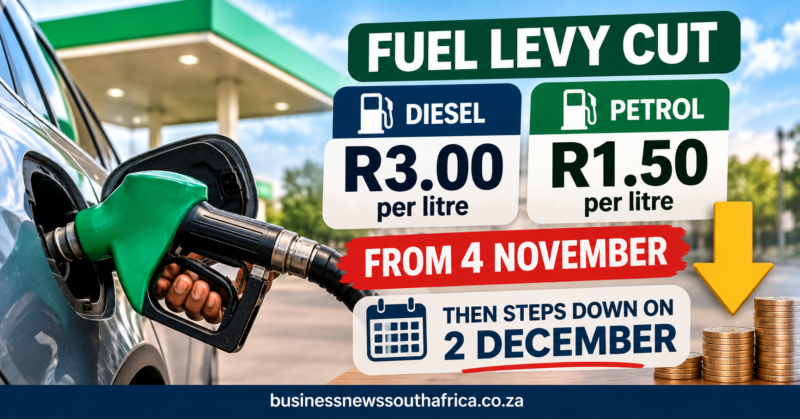
The December fuel price outlook is split: petrol is on course for a sizeable drop, while diesel is set to barely move, because the temporary fuel levy relief announced in October steps down after 1 December. Central Energy Fund (CEF) data for the first three weeks of November, as reported by BusinessTech, points to a projected cut of about R2.94 a litre for 93 petrol, but only 8 cents for 0.05% diesel. These are projections, not official prices.
What the levy relief schedule actually says
The headline that Treasury has “reversed” fuel relief is not quite right. The step-down was written into the plan from the start. In the Medium-Term Budget Policy Statement speech of 21 October 2026, Finance Minister Enoch Godongwana said the fuel levy would be cut by R3 a litre for diesel and R1.50 a litre for petrol from 4 November 2026 until 1 December 2026. He added that “thereafter, the relief will continue at a lower amount until 5 January 2027”, with the diesel levy reduced by R1.50 a litre and the petrol levy by R1 a litre.
The speech put the cost at R10 billion in foregone revenue. To fund it, the R10 billion that had been transferred to the Central Energy Fund will be returned to the National Revenue Fund and placed in the Contingency Reserve.
The arithmetic is simple. In December, motorists lose 50 cents a litre of petrol relief (from R1.50 to R1) and R1.50 a litre of diesel relief (from R3 to R1.50). When the relief ends in January, the remaining R1 on petrol and R1.50 on diesel is added back, according to BusinessTech’s reading of the schedule.
The projected December numbers
BusinessTech, which credits CEF data and Bloomberg, reports the over-recoveries (the gap between what the fuel price formula says products should cost and what motorists currently pay) at the end of the third week of November:
- Petrol 93: R3.44 a litre
- Petrol 95: R3.68 a litre
- Diesel 0.05% sulphur: R1.58 a litre
- Diesel 0.005% sulphur: R2.00 a litre
Once the levy relief step-down is added, BusinessTech’s inland projections work out as follows:
- Petrol 93: from R29.87 to about R26.93, a net fall of R2.94
- Petrol 95: from R30.24 to about R27.06, a net fall of R3.18
- Diesel 0.05%: from R30.85 to about R30.77, a net fall of 8 cents
- Diesel 0.005%: from R31.60 to about R31.10, a net fall of 50 cents
Illuminating paraffin is projected to fall by R2.61 a litre. BusinessTech notes that its figures exclude the slate levy and other monthly adjustments, which could change the direction or size of the final numbers. Diesel users get the smaller benefit because the relief that disappears is far bigger for diesel than for petrol.
Why the oil price is helping
The same report says global oil fell to about $91 a barrel, after trading above $100 for more than a month and reaching $118 at the start of November. A weaker rand offset part of that gain, adding 13 to 20 cents a litre. BusinessTech also points to market pricing of a possible US Federal Reserve rate hike in December, and to local political uncertainty after the local government elections, as pressure points for the currency.
On the supply side, the report says the International Energy Agency forecasts a surplus of roughly 2 million barrels a day this quarter, and that Goldman Sachs has flagged a risk of a glut next year. The report also refers to the Iran conflict and the US blockade of Iran, so the oil outlook remains tied to events that can change quickly.
What was said when the relief was announced
When the relief was unveiled, the Automobile Association (AA) said it was not enough. In EWN’s report, AA chief executive Bobby Ramagwede argued that the relief “can be funded through better fiscal management” and warned about inflation effects expected in early 2027.
Treasury took the opposite view of its value. In a separate EWN report from 30 October, Treasury head of taxation Chris Axelson defended the decision, calling the levy cut “the one mechanism that can have the most direct impact to provide relief” while prices are rising. The report puts the general fuel levy at R4.29 a litre of petrol, and says the relief could also help dampen inflation. The same article makes clear that no decision to scrap the levy entirely had been reported.
What to watch before the official announcement
The official December adjustment is announced by the Department of Mineral and Petroleum Resources in the first days of the month, after the CEF finalises its numbers. Between now and then, the rand, the oil price and the slate levy can all move the result. Treat the figures above as a guide to direction. Petrol motorists look set for a clear drop, and diesel users, including freight operators who pass costs through to businesses, should expect little relief.
For households and companies planning around fuel costs, the more important date is January. Once the relief ends on 5 January 2027, the full levy returns, and any oil price gains will have to carry the whole load. For related coverage, see our reports on the fuel levy cut and its step-down, the pressure on household budgets, and the debate over the fuel price formula review.
Source note: the CEF-based projections are as reported by BusinessTech on 20 November 2026. We could not retrieve the CEF data itself, so confirm against the official announcement.