Petrol stations earn a regulated retail margin of R3.20 a litre on petrol, according to the official fuel price structure the Department of Mineral and Petroleum Resources (DMPR) published for 7 October to 3 November 2026. That margin is a fixed amount in cents, so a station earns the same on a litre sold at R30.25 as it would at a lower price, while the costs of running a forecourt keep rising. The South African Petroleum Retailers Association (SAPRA) says this is why record pump prices are not helping its members.
At the same time, Discovery Insure reported on 2 November 2026 that its clients bought 33% less fuel by volume in October, after 95 unleaded broke R30 a litre. That figure needs careful reading, as explained below.
What it means for your business
If you run a forecourt, the squeeze comes from costs, not from the margin line. If you run a fleet or buy fuel on account, expect retailers to be careful about opening hours, credit and card charges. If you supply stations, watch for operators trimming night shifts and staff.
What the official price structure shows
The media statement released by the Central Energy Fund on behalf of the DMPR sets out the October price build-up. Its annexure lists the following elements for petrol, in cents per litre: wholesale margin 66.5, secondary storage 39, secondary distribution 19.1, retail margin 320, zone differential in Gauteng 91.1 and fuel levy 429. For diesel, the retail margin line is shown as zero, and the diesel prices in the statement are wholesale prices.
The statement raised the petrol price by 312 cents a litre for 93 and 333 cents a litre for 95 from 7 October 2026. An earlier DMPR statement, for the adjustment on 2 September 2026, included a 4.9 cents a litre increase in the retail margin on petrol. The margin moves through those periodic adjustments, not with the pump price.
By our arithmetic, R3.20 is about 10.6% of the R30.25 inland price of 95 unleaded that Discovery cites. The margin is not the station’s profit: SAPRA says wages, electricity, security, compliance and stock losses all come out of it. We could not verify the amount of those costs.
What SAPRA says
SAPRA national chair Henry van der Merwe told the press that the regulated retail margin is a fixed amount in cents per litre, according to TopAuto’s report of SAPRA’s statement on 7 October 2026. TopAuto quotes him saying record pump prices add no margin to the retailer, while more capital is tied up in deliveries, card and bank charges rise with the value of each sale, and stock losses cost more. We did not find that statement on SAPRA’s own website.
On 23 October, EWN reported Van der Merwe saying: “there’s no real relief for fuel retailers because, as you know, we’re only getting a margin, our margin stays exactly the same.” EWN also reported that declining sales are putting pressure on retailers, with some rural stations closing at night to cut costs. EWN names the body the South African Fuel Retailers Association, while TopAuto uses the South African Petroleum Retailers Association; both name the same chair.
What Discovery’s data does and does not show
The Discovery press release of 2 November 2026 analyses fuel transactions and telematics from more than 200,000 Discovery Insure clients. It says fuel purchases among those clients fell 33% in volume in October. It does not measure what stations sold nationally.
The release also says everyday driving has remained largely stable. After the October increase, trips fell 6% and kilometres travelled fell 7%. Average purchase size fell from about 36 litres to 31 litres in months with larger increases, and purchases of under 20 litres were about 36% of transactions in 2026, up from 25% in 2025. Average monthly station visits rose from 2.4 to just over three. Before the October increase, purchasing volumes surged by 300% before midnight on 6 October, and by 400% for diesel.
In plain terms, Discovery’s clients are buying smaller amounts more often, and timing their fills around price changes. We have covered the spending side separately in Discovery data shows South Africans spending up to R950 more on petrol each month. No public data we found shows a national fall in litres sold at stations, and SAPRA has not published figures for its members.
The levy relief does not touch the margin
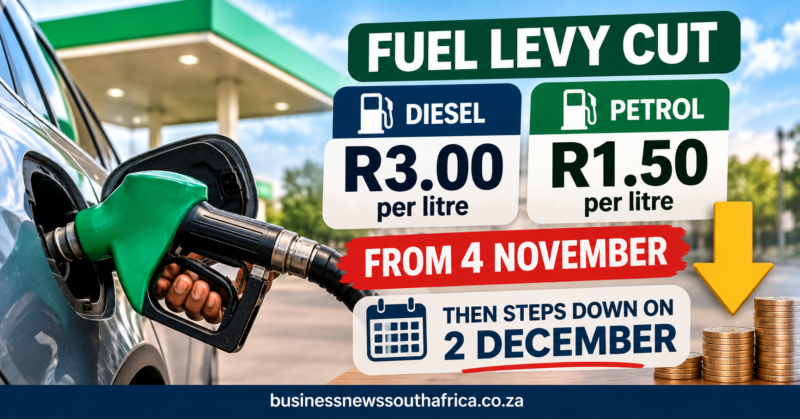
The finance minister announced in the Medium-Term Budget Policy Statement that the fuel levy falls by R3 a litre for diesel and R1.50 a litre for petrol from 4 November 2026 until 1 December 2026, then by R1.50 and R1 until 5 January 2027, according to the government’s SAnews agency. The levy is a separate line in the price structure from the retail margin, so the relief lowers the pump price without raising what the station earns. Our report on the levy cut and its December step-down has the dates.
What to do
- Fleet and account customers: confirm credit terms and card fee treatment with your forecourt supplier before the 2 December step-down.
- Forecourt operators: track litres per transaction, not just total litres, because smaller fills mean more card transactions for the same fuel.
- Everyone: budget on the levy dates, as the relief shrinks on 2 December and ends on 5 January 2027 unless Treasury says otherwise.