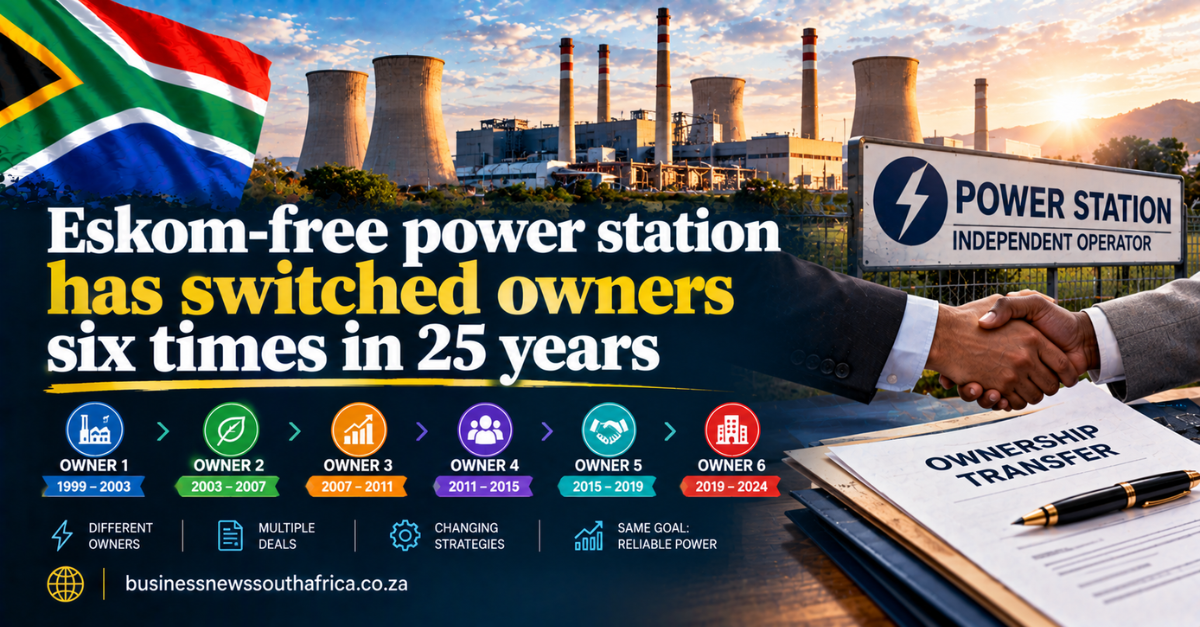
South Africa’s first experiment in privatising power generation is about to change hands again. Kelvin Power Station in Kempton Park has had six owners in the 25 years since the City of Johannesburg sold it, and the city that sold it now wants it back.
Kelvin is a coal-fired station on the East Rand, commissioned in stages between 1956 and 1969 and built by the Johannesburg municipality rather than by Eskom. Of its 13 units, the six 30MW Phase A machines have been retired; seven 60MW Phase B units remain, giving it roughly 420MW of installed capacity. That is small next to a Medupi or a Kusile, but it is not trivial: Kelvin supplies about a tenth of Johannesburg’s base load.
Six owners in 25 years
The station was privatised in 2001, the first time a South African power generation asset passed into private hands. The chain since then reads like a tour of two decades of infrastructure finance:
- 2001, US independent power producer AES buys the station, with Global African Power holding a 5% local stake.
- 2003, AES sells to Globeleq.
- 2007, A consortium led by Macquarie-managed infrastructure funds, Old Mutual Investment Group and Kagiso Trust Investments takes 95%, alongside Aldwych International, Dutch development financier FMO and J&J Infrastructure Holdings.
- 2013, Nedbank and Investec acquire the equity.
- 2015, An Aldwych-led consortium buys it back out.
- 2024, The Competition Commission approves the acquisition of Aldwych, by then rebranded Anergi, by Harith InfraCo, whose shareholders include the Government Employees Pension Fund, the Development Bank of Southern Africa, Mergence Investment Managers and Zungu Investments.
Six changes of control in 25 years is a lot for a single generating asset. It is worth being precise about why, because the easy reading, that private power in South Africa does not work, is not quite what the record shows.
Why the churn happens
Kelvin has kept running throughout. What changed each time was not the plant but the kind of money that owned it: a strategic operator, then a development-finance consortium, then two commercial banks, then an infrastructure fund. Generation assets with a contracted offtake behave like bonds, and bonds get traded. Infrastructure funds have finite lives, typically 10 to 12 years, and are obliged to exit whether or not the asset is performing.
That said, the risk is real. An independent power producer carries policy risk it cannot control: tariff determinations by Nersa, the creditworthiness of a municipal offtaker, and the coal price. Johannesburg’s own payment record matters here, and Eskom has spent much of the past two years arguing that municipalities have breached the conditions of its R40.5bn debt relief programme. An asset whose customer may not pay is an asset that trades at a discount, repeatedly.
Why City Power wants it back
In January 2026, City Power put feasibility proposals to the Johannesburg council seeking approval to run detailed financial and technical studies on reacquiring Kelvin. The argument is arithmetic. In the year to April 2025 the utility bought 789.7GWh from Kelvin for R1.27bn. That works out to about R1.61 per kWh, against R1.89 from Eskom, a saving of 28 cents a unit.
On last year’s volumes, closing that gap across the full purchase would be worth roughly R220m a year. Owning the station outright rather than buying its output would change the calculation again, though it would also hand the city the capital cost, the coal supply problem and the eventual decommissioning liability of a plant approaching 70 years old.
What it means if you run a business in Johannesburg
Two things follow for firms in the metro. The first is that a meaningful slice of your electricity does not come from Eskom and is not priced like Eskom’s, which is part of why Johannesburg’s tariff path has not tracked the national one exactly. If Kelvin’s economics change, your bill changes with them, and the gap between what you expect to pay and what you are billed is already wide enough to hurt.
The second is a due-diligence point for anyone signing a power-purchase agreement with a private generator. Kelvin’s history is a reminder that the counterparty you sign with is often not the counterparty you finish the contract with. Read the change-of-control clause, check whether tariff escalation is indexed or negotiated, and establish who carries the risk if the plant goes offline. Businesses weighing the capital cost of their own generation against a supply contract can model both paths in our cash flow and opportunity simulator.
Whether the city buys Kelvin back is now a council decision rather than a market one. What is already clear is that 25 years after Johannesburg sold its power station to prove that private generation could work, the most enthusiastic bidder for it is Johannesburg.