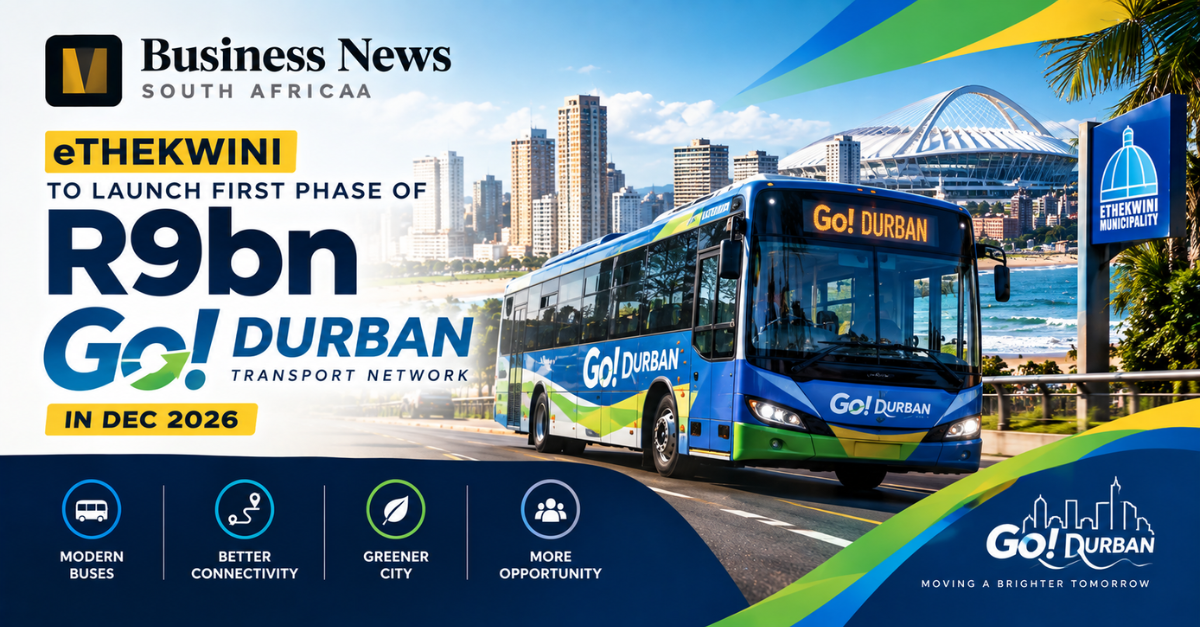
The City of eThekwini announced that the first stage of its R9 billion Go! Durban public transport network will begin operating on the C3 corridor in December 2026. The soft launch is set for October, giving the municipality a narrow window to move from testing to full service.
For commuters, local retailers and small-scale freight operators, the new service promises a reliable link between Pinetown and Bridge City. The city says the corridor will be served by 22 new buses owned by the municipality, while feeder vehicles will be supplied by a Vehicle Operating Company, a third-party that will run the day-to-day service. Seventy-five percent of the staff on the project are slated to come from people who lost jobs because of the construction, a claim the mayor used to underline the socio-economic angle of the investment.
Why the launch matters now
Durban’s traffic congestion has long been a headache for businesses that rely on timely deliveries and for workers who spend hours stuck in gridlock. A functional Bus Rapid Transit (BRT) system, a network of dedicated bus lanes that aim to keep buses moving faster than regular traffic, could shave travel times and lower transport costs. For a small shop on the route, the difference between a customer arriving by car or by a frequent, on-time bus can be the difference between a sale and an empty till.
The Go! Durban programme is part of an Integrated Rapid Public Transport Network (IRPTN) plan that envisions 250 kilometres of corridors, including 60 kilometres of rail. The long-term goal, according to the city, is to have 85 percent of the municipality’s residents living within an 800-metre walk of a high-quality transit service. If the first corridor meets its targets, it could set a template for the remaining BRT trunk routes and the single Rail Rapid Transit (RRT) line.
However, the project has been anything but smooth. Planning began in 2010, with design work starting in 2012 and construction contracts awarded in 2013. The original timeline aimed for a 2018 rollout, but utility relocations, land expropriation battles and protracted negotiations over fleet ownership with local bus and taxi operators pushed the date back repeatedly. An intermediate target for early 2025 was also missed.
Political opposition is vocal. ActionSA KwaZulu-Natal leader Zwakhele Mncwango warned that “not a single bus has operated on this corridor” and called for accountability. Democratic Alliance councillor Melanie Brauteseth echoed the concern, noting that the municipality has not yet received a cent of the R9 billion grant and continues to incur costs for buses that remain idle.
These criticisms highlight a risk that the launch could stall again if the operational hand-over to the Vehicle Operating Company does not go as planned. The city’s statement that it will pay the VOC to run the service is a claim that has yet to be verified by an independent audit of the funding flow.
For small-business owners, the immediate question is whether the promised buses will actually appear on the road in December. If they do, the corridor could open up new customer bases, reduce reliance on private vehicle parking, and make employee commutes more predictable. If the launch slips, the city may face renewed pressure to justify the R9 billion spent on infrastructure that remains unused.
Durban is not the first South African city to try a BRT system. Gauteng’s Rea Vaya, launched in 2010, showed that a well-executed network can attract thousands of daily riders, but it also revealed the importance of sustained funding and clear agreements with existing minibus taxi operators. Those lessons appear to have informed the recent agreement between eThekwini and local transport operators, though the details of that deal are still largely private.
In the short term, the city’s focus is on translating the investment already made into a functioning service. The mayor’s office says the priority now is to move from infrastructure, stations, lanes and buses, to operation. For the many small enterprises that line the future route, the outcome could be a modest boost to foot traffic and a more dependable supply chain.
Whether the Go! Durban launch will deliver on those expectations remains to be seen. The next few months will test the city’s ability to coordinate the VOC, manage staffing targets and keep the buses on schedule. If the December start date holds, Durban will finally see the first public transport service that has been promised for more than a decade.