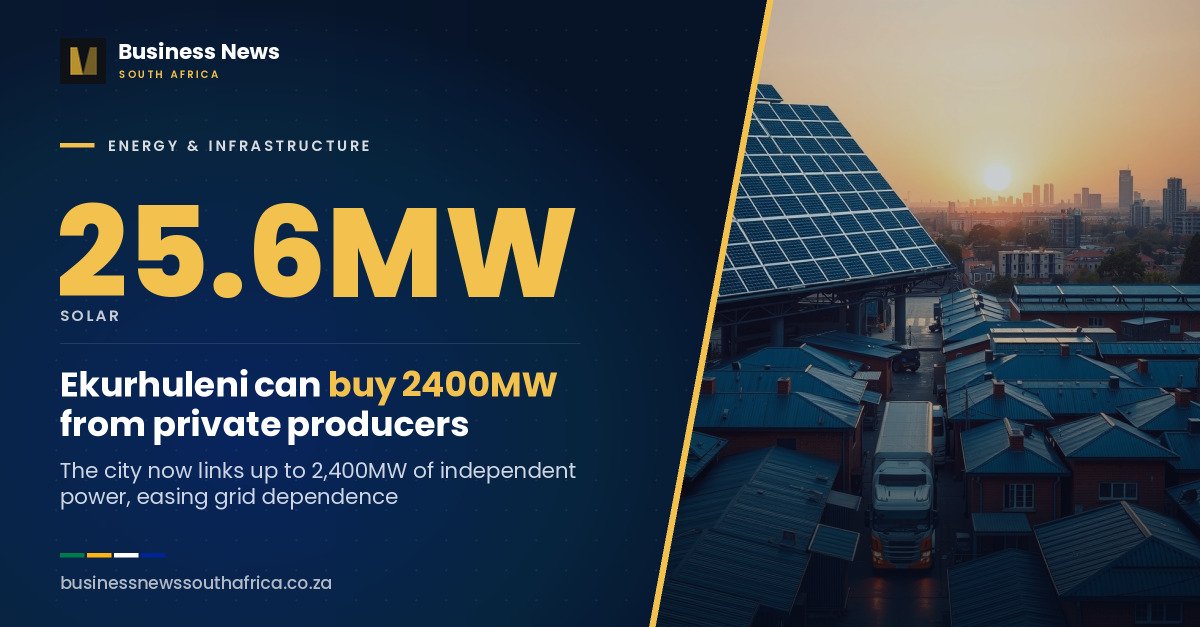
Ekurhuleni, the Gauteng metro that is a key manufacturing and logistics hub, can now buy up to 2,400MW of power from independent producers. A ministerial determination under Section 34 of the Electricity Regulation Act, announced on 19 October, ends a procurement programme that had been stuck since 2021. Three days later the first project broke ground: a R360 million, 25.6MW solar plant on the roof of the Springs Fresh Produce Market. With local government elections scheduled for 4 November, the open question is whether the next council keeps the programme moving.
What the determination allows
According to SAnews, the government news agency, Electricity and Energy Minister Kgosientsho Ramokgopa and Ekurhuleni mayor Nkosindiphile Xhakaza announced the determination at a Pretoria briefing. The mix is 1,237MW of solar photovoltaic capacity, of which 1,137MW is embedded generation inside the city, 780MW of natural gas, of which 535MW would be wheeled, 183MW of waste-to-energy and 200MW for newer technologies. The city will remain connected to the national grid.
Ramokgopa said Ekurhuleni was the first city to apply for a determination, but that it took longer than the others because of the size and composition of the request. Earlier municipal determinations were 400MW for eThekwini and 220MW for Cape Town. He said the new one “potentially” frees Ekurhuleni from total dependence on Eskom, while noting that it will stay grid-tied.
Engineering News adds that the minister said the National Energy Regulator had concurred and that National Treasury had been informed. It reports that without the determination the council could not conclude the 20-year power purchase agreements it wanted, and that the programme had been on hold since 2021. Xhakaza said 75 individual producers had been identified through two bid windows run some years ago. The minister said the approval was granted only because the city is in good financial standing with Eskom: its current account is up to date and it has a settlement agreement on about R2 billion of historical arrears.
The first plant shows the model
The Springs project is a partnership between BluEnergy, a subsidiary of JSE-listed Blu Label Unlimited, and its development partner IBS Crafts. Engineering News reported that it will supply about 40GWh a year to the city under a 20-year power purchase agreement and connect to the Springs bulk substation. Business Day reports that the plant will be owned and operated by Olympia Park, a company held by BluEnergy, which has the majority stake, and IBS Crafts, and that it is the first project to enter construction from Blu Label’s disclosed 180MW pipeline. The producer funds the R360 million capital cost, so the municipality makes no upfront contribution and pays for the electricity it receives. Blu Label told Business Day that electricity from its projects is expected to come online in the fourth quarter of next year.
Blu Label’s pitch rests on its existing municipal business. Co-chief executive Mark Levy said its Cigicell prepaid vending and revenue-assurance systems are embedded in more than 95 municipalities, and argued that reliable revenue collection helps support investment in new supply. BluEnergy chief executive Aaron Suckerman called Springs a “flagship project” and a blueprint for municipal energy partnerships. Those are company views, not independent assessments.
The savings are the city’s estimate
The mayor said the programme could attract about R6.2 billion in infrastructure investment and save about R36 billion on bulk electricity over 20 years. Engineering News notes that figure applies if the full capacity is built at the tariffs the producers have indicated, measured against what the city would have paid Eskom. Xhakaza also said households paying about R3 a unit could save up to 31%, and that the savings would be passed on to ratepayers. None of this has been tested against signed contracts, and the reports reviewed do not disclose the tariffs.
What it means for businesses
For manufacturers and logistics operators in the metro, more locally embedded generation could mean a cheaper and more certain supply, and Engineering News points out that clean-electricity credentials matter when trading partners move towards carbon border adjustments. The city’s peak demand is about 2,500MW, so the allocation is large against its needs, though installed capacity is not the same as the energy delivered, particularly for solar, which produces only in daylight.
For energy developers, equipment suppliers and lenders, the determination opens a sizeable pipeline with a municipal counterparty. That counterparty’s reliability is the key risk. Our earlier reporting shows that Eskom’s municipal debt plan has stalled over legal hurdles and that Eskom says some municipalities have breached payment conditions on a R40.5bn programme. A 20-year offtake agreement is only as strong as the buyer’s ability to pay.
The determination also sits alongside national policy that has been moving. In early October the minister announced a separate determination favouring batteries and gas, as we covered in government prioritises batteries and gas over wind and solar. Ekurhuleni’s solar allocation shows that city-level procurement is running on its own track.
What is still unknown
Engineering News reports that no project specifics were given for the gas plants, including where they would source fuel. The 75 producers have not been named, and the tariffs were not disclosed in the reports reviewed. Business Day notes that BluEnergy holds an energy trading licence from the National Energy Regulator but has not started trading or wheeling electricity from other producers. It is also unclear how many of the 75 projects can reach financial close, and whether a new council after 4 November will keep the programme as a priority. Engineering News says the election outcome could materially influence that.
For now, one plant is under construction and the legal permission exists for a great deal more. The next test is whether contracts, tariffs and payment security follow at the pace of the announcements.