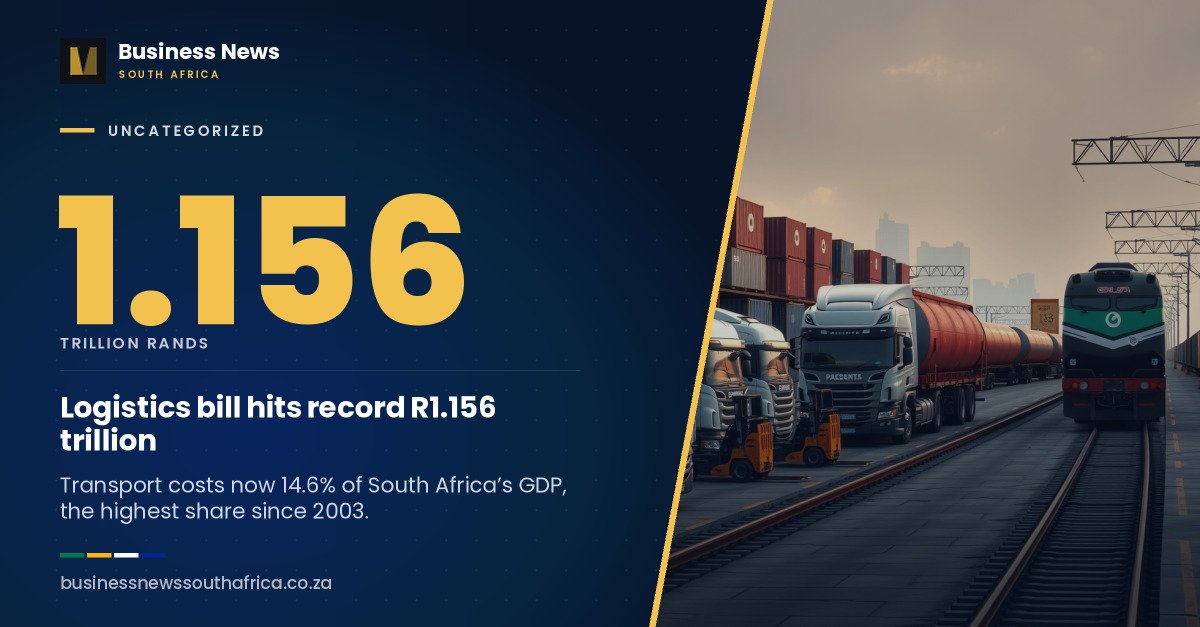
Moving goods around South Africa is set to cost R1.156 trillion in 2026, equal to 14.6% of GDP, the highest share recorded since the series began in 2003. The figures come from the State of Logistics 2026 report, published in October by the research and consulting firm GAIN Group and presented in Johannesburg on 22 October. The bill is a business cost before it is a national statistic: it sits inside the price of every loaf, ton of ore and container that crosses the country.
The logistics bill passed R1 trillion for the first time in 2025
According to the report, national logistics costs were R972 billion in 2024 and an estimated R1.009 trillion in 2025, the first year above R1 trillion. The 2026 forecast adds a further R147 billion. As a share of the economy, the burden rises from 13.2% in 2025 to 14.6% in 2026. Between 2009 and 2018 the ratio generally sat between 10% and 12%.
The model counts four buckets of spending. Transport is forecast at R683 billion, about 59% of the total. Inventory carrying, the cost of capital tied up in stock, is R191.4 billion. Warehousing is R151.7 billion, and management and administration is R130 billion. Transport accounts for R117 billion of the R147 billion increase, a jump of 20.7% in one year, which the authors link to higher fuel prices during 2026.
Road rates have outrun inflation and diesel
The report tracks freight rates against consumer price inflation and the diesel price, indexed to 2014. Between 2014 and 2025 the road freight rate index rose by about 82%, against 68% for CPI and 53% for diesel. The authors note that this suggests road pricing reflects more than fuel, including maintenance, labour, insurance and capital costs, while cautioning that rates are prices charged, not a direct measure of what operators spend.
For 2026 the report forecasts the road rate index at 112% above its 2014 level, against 60% for rail. That gap is one reason GAIN argues for moving long-distance, high-volume freight back onto rail where the service is reliable. We covered the diesel side of this squeeze earlier in the year, when diesel had jumped more than 58% since February.
Rail underperformance still costs R180.8 billion a year
GAIN estimates the economic cost of weak freight rail performance at R180.8 billion in 2025. That figure combines R92.4 billion in transport inefficiencies with R88.4 billion in unachieved bulk mineral exports. The authors point out that the second part is foregone economic activity, not direct logistics spending. The total is down from a revised R410.7 billion for 2022, and works out to roughly R495 million a day, compared with the R1 billion a day cited by President Cyril Ramaphosa at the height of the crisis.
Volumes are recovering. Transnet’s rail volumes fell from about 226.3 million tonnes in 2017/18 to 149.5 million tonnes in 2022/23 and reached about 167.9 million tonnes in 2025/26. The report puts the desirable level at roughly 250 million tonnes by 2035 and 320 million tonnes by 2055. It also records network access agreements with eleven private train operating companies, but says their full contribution is expected beyond the current reporting period. Our earlier reports on private operators preparing test trains and on the rail infrastructure manager’s R26 billion request to Treasury cover the mechanics of that reform.
Professor Jan Havenga of GAIN Group told the launch that general freight is the weak spot. As reported by Engineering News, he said: “Although the recovery of established bulk commodity corridors for iron-ore and coal remains important, South Africa’s longer-term freight requirements cannot be met without rebuilding competitive general freight rail services.” Heavy-haul lines have recovered, while general freight volumes continued to contract, according to that account. The Gauteng corridors to KwaZulu-Natal and the Western Cape are the ones he singled out. Bulk commodity corridors such as the Sishen-Saldanha ore line are receiving money; the general freight network is the harder case.
What GAIN says could be saved, and what it cannot
The report names three priorities: choosing the right transport mode, using capacity more fully, and making each tonne-kilometre more efficient. It models what costs would have been had those improvements been realised from 2022, assuming direct rail savings, a 10% efficiency gain on the road costs that remain, and fewer port-related road delays. On that basis, identified avoidable costs are a forecast R149.3 billion in 2026, or 12.9% of the logistics bill. The 2026 ratio would be 12.7% of GDP instead of 14.6%.
The authors are careful about the limits. Even in the improved scenario, costs still climb, from R686.7 billion in 2022 to a forecast R1.0066 trillion in 2026. They also stress that a higher cost-to-GDP ratio is not a direct measure of inefficiency, because geography, commodity mix and freight intensity all matter. South Africa is described as a transport-hungry economy, with long distances between inland centres and the ports. Internationally the report places the country towards the high end of its comparators: Brazil is at 15.5% (2025) and South Korea at 14.5% (2023), while the United States is at 7.8% and China at 13.9%. The authors say the reference years and methods differ, so these are not a ranking.
What it means for businesses
For a manufacturer, retailer or exporter, the practical reading is that freight is now the line most exposed to fuel prices and rail reliability, and that stock-holding costs rise when deliveries are unreliable. The report says unreliable freight can push companies towards buffer stock, which lifts inventory and warehousing spending. Firms with long-haul, high-volume flows are the ones that would feel any move from road to rail first. The report was sponsored by Absa Business Banking and the Western Cape Government Mobility Department, which readers should weigh when reading their foreword messages, although the cost model is GAIN’s own.
What is still unknown
The 2025 figure is an estimate and 2026 is a forecast, so both will be revised. The avoidable-cost scenario is a modelled counterfactual, not a measured saving, and it does not say who would pay for the rail rebuild. Havenga argued that the private sector cannot be expected to finance the core freight network and that the infrastructure manager should be fully unbundled from Transnet. Whether government and Transnet adopt that path is a policy decision that has not been announced. The model does not isolate how much of the inventory cost rise comes from interest rates, stock values or supply chain reliability. IndexBox carried the same headline numbers, citing Mining Weekly, so the findings have not been independently reproduced outside GAIN’s model.