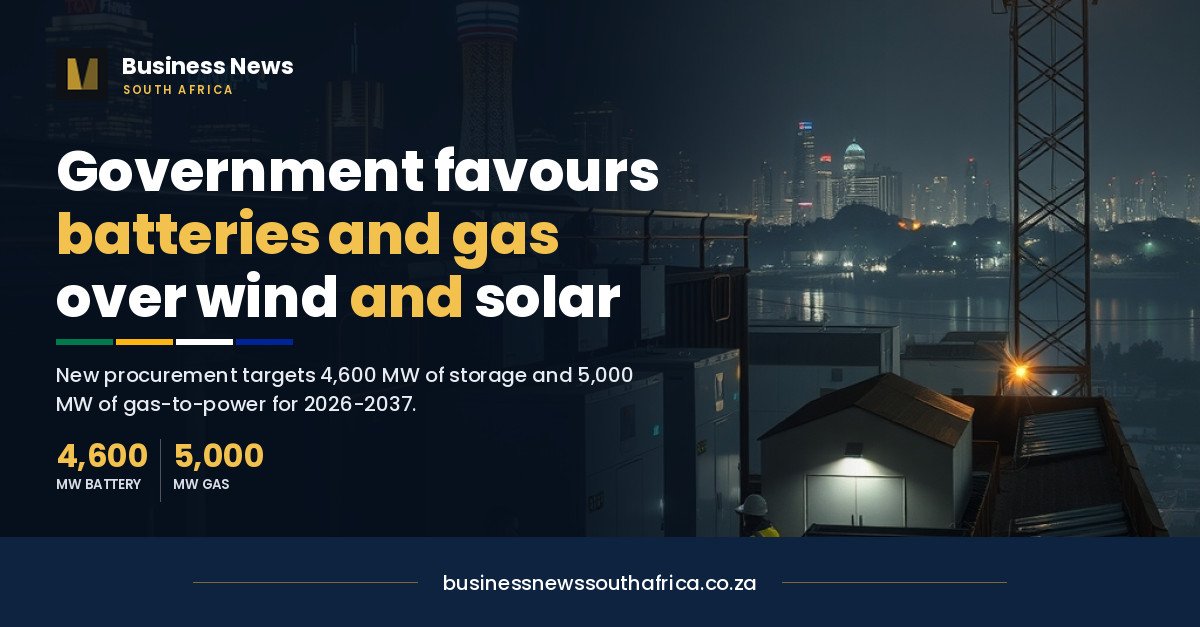
Government will direct its next round of electricity procurement towards batteries and gas-fired power, and leave wind and solar out of this determination. Electricity and Energy Minister Kgosientsho Ramokgopa announced a new Section 34 determination at a media briefing on Wednesday 7 October 2026. It prioritises 4,600 MW of battery storage and 5,000 MW of gas-to-power for new generation capacity over the 2026 to 2037 planning horizon, according to SAnews.
For businesses that buy electricity, the question is whether the grid can keep supplying them when they need it, and what that costs. The determination makes no provision for new wind or solar capacity. Ramokgopa said a subsequent determination will cover new variable renewables, hybrid renewables-storage projects and pumped storage, Engineering News reports.
Curtailment is the problem being solved
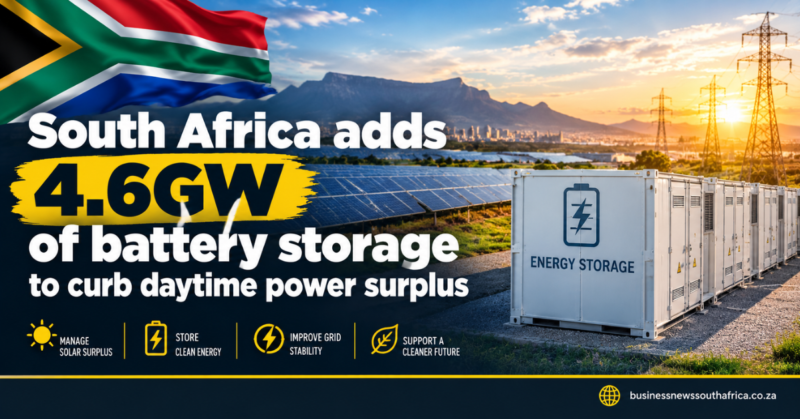
The System Operator curtails generation when the grid cannot take it, because of network constraints or operating conditions, including when supply exceeds demand. Engineering News reports that curtailment has risen materially, which has increased compensation payments by the National Transmission Company South Africa to renewable independent power producers from earlier bidding rounds.
Ramokgopa put the core issue simply at the briefing: “We are addressing an immediate problem. It’s a curtailment problem.” Business Day reported the remark. Batteries can charge from power that would otherwise go unused and discharge during evening peaks. SAnews reports that the minister called curtailment a major risk, because it could raise financing costs and the failure risk for future private projects.
The storage procurement is set to line up with the System Operator’s charging and discharge requirements, backed by enforceable availability and performance obligations. The programme is also linked to transmission expansion, new industrial demand and regional electricity trade, according to SAnews.
Gas is the back-up when renewables fall short
Gas-to-power does not absorb surplus electricity. It is meant to supply dispatchable power when renewable output drops or demand rises. Procurement will weigh fuel availability, delivered gas prices, port and pipeline infrastructure, grid connections and commissioning schedules together. The department says: “Affordability must be evaluated against the expected operating profile of the plants.”
Business Day reported that the gas industry is still waiting for preferred bidders, which market participants say are needed to provide demand certainty. The IPP Office has said the first gas-to-power bidding process remains on track. Engineering News reports that the evaluation of the first gas round has not yet concluded.
What has already been procured
Engineering News reports that 1,744 MW of battery storage, totalling 6,976 MWh, has been procured across three bidding rounds run by the Independent Power Producer Office. The first round covered five projects totalling 513 MW and 2,052 MWh, with combined investment of more than R15 billion, and all five have advanced to construction. Eskom is also prequalifying partners for a 6 GW Eskom Green pipeline that includes battery projects of 1,000 MW and 4,000 MWh.
The new procurement is open to all market participants, Eskom included. Both programmes are designed to support local manufacturing and construction, and both include measurable commitments to broaden black South African ownership of energy infrastructure.
What the announcement does not say
Neither report gives dates for bidding rounds, submission deadlines or preferred bidder announcements. The IPP Office’s assurance that the first gas round remains on track is not tied to a date in the reports reviewed. Neither gives a price estimate for the programme, so a business cannot yet tell whether it will change the electricity line on its bill. SAnews describes the 4,600 MW and 5,000 MW figures as proposed allocations, which means they can still change.
What to watch next
Three things will show whether this changes costs for operators: the gazetted text and any bid window dates, the outcome of the first gas-to-power round, and the next determination covering wind, solar and pumped storage. Readers who want to check public support can start with our government funding finder, our investing section covers the wider picture for business owners weighing where to put money, and our guides offer practical background.