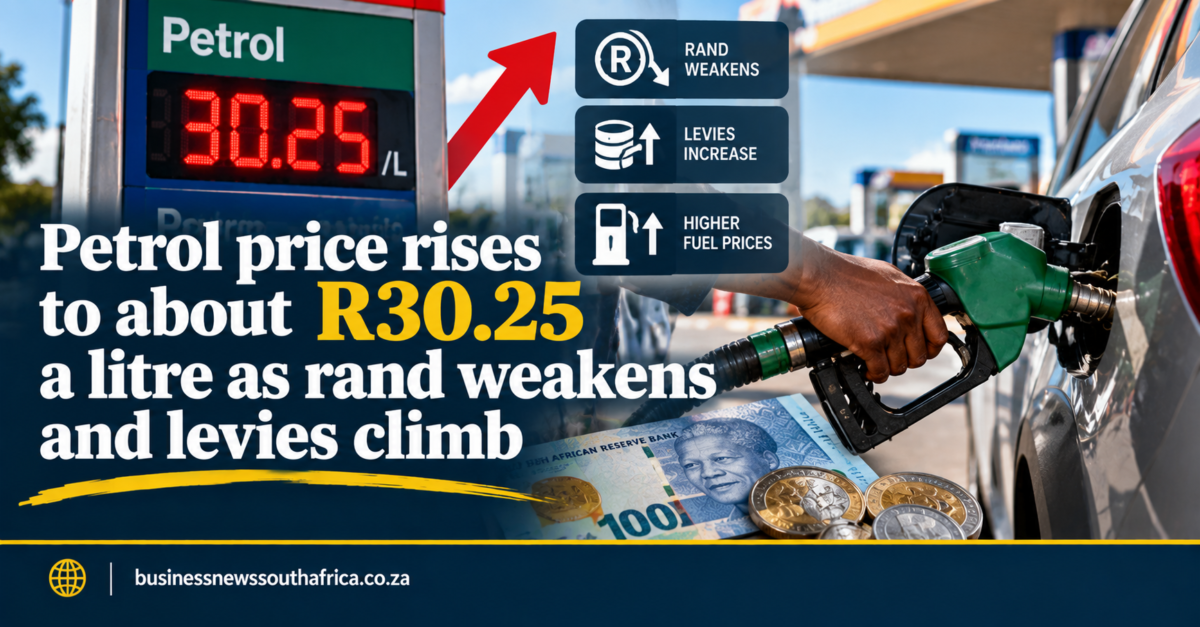
According to a Moneyweb column, the Department of Mineral and Petroleum Resources announced a R3.33 increase for 95 octane petrol effective 7 October, taking the Gauteng price from R26.92 to roughly R30.25 per litre.
The department attributes the rise to higher international oil prices and shortages of petrol and diesel abroad. While those factors matter, the column points out two additional drivers that make the current shock larger than the one seen in 2008.
Weaker rand and higher levies
In March 2008 Brent crude averaged $104 a barrel and the rand traded near R8 to the dollar; 95-octane petrol cost R8.25 a litre in Gauteng. Today the rand is about R16 to the dollar, roughly double the 2008 rate, and because South Africa buys oil in US dollars, that exchange-rate shift alone adds a substantial cost component.
The general fuel levy, set by the South African Revenue Service, was R1.27 per litre in April 2008 and is now R4.10, an increase of about 223%. On a typical 50-litre fill-up that translates to roughly R231 more in levy charges. The levy is not the direct cause of the latest price hike, but it raises the baseline from which the international price shock hits motorists. Removing it would cut the current R30.25 price to about R26.15, leaving only the Road Accident Fund and carbon levies in place; applying today’s levy rates to 2024 fuel sales suggests an annual levy collection of roughly R89 billion, a sum the government would need to forgo to keep the price lower.
Reduced local refining capacity also plays a role. South Africa once operated six major refineries; today only three remain, Natref, Astron‘s Cape Town refinery and Sasol‘s Secunda complex, with their combined operating capacity in 2024 about half the peak recorded between 2016 and 2019, increasing reliance on imported finished fuel. The column estimates that if a local refinery could save 50 cents per litre compared with an import, the market could see an average relief of about 28 cents per litre; adding a new refinery capable of processing 150,000 barrels a day might deliver a further 12 cents per litre, but such a project would cost between R81 billion and R130 billion based on international benchmarks.
Strategic fuel reserves have also dwindled. Minister of Mineral and Petroleum Resources Gwede Mantashe told parliament that the Strategic Fuel Fund holds 6.9 million barrels of oil, roughly 96% below the 1988 peak of 158.5 million barrels. The current estimate of about 30 days’ crude cover refers only to the amount the refineries can process, not the total fuel the country needs. The government proposes building a net-import cover of 60 days, rising to 90 days, and expanding finished-fuel reserves, citing China’s 2021 practice of selling state-owned oil stocks to domestic refiners as an example of how reserves can ease cost pressures during supply tightness.
The pump price increase is the result of three converging trends: a weaker rand that magnifies the dollar-priced oil cost, a fuel levy that has more than doubled since 2008, and a halved refining capacity that forces greater import dependence. Motorists feel the impact directly, while policymakers must balance revenue needs against the desire to keep fuel affordable.
We reported on Investec’s warning that a further R4.60 per litre petrol increase is on the cards for November, which would land directly on top of October’s rise and push the structural pressures described here even higher.