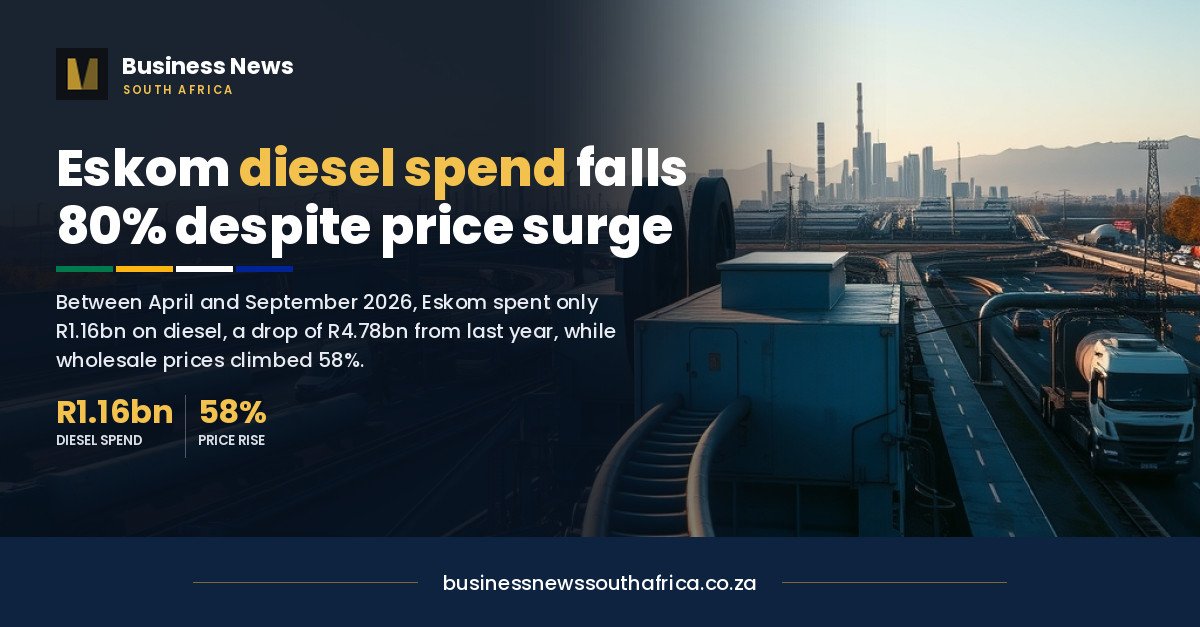
Diesel has been one of the sharpest cost increases in South African business this year, and one very large buyer has hardly felt it. Between 1 April and 24 September 2026, Eskom spent R1.16 billion on diesel, against R5.94 billion in the same stretch of last year: a fall of R4.78 billion, or 80.56%, according to its 25 September power system update. Since the Middle East conflict began in late February, the wholesale diesel price has climbed more than 58% to R29.31 a litre, Business Day reported, citing Department of Mineral and Petroleum Resources data.
The fuel price and the fuel bill have moved in opposite directions, by a wide margin, at the country’s biggest electricity producer. The reason has less to do with clever buying than with not needing to buy.
Why a power utility buys diesel at all
Eskom burns diesel in open-cycle gas turbines, known as OCGTs: jet-engine-style generators that start quickly and cost a lot to run. They are the emergency brake of the grid, brought in when coal stations cannot cover demand. Business Day describes diesel as one of Eskom’s most expensive tools for stabilising the system under strain.
The number that shows how often the brake is used is the load factor, the share of the turbines’ maximum possible output that they actually generated. It fell from 6.97% to 1.05% this financial year, against an annual target of 3%. Diesel-fired generation was 151.14 gigawatt-hours, about 85% lower than a year earlier. Eskom also says its diesel spend for the year to March 2026 was R23.0 billion lower than for the year to March 2023.
What changed: coal units breaking down less
The turbines sit idle because the coal fleet is failing less often. Eskom’s energy availability factor, the share of time its plants can produce at full rated output, is 68.06% for the year to date, up from 62.42% a year earlier and the highest in six years. The week of 18 to 24 September reached 70.44%. The country has now gone 497 consecutive days without load-shedding, since 16 May 2025.
Group chief executive Dan Marokane said in April that diesel use had dropped sharply because more coal-fired units were available, and that Eskom aimed to keep it low to limit its exposure to fuel prices, Business Day reported. The improvement is real but not complete: the share of capacity lost to unplanned breakdowns still stands at 19.09% for the year so far, which is nearly a fifth of the fleet out for reasons Eskom did not plan.
What it means for a business that buys its own diesel
Eskom supplies about 90% of South Africa’s electricity, and about 80% of that is coal-fired, Business Day noted, so the grid’s running costs are not tied to the oil price the way a delivery fleet’s are. A business with its own generator or trucks has the opposite exposure. Our own reporting has 50ppm diesel heading for about R33.05 a litre wholesale inland in October, a rise of about R3.00 on September, before a filling station adds its margin: see October’s fuel hike just got bigger.
The practical question for a business that bought a generator to get through load-shedding is how many hours it actually ran last quarter. If the answer is close to none, the diesel in the tank is the only cost still moving, and it is moving up. If the business sits on one of the feeders still under load reduction, the sums are different. Eskom says 247 617 customers, 3.4% of its base, are still affected, all of them in Gauteng and KwaZulu-Natal, and it aims to end load reduction by March 2027. We looked at why those two provinces are the holdouts.
What is Eskom’s claim, and what is not proven
These figures come from Eskom’s own update, and the release carries no independent verification. Eskom credits its Generation Recovery Plan for the gains. Business Day adds that solar from independent power producers has helped too. A low diesel bill is also a symptom rather than a guarantee: it depends on the coal fleet staying reliable, and Eskom’s own annual target of 3% shows it expects to burn some diesel even in a normal year. Every gigawatt-hour that returned to the turbines would now cost far more than it did a year ago.
Eskom says it is holding 6 571 MW in cold reserve because of excess capacity, a surplus we examined in Eskom’s surplus electricity emerges as a new challenge. The larger bill still lies ahead: Business Day says the country must expand its transmission grid by about 14 500 km by 2034, at a cost of about R440 billion, to move that power to where it is needed. Whether the current run survives the summer is the open question, and Eskom says its power system status and Summer Outlook will be announced in the coming weeks.
The diesel price at the pump is heading for records in October. Eskom, which spent R5.94 billion on the fuel in the same period last year, is the buyer that has arranged things so that it hardly notices.