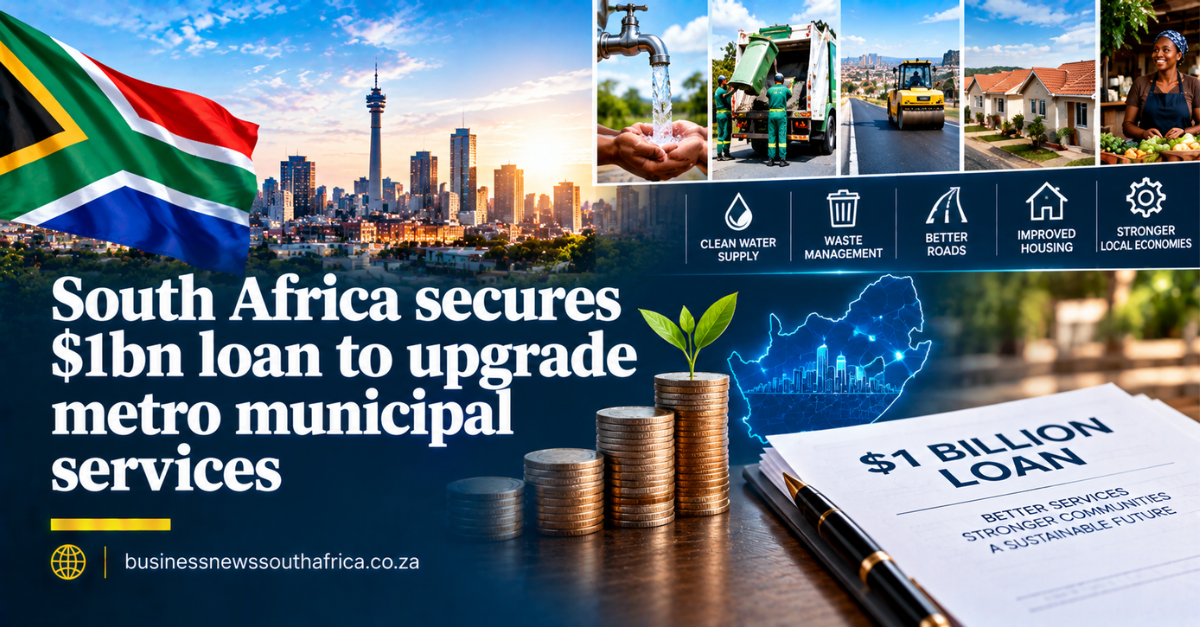
South Africa has signed a $1 billion loan agreement, about R16 billion, with the New Development Bank (NDB) to improve water, electricity and waste services in its big cities. National Treasury announced the deal on Tuesday, 15 September 2026, as part of the Metro Trading Services Reform Programme.
The programme is aimed at improving the governance, financial sustainability and operational performance of municipal trading services in metropolitan municipalities, in particular water and sanitation, electricity and energy, and solid waste management, according to the Treasury statement as carried by Polity. IOL put the rand value at R16.3 billion and listed the eight metros the programme covers: Buffalo City, Cape Town, Ekurhuleni, eThekwini, Johannesburg, Mangaung, Nelson Mandela Bay and Tshwane.
## Money that depends on results
Treasury calls it a performance-based loan, with financing linked to institutional strengthening and to independently verified, measurable performance targets that each metro council approves for its trading services.
The terms, as BusinessTech reported from the statement, are a 16-year maturity, a three-year grace period and interest at daily SOFR plus 1.18508%. SOFR is the Secured Overnight Financing Rate, the dollar benchmark the loan is priced against, so the rate floats with US money-market conditions. The statement describes the terms as concessional. Reports differ on the tenor: IOL gave 15 years with a five-year grace period, but the Treasury figures carried by Polity and BusinessTech are 16 and three.
The New Development Bank was established in 2015 by Brazil, Russia, India, China and South Africa and has its headquarters in Shanghai. It describes itself as a multilateral development bank that mobilises resources for infrastructure and sustainable development projects in the BRICS countries and other emerging market and developing economies. Dilma Rousseff was re-elected as its president in 2025.
The NDB is not the only lender. According to the Treasury statement, it is financing the programme together with the World Bank, the Asian Infrastructure Investment Bank, KfW Development Bank and the French Development Agency. Treasury said the NDB’s support was prepared in coordination with development partners active in South Africa’s infrastructure sector, and that the reform is being carried out within existing legal and fiscal frameworks.
## The wider metro programme
The NDB loan is one strand of a larger effort. In November 2025 the World Bank approved a US$925 million loan for the same eight metros, which serve 22 million people and generate 85% of South Africa’s economic activity, according to SAnews. That loan is part of a US$3 billion initiative over six years and is structured as a Program-for-Results, meaning money is paid out against verified results. Finance Minister Enoch Finance Minister Enoch Godongwana said at the time: “Metros will receive grants from the national government, based on results achieved.”
The domestic side was launched on 19 March 2026 in Pretoria: a R54 billion performance-based grant for the eight metros, with R27 billion allocated in the current three-year expenditure framework and an aim of mobilising more than R100 billion of infrastructure investment over six years, Engineering News reported. To draw the money, metros must meet targets they set in Performance Improvement Action Plans, match the grants with their own revenues and borrowings, and ring-fence trading-service revenue for reinvestment. National Treasury director-general Duncan Pieterse said the scheme “creates a single unit of management accountability to deliver core trading services.”
Earlier in September, KfW Development Bank of Germany and the Agence Française de Développement agreed €300 million (about R5.6 billion) in concessional financing for the programme, Business Day reported. Godongwana said the money strengthens government’s programme to improve the governance, financial sustainability and operational performance of essential trading services in the metros. The report said the financing aligns with France’s and Germany’s Just Energy Transition commitments to South Africa and complements the R54 billion incentive programme.
## What to watch
The disbursements depend on independently verified results, so the practical test for businesses that rely on municipal water, power and waste collection is whether those services improve in the eight metros over the coming years. Related coverage is in our energy and infrastructure and regulatory policy sections, and small businesses will find more in SME and entrepreneurship.