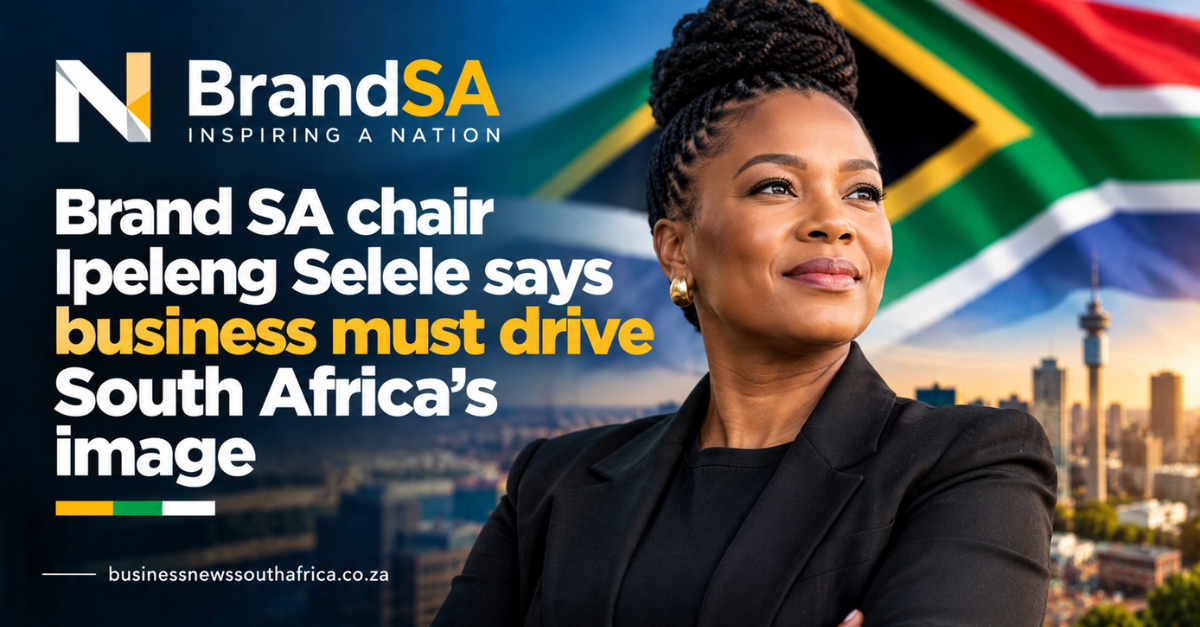
When Ipelang Selele stepped into the Moneyweb studio, the question was not about policy or politics but about who really carries the weight of South Africa’s reputation abroad. Selele, chair of Brand SA, answered plainly: the private sector, not the state, must be the engine of the country’s brand.
Brand SA is a public-private partnership created to promote South Africa’s image to investors, tourists and global talent. It is not a marketing agency that produces glossy brochures; its mandate is to align the country’s narrative with measurable outcomes such as foreign direct investment, visitor numbers and talent attraction. In other words, the organisation’s success is judged by delivery, not by lofty promises.
Selele’s point matters for anyone who runs a small or medium enterprise. If the national brand is built on the performance of businesses, then the credibility of a company’s own brand can benefit from the wider perception of South Africa as a place that delivers. Conversely, a weak national brand can make it harder for SMEs to win contracts abroad or attract skilled staff.
Why the state’s role is limited
The chair reminded listeners that the government’s role is to set the framework, tax policy, infrastructure investment and regulatory stability, but the day-to-day reputation of South Africa is forged in boardrooms and factories. “The state can create the conditions, but it is the businesses that show the world what we can achieve,” she said.
This view aligns with recent trends in other emerging markets where public-private branding initiatives have shifted from government-led propaganda to market-driven storytelling. In South Africa, the shift is especially relevant after a series of high-profile service delivery failures that have dented confidence in state institutions.
For SMEs, the implication is clear: aligning with national brand goals can open doors. Participation in Brand SA campaigns, for example, can provide exposure to international buyers and investors who are looking for partners that embody the country’s values of resilience and innovation.
Selele also warned that measuring progress by delivery means looking at hard data, export growth, tourism receipts and talent inflows, rather than relying on political rhetoric. She cited the recent increase in foreign direct investment as a sign that the private sector’s credibility is improving, though she stopped short of providing exact figures.
While the interview did not disclose specific targets, the emphasis on accountability suggests that Brand SA will likely tighten its metrics. Companies that can demonstrate contribution to these metrics may find themselves highlighted in future promotional material, creating a virtuous cycle of brand reinforcement.
For entrepreneurs, the message is both a challenge and an opportunity. The challenge is to ensure that their own operations meet the standards that the national brand aspires to. The opportunity lies in leveraging the national narrative to amplify their own market reach.
Selele’s remarks come at a time when South Africa is navigating a complex economic landscape marked by load-shedding, currency volatility and a need for job creation. By positioning business as the carrier of the national brand, she is calling for a pragmatic partnership where success is measured in concrete outcomes rather than political promises.
Readers who want to explore how their own companies can align with Brand SA’s objectives can visit the organisation’s website or consult the Markets & Finance section for tools on commercial funding and compliance.
Brand SA’s actual mandate
Brand South Africa was established in 2001 as the International Marketing Council of South Africa before adopting its current name, and operates as a public entity reporting to the Department of Trade, Industry and Competition rather than as a conventional marketing agency. Its dual accountability, a state-funded mandate delivered through private-sector partnership, is precisely the tension Selele’s comments address: the organisation depends on government funding to exist, but its stated theory of change treats business performance, not state messaging, as the primary driver of how the country is actually perceived abroad.