South Africa’s next energy problem may not be about generating power at all. Writing in TechCentral, chartered accountant Craig Holmes, co-founder of Let’sCreate and managing director of Let’sEquip, argues that the real crisis is moving into finance departments: businesses that now buy electricity from several sources are receiving bills they cannot easily reconcile.
How the market opened up
Two rule changes did it. In 2021 the threshold above which a power generator needs a licence rose from 1 MW to 100 MW. In January 2023, amendments to Schedule 2 of the Electricity Regulation Act removed licensing for facilities that wheel power, meaning they send electricity across a third party’s network, and replaced it with registration.
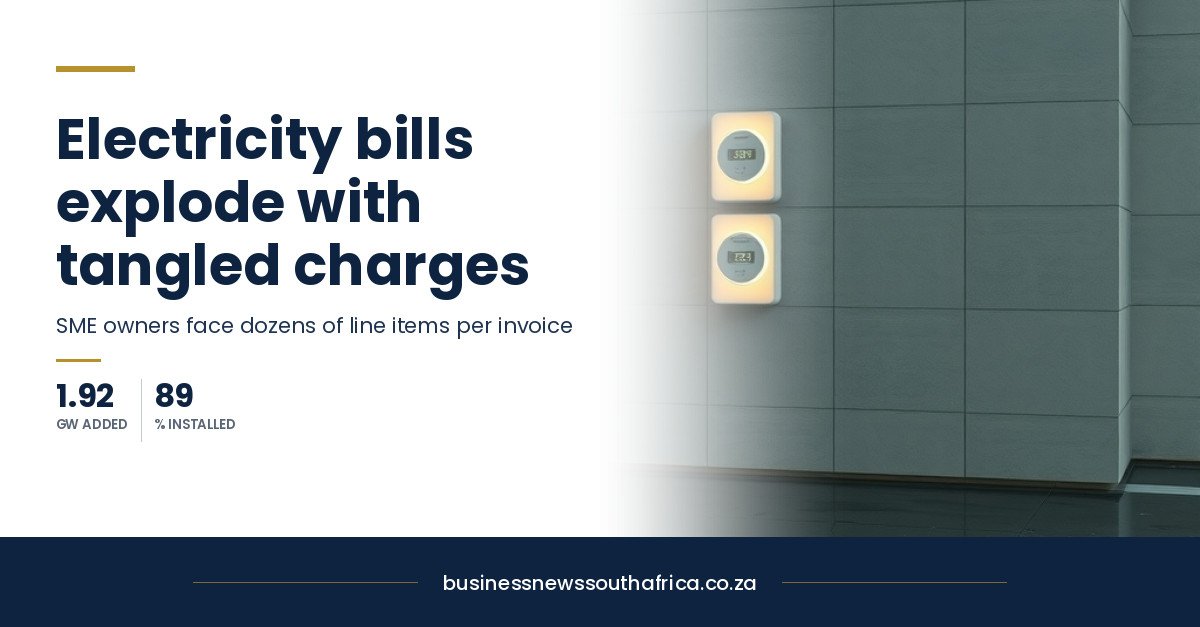
The result is a wave of private projects. According to the Power Futures Lab at the University of Cape Town’s Graduate School of Business, 17 independent power producer projects reached commercial operation in the first half of 2026, adding 1.92 GW, the highest half-year total on record. Nersa recorded another 124 renewable energy facilities in the first quarter of 2026/27, together representing 804 MW and R20.2 billion of investment. It is part of the wider opening of the market we covered when Eskom’s 103 year monopoly was set to end in 2027.
One site, several suppliers
Traders now sit between generators and buyers. In May, Growthpoint, energy trader Etana Energy and the City of Cape Town announced the first pooled wheeling of renewable electricity across several properties on the municipal network. Power from the Boston hydroelectric plant near Clarens, co-owned by Serengeti Energy and Growthpoint, is sent through Eskom’s network and shared among five Growthpoint buildings rather than one site, and Growthpoint wants to extend the arrangement to more than 30 of its properties in the city. Andre Nepgen, chief executive of Discovery Green, has estimated that about 80% of newly closed private renewable generation now goes through traders rather than direct contracts between a generator and a buyer.
For a finance team, each source arrives with its own commercial terms, on top of tariffs that vary by time of use, season, public holidays and demand. One invoice can combine energy charges, demand charges, network charges for wheeled power and municipal surcharges, and matching them to the right building, cost centre or tenant is the hard part. Holmes says someone has to take on that reconciliation job and that none of the obvious candidates fits it comfortably.
Meters, tariffs and the new pricing policy
Metering is catching up unevenly. Eskom’s smart meter programme on load-reduction feeders targets 577,347 meters, and by 11 September it had installed 513,022. Prices are rising at the same time: Nersa approved an 8.76% increase in Eskom’s direct tariff for 2026/27 and about 9% for municipal distributors from 1 July, after a R54.7 billion correction to Eskom’s regulatory asset base. The pressure is not limited to electricity. Johannesburg’s water tariffs rose 12.5% from 1 July, and the city has proposed raising the fixed water charge for households by roughly 66% in 2026/27.
A revised electricity pricing policy, gazetted for comment in August 2026, would require bills to show a full breakdown of the constituent tariffs for each service consumed, itemising energy, demand, network charges, levies, subsidies and municipal surcharges. How much of that detail a business can check will depend on the metering at its site.
What owners can do now
Holmes does not offer a fix, but the problem points to a few practical steps. Ask each supplier and trader for itemised invoices, compare them with your own meter data, and find out which network and municipal charges your contract passes through to you. Landlords who recover electricity costs from tenants should check that their allocation method matches how the power is actually bought. The shift will bring more suppliers and more line items, not fewer, so the businesses that build the habit of reconciling early will be the ones least surprised later.