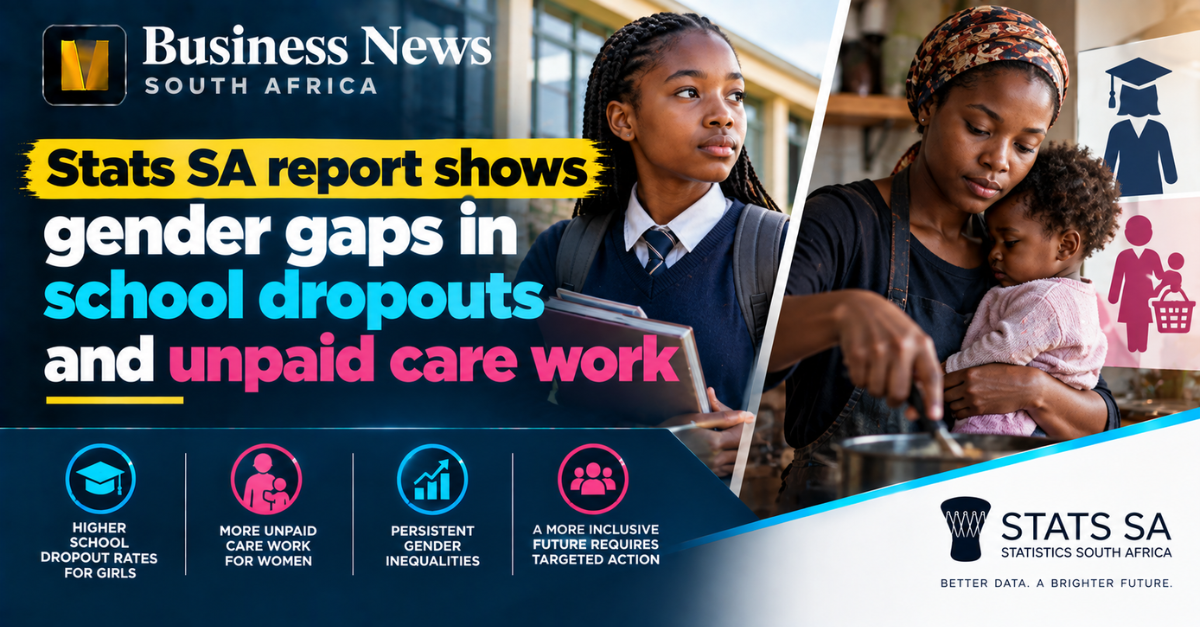
Statistics South Africa (Stats SA) released a new gender report that points to clear differences between men and women in two key areas: school dropout rates and the amount of unpaid care work performed at home. The agency said the data highlight that girls are more likely to leave school before completing their secondary education, while women carry a larger share of household and caregiving responsibilities.
For owners of small and medium enterprises, the findings matter because they touch on the supply of skilled workers and the availability of staff during working hours. If a higher proportion of young women are leaving school early, the pool of future employees with formal qualifications shrinks. At the same time, the burden of unpaid care work, tasks such as looking after children, the elderly or sick relatives, can limit the hours that women are able to work or make them more likely to request flexible schedules.
Stats SA did not publish exact percentages in the brief headline, but the agency’s statement noted that the gender gap in school dropouts has persisted despite overall improvements in enrolment. The report also confirmed that women continue to perform the majority of unpaid care work, a pattern that mirrors findings from earlier surveys.
These trends are not new to the South African economy. Historically, the country has struggled with high youth unemployment, especially among women who face both labour market discrimination and the double-shift of paid work and unpaid care. The current data suggest that the problem is not disappearing, which means that SMEs may need to rethink recruitment and retention strategies.
What the gaps could mean for small businesses
First, a reduced pipeline of educated women may force employers to rely more on on-the-job training or to adjust job requirements. Second, the concentration of care duties on women can increase absenteeism or turnover if employees cannot balance work and home responsibilities. Some SMEs have responded by offering part-time roles, job-sharing arrangements or on-site childcare, but such measures are not yet widespread.
Third, the gender gap in education can affect the types of skills available in the local labour market. For sectors that depend on technical or administrative expertise, for example, retail management, light manufacturing or service industries, a shortage of qualified women could limit growth or increase wage pressure.
Finally, the report’s findings may influence policy discussions around education and social support. If the government expands programmes that keep girls in school or provides subsidies for childcare, SMEs could benefit from a more stable and skilled workforce.
Stats SA’s release is a reminder that gender-related data are not just academic. They translate into real decisions for business owners who must plan hiring, training and scheduling. While the agency’s numbers are still being analysed, the direction of the trends is clear: without targeted interventions, the gender gap in education and care work will continue to shape the labour market in ways that affect every size of enterprise.
For now, SME owners can start by reviewing their own workforce demographics, assessing whether care responsibilities are influencing attendance or performance, and exploring flexible work options that could retain valuable staff. As more detailed figures become available, businesses will have a better basis for strategic planning.
Reading a gender statistics release without over-reading it
Official statistics agencies publish this kind of report on a regular cycle, and the value of any single edition lies less in the headline than in the direction of travel across successive releases. A gap that narrows slowly over several years tells an employer something quite different from one that has held steady, and the underlying tables usually allow that comparison even when the summary release does not.
It also helps to know where unpaid care work comes from as a measurement. It is captured through time use surveys, in which respondents record how their day divides between paid work, unpaid work in the household and everything else. Because none of that unpaid activity is bought or sold, it falls outside gross domestic product entirely, which is one reason it can be economically enormous and statistically invisible at the same time. The distance between what an economy measures and what it actually runs on is most of what makes a report like this worth reading.
For a small employer the practical translation is narrower than the policy debate. Labour force participation, the share of working age people either employed or actively looking for work, is the figure that determines how deep a local hiring pool really is, and care responsibilities are one of the standard reasons participation sits below what the working age population alone would suggest. An employer who cannot change any of that can still notice it. Where a role has been hard to fill for months, the binding constraint is sometimes the shift pattern rather than the pay.
Schooling data behaves the same way, only slower. Completion rates feed the pool of candidates who can be trained quickly, and the effect arrives on a delay measured in years rather than quarters. That long lag is precisely why these releases are worth reading before the shortage turns up in a recruitment round.