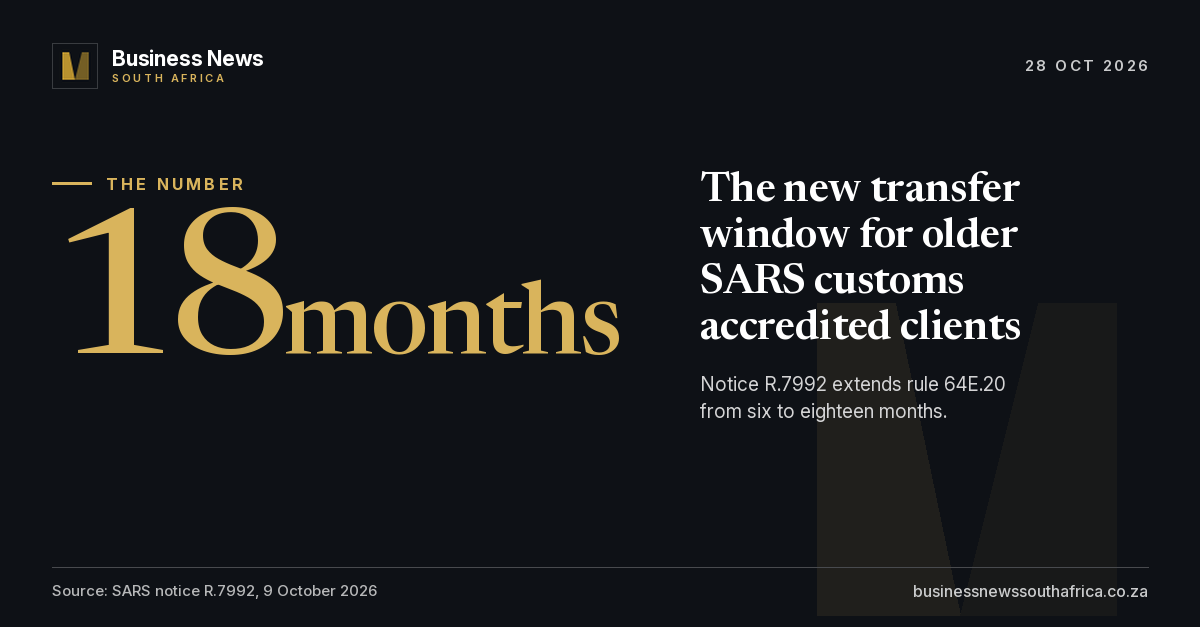
SARS has extended from six to eighteen calendar months the period in which holders of customs accredited client status granted before 8 December 2023 must transfer their accreditation details to its electronic accreditation system. The amendment, signed by SARS Commissioner Ngobani Johnstone Makhubu, was published on 9 October 2026 in Government Gazette 55506 (Notice R.7992) and applies retrospectively from 1 September 2025. BusinessTech reported the change on 9 October.
For an importer, exporter or clearing agent, the practical point is that this extension covers only the transfer of older accreditation details. It does not change the separate requirement to keep customs registration and RLA profiles up to date.
Who is covered
BusinessTech described the change as applying to all traders registered or seeking accreditation under section 64E. The notice is narrower. It amends only rule 64E.20, which applies to holders of accredited client status granted before 8 December 2023, when the electronic accreditation system was introduced. In rule 64E.20(2) it replaces “six” with “eighteen” calendar months and “6 month period” with “eighteen month period”. It does not change the rules for ordinary registration of importers and exporters.
Under the rule as published, those clients must transfer their details by applying for accredited client status within eighteen calendar months of the rule’s effective date, or earlier if the 30 day renewal period for their status starts before the eighteen months end. A client that does not comply may have its status cancelled or suspended by the Commissioner. SARS offers two accreditation tiers: Level 1 for clients with a three-year record of high customs and tax compliance, financial viability and sound record-keeping, and Level 2 for clients that meet international supply chain safety and security standards.
Registration on the RLA platform
SARS introduced its electronic Registration, Licensing and Accreditation (RLA) platform in 2020, and BusinessTech reports it is now the central platform for customs client registrations and updates. BusinessTech also reports that traders previously registered on paper forms, such as the DA185, are required to re-register, link their VAT and tax details and update their profiles on the RLA system. The notice does not mention RLA registration, so the 18 months should not be read as extra time for that.
Western Cape accounting and advisory firm ASL said that from April 2025 SARS began suspending the customs codes of traders that had not onboarded and updated their details on the RLA platform. A suspended code stops a business importing or exporting goods, which ASL said led to delays, reputational damage and financial penalties. It also noted stakeholder reports of more entry rejections at border posts because of incomplete or outdated importer and exporter validations.
What ASL advises
ASL urged businesses to link their profiles on eFiling, making sure VAT numbers, import and export codes and clearing agent details are correctly linked, and to update their RLA information. That can be started on eFiling, although merging legacy codes or correcting legal entity data may still need a visit to a SARS Customs Office. It also advised assigning the right eFiling user roles to staff who handle customs functions and validating all entity details, because incomplete or inaccurate information can lead to rejected entries. Businesses that delay risk having their customs codes suspended, the firm said.
See also our guide to importing goods into South Africa and our Regulatory & Policy section.
Correction, 28 October 2026: an earlier version of this article said SARS had extended the customs compliance window for all traders to 18 months, and that the notice covered all traders registered or accredited under section 64E. The change applies to holders of accredited client status granted before 8 December 2023 moving their details to the electronic accreditation system. It has been corrected.