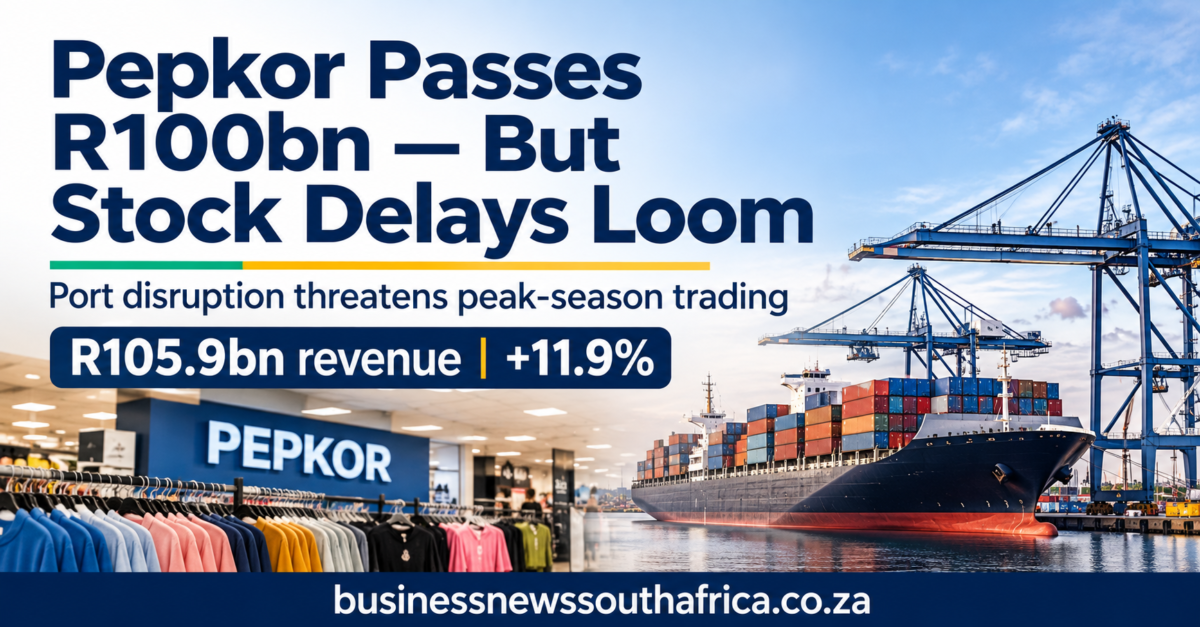
Pepkor said on 24 November that revenue from continuing operations rose 11.9% to R105.9 billion in the year to 30 September 2026, the first time the group has passed R100 billion. In the same announcement it warned that “ongoing port operational disruptions and delayed inventory inflows are expected to weigh on near-term trading performance”, and said management has prioritised key product inflows ahead of Black Friday and the festive period.
The figures below come from Pepkor’s reviewed annual results and its short-form announcement. Its auditor, PricewaterhouseCoopers, issued an unmodified review conclusion.
The headline numbers
- Revenue: R105.9 billion, up 11.9%, with organic growth of 7.3%. Pepkor says that organic growth came off an elevated base created by two-pot retirement withdrawals in the previous year.
- Operating profit: R11.9 billion, up 7.4%.
- Headline earnings per share: 171.3 cents, up 6.9%. Excluding its investment in the planned PlusB bank, normalised headline earnings per share were 177.5 cents, up 9.7%.
- Dividend: 57.9 cents a share, up 9.3%, payable on Monday 18 January 2027.
- Cash: cash generated from operations rose 40.6% to R15.3 billion, and free cash flow more than doubled to R4.8 billion from R1.7 billion.
What it says about the port problem
The results say summer stock inflows “have been disrupted by adverse weather and domestic port congestion”, and the outlook section links the disruption to near-term trading. Inventory rose 1.2% to R18.8 billion, which Pepkor says includes acquisitions and a larger store footprint, and fell 3.4% when acquisitions are excluded.
The congestion at the container terminals in Durban has been building for weeks. We have covered the ship queues at Durban Gateway Terminal and how one manufacturer put port costs at 20% to 25% of its EBITDA. Pepkor’s warning shows the effect has reached retail shelves just as the busiest weeks of the year begin.
Shoppers: credit is tighter and growth is uneven
Pepkor says trading conditions across southern Africa are expected to remain constrained, with elevated living and transport costs weighing on household budgets. Its brands diverged:
- PEP: sales up 5.1%, like-for-like up 3.1%, with 2,772 stores.
- Ackermans: sales up 0.2%, like-for-like down 1.5%. Pepkor attributes this to slower credit granting, a shift of credit spend to other Pepkor brands, declining lay-by, low inflation and assortment problems in babies and youth ranges.
- Specialty: sales up 51.0%, or 8.3% excluding the 474 acquired stores.
- Group retail: sales up 10.1%, or 4.8% excluding acquisitions, with like-for-like growth of 2.6%.
The group says it deliberately moderated credit granting from the second quarter to manage risk, and its active Capfin unsecured lending accounts fell to 344,000. Active A+ retail credit accounts grew to 4.1 million.
Beyond the shops: parcels, handsets and the bank
Several numbers matter to small suppliers and informal traders. Pepkor says its Flash business processed R70.6 billion in throughput, up 17.6%, and that its trader base grew to 176,000 traders. PAXI parcel volumes rose 18% to 8.1 million, and PEP sold 9 million handsets. It announced a merger of Flash with Shop2Shop.
On financial services, revenue rose 35.2% to R6.2 billion and operating profit 37.0% to R1.5 billion. Pepkor says its application for a banking licence for PlusB is in the final stage of adjudication, with a launch planned for the second half of its 2027 financial year within a R920 million build cost target.
What retailers and suppliers can take from it
- Check your own stock position today. If Pepkor’s inflows were delayed, other importers with goods in the Durban queue face the same problem, so confirm what is on shelf before you advertise a Black Friday special. Our guide to what the Consumer Protection Act says about advertised prices and stock limits explains why.
- Watch credit. Pepkor’s own accounts show consumers leaning less on credit and lay-by, which affects any seller offering terms.
- Plan supply chains for January. Pepkor expects port bottlenecks to remain a headwind in the near term, so festive stock decisions made now may need a fallback supplier.
This is news reporting, not investment advice.