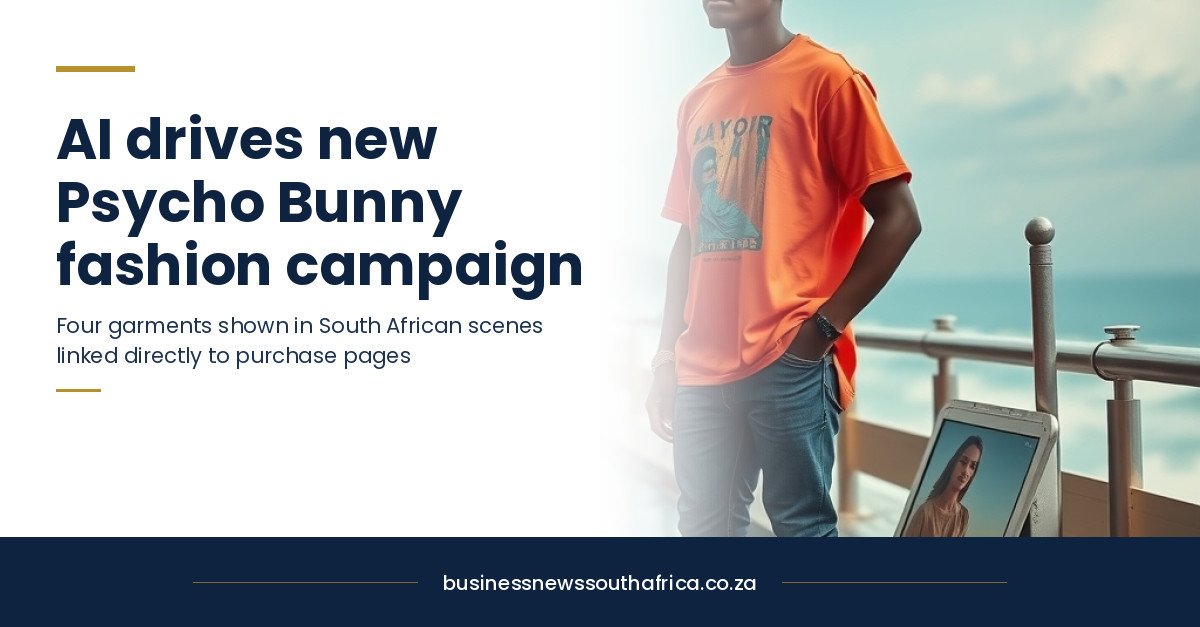
In September, international label Psycho Bunny rolled out a new AI-driven advertising campaign called The Bunny Was Here. The campaign combines AI-generated short films, digital ads and dedicated shopping pages to showcase four garments in recognisable South African settings.
The creative team, led by Paul Domanski of Domanski.AI, produced four short films and 16 digital advertisements. Each ad points to a specific product page on psychobunnyza.com where shoppers can choose the colour and size shown on screen. The approach is designed to turn a visual discovery into an immediate purchase.
Domanski says, “In fashion advertising, AI should not be used to invent a product that does not exist. Its real creative power lies in taking an authentic product and placing it inside a moment that would otherwise be impossible to create.” The brand therefore focused on accurate representation of stitches, cords, colours and branding, ensuring that the AI-created scene does not mislead consumers about the physical item.
AI is increasingly used in fashion marketing to generate eye-catching imagery, but many retailers struggle to keep the visual promise aligned with the actual product. By linking each AI-crafted scene directly to an e-commerce page, Psycho Bunny offers a practical model for small and medium-size retailers who want to experiment with AI without sacrificing product fidelity.
The four featured items, a Tanner Bunny Graphic Tee, a Samos Hydrochromic Printed Swim Trunk, a Devon Bubble Stitch Knit Polo and a Classic Pique Polo with cap, appear against backdrops such as the rain-wet Camps Bay strip, an infinity pool terrace in Umhlanga, a private Cape Town room and a rain-soaked padel court in Green Point, with Cape Town Stadium visible in the latter. The campaign runs nationally on Facebook and Instagram until the end of September 2026.
For South African retailers, the campaign illustrates how AI can be woven into the broader retail funnel, from attention-grabbing storytelling to product discovery and conversion, while keeping the core promise of product accuracy intact. Retail & Consumer businesses can watch this experiment for ideas on blending creative tech with a seamless shopping experience.
Why AI matters for the South African fashion sector
The South African fashion industry has long relied on visual storytelling to differentiate brands in a crowded market. Traditional photo shoots require location scouting, model fees, wardrobe logistics and post-production work that can stretch budgets and timelines. AI-generated content reduces many of these constraints by allowing creators to render realistic scenes without the need for physical travel or extensive set construction. This cost efficiency is especially relevant for retailers that operate on thin margins and need to allocate resources to inventory, logistics and customer service.
Beyond cost, AI offers speed. A campaign that might have taken weeks to film and edit can be produced in days when the underlying technology can synthesize lighting, weather and background elements on demand. For a market where fashion seasons shift quickly and consumer attention moves from one trend to the next, the ability to launch a fresh visual narrative rapidly can translate into higher conversion rates and reduced inventory risk.
Another advantage is the capacity for hyper-localisation. By placing garments in recognisable South African landmarks, the campaign taps into a sense of place that resonates with local shoppers. This approach aligns with the broader trend of brands seeking to speak directly to regional cultures rather than relying on generic global imagery. When consumers see a product against a backdrop they know, the emotional connection can increase the likelihood of purchase.
Integrating AI into the e-commerce funnel
The Psycho Bunny campaign demonstrates a clear, end-to-end integration of AI content with the e-commerce journey. Each digital advertisement is not merely a static banner; it is a gateway to a product page that mirrors the exact colour and size displayed in the AI-generated film. This eliminates the common friction point where shoppers click an ad, land on a page with a different visual, and abandon the purchase. By ensuring visual continuity, the brand reduces cognitive dissonance and builds trust.
From a technical perspective, the workflow involves generating the short film, extracting key frames, and then linking those frames to dynamic product pages that pull inventory data in real time. The result is a seamless transition from inspiration to transaction. For South African retailers that already operate online stores, the model can be replicated with existing content management systems, provided they have access to AI generation tools and the ability to map visual assets to SKU data.
Importantly, the campaign also showcases how AI can be used responsibly. By committing to accurate representation of stitches, cords, colours and branding, the brand addresses a common criticism that AI-generated images can create unrealistic expectations. This level of transparency is essential for maintaining consumer confidence, especially in a market where word-of-mouth and online reviews heavily influence buying decisions.
Regulatory considerations and consumer protection
South Africa’s consumer protection framework places a strong emphasis on truthful advertising. The Consumer Protection Act requires that marketing communications do not mislead consumers about the nature, quality or price of a product. By linking each AI-crafted visual directly to a product page that offers the exact specifications shown, the campaign aligns with these legal expectations. Retailers adopting similar AI strategies should therefore ensure that any generated imagery is clearly tied to verifiable product data.
Data privacy is another area of relevance. The Protection of Personal Information Act governs how personal data can be collected and used in digital advertising. While the Psycho Bunny campaign primarily uses AI for visual creation rather than personal data processing, any retailer that incorporates AI-driven targeting must obtain appropriate consent and provide clear opt-out mechanisms. This ensures compliance and protects the brand from potential penalties.
In addition to formal legislation, industry bodies such as the Advertising Standards Authority provide guidelines on the use of synthetic media. These guidelines encourage advertisers to disclose when content has been artificially generated, especially if the manipulation could affect consumer perception. By maintaining a transparent link between the AI scene and the actual product, Psycho Bunny pre-emptively addresses this recommendation.
Implications for small and medium enterprises
Small and medium-size enterprises (SMEs) often view AI as a technology reserved for large multinational brands with deep pockets. The Psycho Bunny example challenges that perception by demonstrating a scalable approach that can be adapted to modest budgets. The key ingredients are a clear creative brief, access to an AI generation platform, and a robust e-commerce backend that can dynamically display product attributes.
SMEs can start by piloting a single AI-generated visual for a flagship product. By measuring click-through rates, time on page and conversion metrics, they can assess the return on investment before expanding the approach to a full catalogue. Because the AI content can be repurposed across multiple channels, social media, email newsletters, website banners, the incremental cost of each additional placement is minimal.
Furthermore, the ability to showcase products in local settings can differentiate an SME from competitors that rely on generic stock photography. A boutique clothing store that places its garments against the backdrop of a well-known market or a scenic coastal drive can create a narrative that feels authentic to South African shoppers, thereby strengthening brand loyalty.
Future outlook for AI in South African retail
Looking ahead, the convergence of AI, augmented reality and mobile commerce is set to reshape how South African consumers interact with fashion brands. While the current campaign focuses on short films and static digital ads, the underlying technology can be extended to interactive experiences where shoppers manipulate virtual garments in real time. Such capabilities could further reduce the gap between online and offline shopping, a priority for retailers seeking to capture the growing mobile-first audience.
Adoption will likely be driven by a combination of consumer demand for immersive content and the competitive pressure to innovate. Brands that invest early in responsible AI practices, ensuring product fidelity, complying with advertising standards and protecting personal data, will be better positioned to reap the benefits of higher engagement and increased sales.
In summary, the Psycho Bunny “The Bunny Was Here” campaign offers a concrete illustration of how AI can be integrated into the South African retail ecosystem without compromising on authenticity or regulatory compliance. By marrying AI-generated storytelling with direct product links, the brand provides a roadmap for retailers of all sizes to enhance their digital marketing, improve conversion efficiency and deliver a shopping experience that feels both modern and locally relevant.