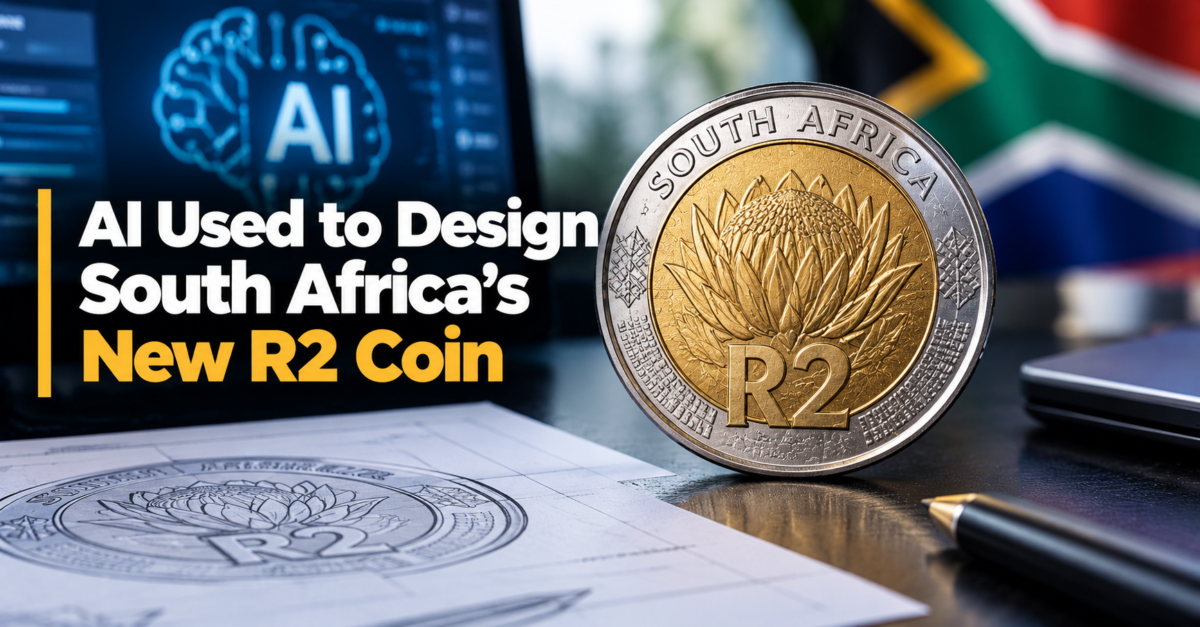
At the South African Mint, a screen flickered with colour-rich patterns that had never been seen on a coin before. According to a brief announcement on 2oceansvibe.com, the new two-rand (R2) coin was designed using artificial intelligence (AI) tools.
AI, in this context, refers to computer programmes that can generate visual designs after being fed data on existing coin aesthetics, security features and cultural symbols. The claim that AI was involved is the only detail provided by the source, so the exact software, the extent of human oversight and the timeline of the project remain unclear.
Why the design matters to cash-using businesses
For small retailers, market stalls and transport operators, the appearance and durability of coins affect everyday transactions. A fresh design can improve public confidence, reduce counter-feiting risk and potentially lower the cost of replacing worn coins. If AI helped streamline the design phase, manufacturers might see lower development costs, which could translate into cheaper minting fees for the South African Reserve Bank (SARB) and, ultimately, for businesses that handle cash.
However, the announcement does not provide evidence that AI reduced costs or improved security. The SARB has not yet released an official statement confirming the role of AI, nor have any coin-producing firms commented on the process. Until those details emerge, the claim remains a single-source report.
Historically, South Africa introduced the R2 coin in 2002 to replace the two-rand note, aiming for a more durable and cost-effective medium of exchange. The current redesign follows a global trend where central banks experiment with digital design tools. For example, the Bank of England and the European Central Bank have both explored AI for banknote design, citing faster prototyping and enhanced pattern complexity.
For SMEs, the practical impact will depend on how quickly the new coins enter circulation and whether any changes in vending-machine acceptance or cash-handling procedures are required. In the past, new coin releases have prompted brief adjustments in cash-register software, but those updates are usually rolled out by point-of-sale providers within weeks.
In the absence of further details, business owners should monitor SARB communications for official rollout dates, any new security features that might affect counterfeit detection, and guidance on handling the new coins. The AI angle, while intriguing, does not yet translate into concrete operational changes.
Until the SARB confirms the design process, the story rests on a single media report. Stakeholders are advised to treat the claim as provisional and await official documentation before adjusting cash-handling policies.
The Mint has periodically refreshed the designs on the country’s circulating coins over the decades, a process that traditionally involves the Reserve Bank’s own currency management function, and the use of AI tools in such a process reflects a broader trend of design software increasingly incorporating generative features. The South African Mint’s own coin design process carries further detail. For related coverage, see this site’s Tech and Telco coverage.
Coin and banknote redesigns in South Africa have historically also served a security purpose, since updated designs can incorporate new anti-counterfeiting features alongside any cosmetic change, a consideration that applies regardless of which tools were used in the design process itself.
The Mint’s own production process still requires physical dies to be cut and tested before a design can be struck onto blank coins at scale, meaning a digitally generated concept has to go through the same physical engineering steps as any other design before it reaches circulation.
South Africa’s coins and banknotes are produced separately, coins at the Mint in Pretoria and banknotes at the Reserve Bank’s own note printing works, and any change to either has to be signed off by the Reserve Bank’s currency and banknote committee before it can be finalised. Previous redesigns of South African currency have often coincided with milestones such as constitutional anniversaries or a change in the country’s head of state depicted on banknotes, giving this AI-assisted process a point of comparison against how such decisions were made in the past.