Editor’s note: Business News South Africa uses AI tools in its newsroom. This article reports Anthropic’s own announcements and customer claims, which we have not tested independently, and it is not sponsored.
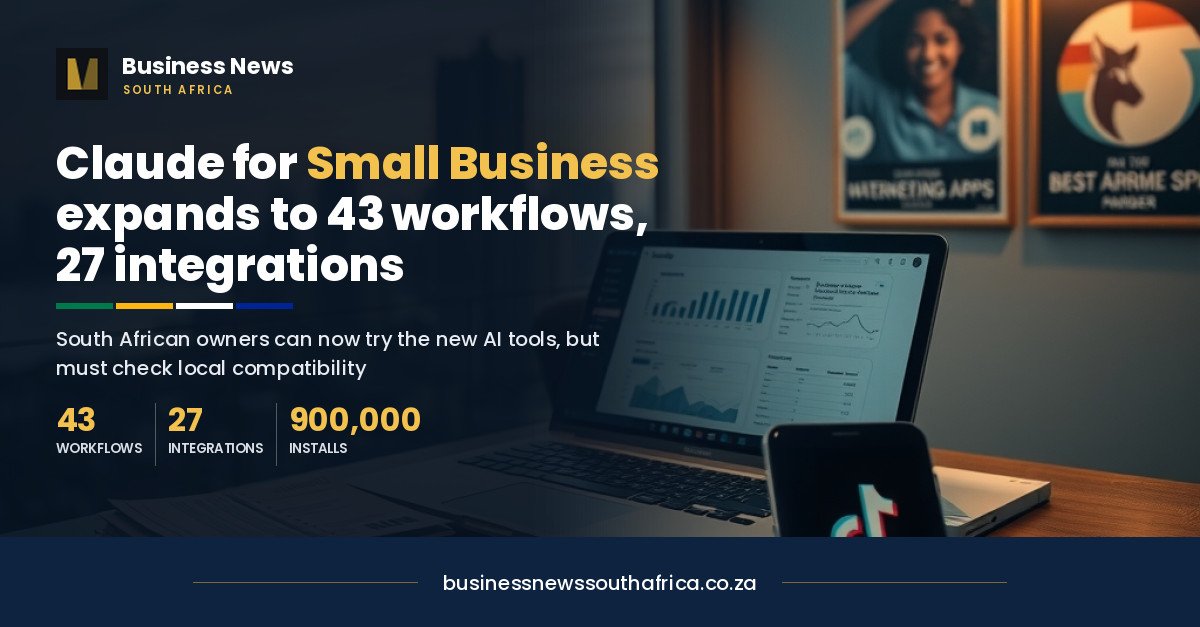
Anthropic has expanded Claude for Small Business, a package of ready-made workflows and app connections aimed at owners who run their own books, sales and marketing. On 15 September it added 43 workflows and 27 integrations, including Xero, Shopify, Stripe, Zoho Books and TikTok, and said the package had been installed more than 900,000 times since it launched in May, according to Anthropic. For South African owners the useful question is not whether the tool is impressive. It is which of it works for a business here, and what it takes to try it safely.
What Claude for Small Business is
Anthropic launched it on 13 May 2026 with 15 workflows and 15 skills across finance, operations, sales, marketing, HR and customer service. Owners switch it on inside Claude Cowork, connect the tools they already use, and choose the job they want done. Anthropic’s pitch is that you stay in control: “You approve the plan first or, when you’re ready, let it run end-to-end.”
The examples on Anthropic’s small business page give a sense of the work. A Monday brief posts your cash position, sales by channel and priority actions to Slack at 6:30 am. A close-the-books workflow reconciles QuickBooks against Shopify Payments and Stripe settlements, flags duplicates and uncategorised transactions, and writes a plain-English profit and loss summary. Another turns voice memos and photos from a site visit into a formatted proposal using your past pricing. A lead workflow qualifies enquiries, drafts replies with your calendar availability and logs contacts in a CRM, without sending anything until you approve.
The September expansion, and the tools South Africans use
The 15 September update added connections to Shopify, Salesforce, TikTok, Atlassian, Zoom, Xero, Gusto, Square, Stripe, Zapier, Mailchimp, MYOB, NetSuite, Notion, PayPal, Trello, Wix, Zoho Books, Zoho CRM and others, on top of the original QuickBooks, HubSpot, Canva, Docusign, Google Workspace and Microsoft 365. Several of these, such as Xero, Zoho Books, Shopify, Wix and Google Workspace, are available to South African businesses, so an owner who already keeps books in one of them has something concrete to test. Others are built around the United States: Gusto, for example, is a US payroll service and will not run a South African payroll.
The TikTok connection is worth noticing on its own, given that TikTok One has just opened to South African creators. Anthropic’s announcement lists the integration, but we have not seen a South African use case for it, so treat it as a sign of direction rather than a finished workflow.
What it costs
The package is available on all paid Claude plans, and Anthropic recommends the Team plan for businesses with more than one user. Anthropic’s pricing page lists Pro at $17 a month billed annually or $20 billed monthly, and Team standard seats at $20 a month billed annually or $25 billed monthly, all in US dollars. Your cost in rand will move with the exchange rate. There is a free plan, but it does not include everything the paid plans do, so read the current plan comparison before you assume the workflows are covered.
Where it does not yet reach South Africa
Anthropic’s training push is American. Its free half-day workshops run in 10 US cities, more than 150 organisations have been approved as Claude small-business trainers, and Anthropic says over 750 community-run workshops are planned, but the announcement names no South African dates. A free on-demand course, AI Fluency for Small Business, was built with PayPal and can be taken online from anywhere.
The claims, and how to read them
Anthropic’s customer results are strong. A cheese maker credits it with recovering about $180,000 in shipping overcharges. One owner says it saves over 21 hours a week. The founder of Blackfyre GovCon says work that “used to take me 120 hours now takes me five minutes.” These are testimonials chosen by the vendor, and none has been independently checked. The page does not say how those businesses are set up, so the results show what is possible, not what a South African shop with a different tax regime, bank and accounting setup should expect.
What to check before you connect anything
- Customer data. Connecting your books or CRM gives an AI tool access to your customers’ personal information. Under POPIA the responsibility stays with you, not the software provider. Anthropic says it does not train on business data on Team and Enterprise plans, and that existing app permissions still apply. Read the data terms for the plan you would actually use, and see our guide on handling a data breach under POPIA.
- Approval settings. By default the owner approves work before it runs. Keep it that way for anything that sends money, emails customers or changes accounting records.
- South African tax. A workflow built around US accounting norms will not know our VAT rules. Check the output against your own books, and see how the VAT threshold changed to R2.3 million this year.
- Alternatives. Microsoft, Google and OpenAI all sell business assistants. Our guide to AI tools for small business compares what is available, and the governance gap in South African AI use explains why rules for staff matter before the tools spread.
The practical read
Claude for Small Business is a real product with real integrations, and some of them fit South African businesses today. The sensible way to test it is small: pick one repetitive task you already do, such as the weekly cash summary or a lead reply, run it on the plan you would pay for, keep approvals on, and measure the time it saves against the cost. The vendor’s numbers will not tell you what it does for your business. A month of your own will. For the cost side of AI running continuously, see our earlier look at agent pricing for South African SMEs.