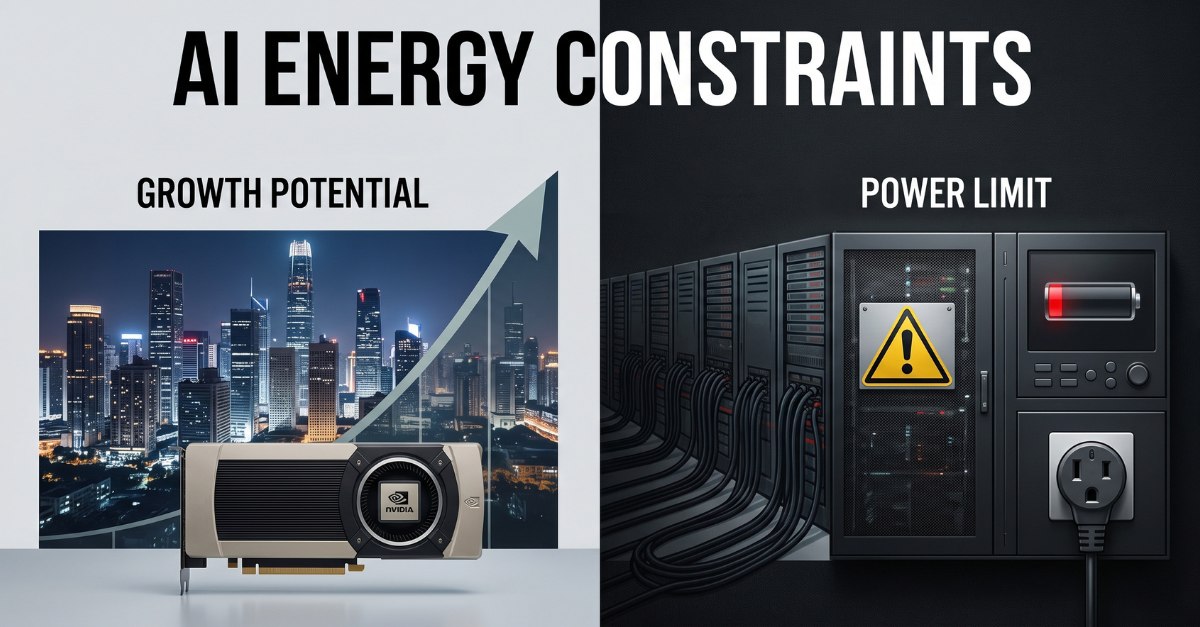
Elon Musk and Jensen Huang said energy, not chips or software, is the main limit on how fast artificial intelligence can grow, in a panel discussion with Anthropic co-founder Tom Brown broadcast by Right Side Broadcasting Network on 29 September 2026. The discussion was framed around how the United States keeps its lead in AI.
For a South African business, the point is familiar: the companies building AI say power supply decides how much computing can be built, and that is a constraint local firms already plan around.
Energy first
Jensen Huang, chief executive of Nvidia, said every part of computing, from chip design to software and applications, is being rebuilt. “Every single layer of the computing stack has been reinvented. This way of doing computing, unlike previous ways of retrieving information, this is a generative approach to computing and therefore, in order for us to succeed, the first thing we need is energy,” he said.
Asked how the US keeps winning, Elon Musk, chief executive of SpaceX and Tesla, said: “You’ve got to scale energy, you’ve got to scale chip production.” He said the US is winning on software, but that in the long run it needs to generate enough power to compete with China, which he said has about three times the electricity production of the United States.
Musk’s rule of thumb on power and growth
Musk said average US power consumption is about 500 gigawatts, so every 5 gigawatts of extra steady-state supply is a 1% increase in power used, and that he expects it to translate into roughly a 1% increase in GDP because the useful intelligence produced per watt keeps rising. That is his own estimate, not a published economic finding.
He said SpaceX and Tesla aim to produce 200 gigawatts of solar capacity a year, and that SpaceX sees orbital computing as a way to reach far more energy than is available on the ground. Solar panels in space get their full rated output or better, he said, while on the ground they produce between a fifth and an eighth of that and need large batteries. He said Starship had just reached orbit for the first time and deployed Starlink V3 satellites.
Data centres as factories
Asked how data centres benefit the communities around them, Huang said: “We call them data centers because that’s where we hold data. But the things that we’re building now, these are really SI factories, super intelligence factories. And the reason why it’s a factory is because you’re producing something of economic value.”
He estimated that building 10 to 20 gigawatts of this capacity a year across the US creates about a million jobs, in power plants, construction, cooling and pipe fitting. Musk said his company is building a $250 million water recycling plant for the community around one of its sites and offers residents half-price access to its satellite internet service.
The same physics applies at home. Energy expert Andy Calitz has urged South Africans to demand 8,760 hours of power a year, the full year of supply that large computing loads need.
Containing and monitoring AI agents
Huang described two Nvidia technologies for running AI agents safely: Open Shell, which he likened to a browser for agents that keeps an agent isolated from the rest of the computer, and a chip called BlueField that monitors what the agent does and escalates if it breaks policy. “Even though you have it contained, you should never trust that it’s contained, and so you want to monitor it in real time. And you want to ideally monitor it with another chip so that it is outside,” he said.
The panellists said they had signed a joint declaration on superintelligence safety at a White House lunch, expected to be published by the White House. One described it as covering joint monitoring and special committees, “grading each other’s homework”; another said it included internal controls, internal audit, external third-party audits and industry sharing of best practice.
Brown said Anthropic’s Opus 5.5 model continues the steady progress of each release, and that its main practical change is that it can handle tasks that take longer than people could hand to earlier models. Anthropic’s chief executive has separately asked the industry to slow down on frontier development.
Using AI at work
One panellist said he uses Claude for comparative research on weekends: instead of spending four to eight hours researching, he gets a condensed report in about three minutes. Another said AI is helping people organise their lives and do better at their jobs: “I think it really will become essential, if it isn’t already, for people to use AI for in their professional lives, certainly, and in their private lives.” For more on what AI leaders are telling founders, see how Sam Altman and Jensen Huang have given founders the same advice.
What this means for South African businesses
- Plan computing around power. If the largest AI builders say electricity is their bottleneck, any local data centre or AI project needs a power plan as much as an IT plan. Local capacity is growing, including what its builders call Africa’s most powerful AI cloud in Johannesburg.
- Limit what AI agents can reach. Huang’s advice is to isolate agents, give them only the rights they need and monitor them continuously.
- Treat Musk’s power-to-GDP ratio as an opinion. It is a rule of thumb for the US, not a forecast for South Africa.
Correction, 26 October 2026: an earlier version of this article said the panellists spoke on Right Side Broadcasting Network, attributed specific statements to named speakers where the recording does not make the speaker clear, said Huang put the research saving at six to eight hours, and described the safety declaration as creating joint oversight boards. It has been corrected.