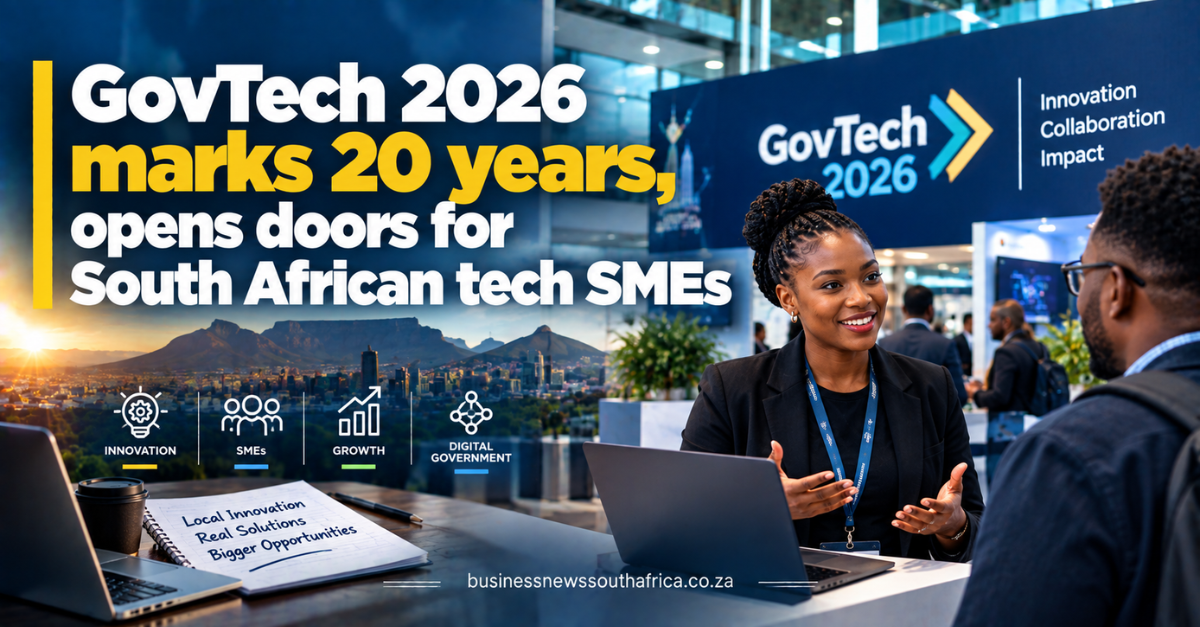
According to TechCentral, GovTech 2026 will be held 21 to 23 September 2026 in Durban, celebrating its 20th edition.
For small and medium-size tech firms, the event is a rare chance to meet the officials who decide the next wave of public-sector spending before those plans become formal tenders. The opportunity is especially relevant for companies listed under the Tech & Telco category who are looking for government contracts.
The conference is built around four permanent anchors, citizen-facing artificial intelligence, robotics and automation; cybersecurity and trust; data governance and interoperability; and aligned infrastructure and connectivity. Artificial intelligence refers to computer systems that can perform tasks normally requiring human judgement, while robotics and automation cover machines that carry out repetitive processes without direct human control.
A new GovTech Progress Tracker will record progress on sovereign cloud adoption, AI governance, interoperability, cybersecurity maturity, connectivity expansion and digital public service delivery. Sovereign cloud means cloud services owned and operated by the government, and AI governance sets the rules for responsible use of AI in public services.
Organisers invite four groups: government departments, regulators and public institutions; technology providers; universities, research councils and TVET institutions; and SMMEs and start-ups. This broader mix is wider than most local tech gatherings.
Start-ups can also compete in the GovTech Challenge, a route that gives direct access to government problem statements, a pathway that rarely appears elsewhere.
Tickets are limited; delegates who secure a pass will sit alongside the people shaping the country’s digital agenda and can benchmark their solutions against peers in one place. The conference is hosted by the State Information Technology Agency, the body that runs the annual event.
GovTech conferences of this kind have become a recurring venue for smaller South African technology firms to pitch directly to government procurement officials, a channel that matters because public sector contracts often carry longer payment terms and larger volumes than private sector work, but also more onerous compliance and B-BBEE requirements that can shut out a firm without dedicated compliance capacity. Twenty years of the same event also gives a useful marker for how far government’s own digital transformation ambitions have progressed against the pace originally promised.
The Department of Public Service and Administration’s own e-government strategy sets out the policy framework GovTech events like this one report against. For related coverage, see this site’s Tech and Telco coverage.
South Africa’s own state IT agency, SITA, has faced repeated criticism over the years for slow, centralised procurement processes that smaller technology vendors say make it difficult to compete against a handful of large, established government IT contractors, a tension that events aimed at opening doors for SME participation are explicitly trying to address.
Smaller technology vendors that do successfully win a foothold in government work often use that reference as leverage to win private-sector contracts afterward, since public sector procurement, despite its slower pace, is seen by many corporate buyers as a credible vetting process in its own right.
Twenty consecutive years also means the event has outlasted several changes in the government’s own digital strategy leadership, a continuity that organisers point to as evidence the underlying need it serves has remained constant even as the specific technology on display has moved from early e-government portals to today’s AI and cloud-based systems.
The government’s own digital transformation targets have repeatedly cited SME participation as a measure of success in their own right, not just a byproduct of a healthy technology sector, since a public procurement pipeline open to smaller vendors also tends to produce more locally relevant, better-supported solutions than one dominated by a handful of large incumbents.
Attendance figures from past editions have also been used by organisers to argue for a larger annual budget allocation toward SME-focused government technology initiatives going forward.