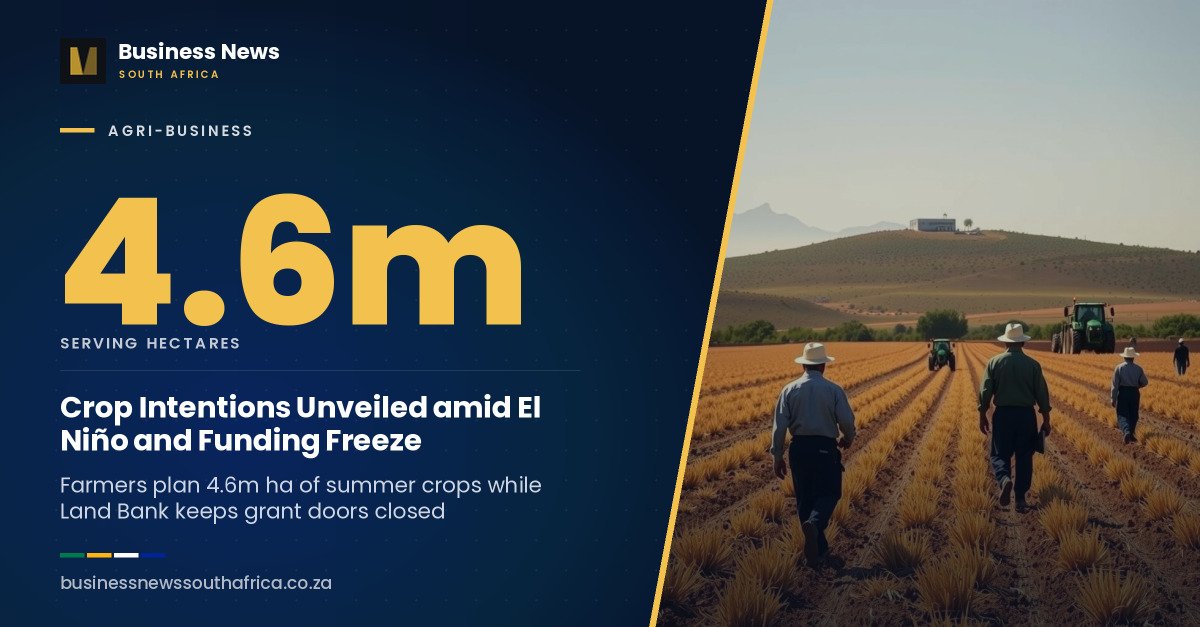
On Tuesday 27 October the Crop Estimates Committee releases its first read on how much land South African farmers intend to put under summer crops. The date comes from agricultural economist Wandile Sihlobo, who wrote on Bizcommunity that the report will cover maize, sunflower seed, soybeans, groundnuts, sorghum and dry beans. The number arrives at an awkward moment: a strengthening El Niño, higher fuel and fertiliser costs, and a state-backed grant scheme that has stopped taking new applications.
For banks, input suppliers, grain buyers and food manufacturers, the planting figure is an early signal for the 2027 harvest and for food prices next year. The finance question sits underneath it.
The baseline farmers are measured against
Sihlobo says farmers usually plant about 4.5 million hectares of summer crops. In 2025/26 the area rose to 4.6 million hectares, with maize at about 59%, or 2.7 million hectares, and soybeans at about 26%, or 1.2 million hectares. He argues that the area farmers hold this season depends on how they weigh drought risk against higher fertiliser and fuel prices, and that for now he does not expect a major reduction, because soil moisture at the start of the season is favourable. That is his assessment, not a committee finding, and the report itself will show whether it holds.
The weather signal is firm
The South African Weather Service’s monthly Seasonal Climate Watch, as quoted by Daily Maverick, says the forecast for the next three overlapping seasons “indicates an increased likelihood of below-normal rainfall across large parts of the summer rainfall region”. The service describes the dry signal as “particularly widespread across the interior and the northeastern half of the country”. Sihlobo notes that the same service said on 30 September that the country is in a strong El Niño state expected to strengthen. The Department of Agriculture has told farmers to stay within recommended planting windows, choose cultivars suited to hot and dry conditions and avoid unnecessarily expanding land under production, according to SAnews.
There is a cushion. The department says the 2025/26 summer brought above-normal rain to many summer rainfall areas and lifted dam levels and soil moisture. A drier season does not automatically mean a failed one, and timing of the rains will matter as much as the total.
The grant scheme is still shut to new farmers
The Land Bank’s Blended Finance Scheme pairs a repayable loan with a non-repayable grant for qualifying emerging farmers. The bank paused new applications for the rest of the 2026/27 financial year, as we reported in our first report on the pause. The Department of Agriculture then confirmed an extra R150 million on top of its R325 million allocation, which we covered in R150m reaches Land Bank.
A further R500 million followed. The Department of Land Reform and Rural Development signed a memorandum of agreement with the bank to provide that grant funding for the remainder of the financial year, according to a joint statement carried by Farmers Mag. The statement says about 540 clients and beneficiaries had been supported by the end of 2025/26 and that demand “substantially exceeded the grant funding available”.
The new money does not reopen the door. In written answers to Farmer’s Weekly, received on 16 October, Land Bank said the extra allocation “is intended to support applications that have already been received by the bank, and does not provide for the reopening of new applications at this stage”. It added that inclusion in the existing pipeline “does not automatically constitute approval or a guarantee of funding”. Priority goes first to transactions that have met disbursement requirements, then to approved deals awaiting contracts, then to applications already in credit assessment, with time-sensitive production finance considered subject to eligibility.
Conventional Land Bank lending continues as 100% loan funding for qualifying farmers. Its response did not give interest rates or security requirements for those loans.
What it means for businesses
For input suppliers and co-operatives, farmers who cannot get blended finance may buy less seed and fertiliser on credit or plant a smaller area, which would show up in later sales rather than in Tuesday’s intention figures. For lenders, a farmer who takes a full-price loan to plant into an El Niño season carries more repayment risk than one who receives a grant component. For grain buyers and millers, the planting area and the rains together set the 2027 supply picture.
Cost pressure compounds all of this, and we have tracked the cost outlook for the 2026/27 season separately.
What is still unknown
Land Bank’s reply did not say whether the R500 million has been transferred, how many existing applicants it can fund, how large the pipeline is, or how big the remaining grant shortfall is. There is no reopening date. The bank says it intends to resume new applications when sufficient grant resources become available, and in its September statement on the pause it said it expects a further R325 million allocation from the Department of Agriculture in 2027/28.
The intention report measures plans, not plantings. Farmers can still change course as rain arrives, and the committee’s later estimates will show whether finance, cost or drought changed what actually went into the ground. Anyone relying on Tuesday’s number should read it as the first of several data points.