The Green Climate Fund (GCF) has approved USD 140 million in catalytic financing for a facility that will put risk capital into industrial decarbonisation projects in South Africa and Namibia, with the Development Bank of Southern Africa (DBSA) acting as the accredited entity. The approval came at the GCF’s 46th Board meeting in Songdo, Korea, which runs from 26 to 29 October 2026, and was announced on 28 October by Climate Fund Managers, the blended finance manager based in The Hague that runs the vehicle. The DBSA published the same release on its own site. For South African businesses, the practical point is that more early-stage and construction equity is lined up for green hydrogen and related industrial projects, but none of it is a grant or loan window for ordinary applicants.
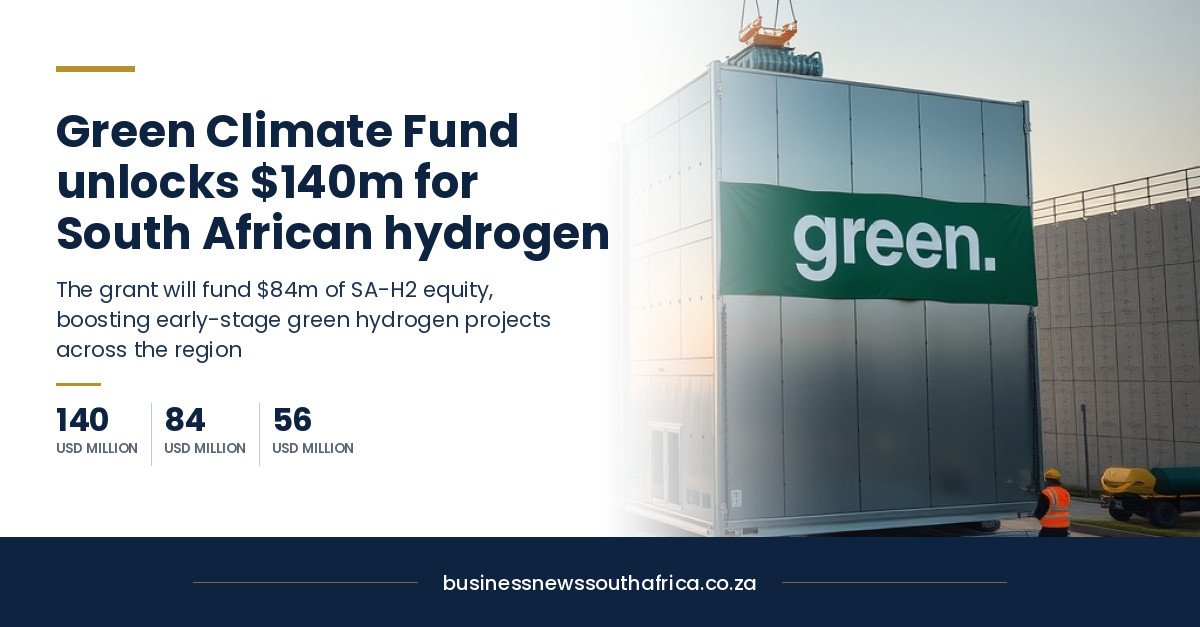
USD 84 million of the approval is earmarked for South Africa’s SA-H2 fund
According to the DBSA’s publication of the release, the money goes to Climate Investor Three (CI3), a global blended finance facility for industrial decarbonisation. CI3 works in South Africa through the SA-H2 Fund and in Namibia through the SDG Namibia One Fund. Of the USD 140 million, USD 84 million is allocated to the Construction Equity Tranche of SA-H2. The other USD 56 million goes to SDG Namibia One, made up of USD 15 million for its Development Tranche and USD 41 million for its Construction Equity Tranche.
The funding will flow through the Southern African Industrial Decarbonisation Facility, which the GCF’s regional director for Africa, Catherine Koffman, described in the release as the GCF’s first platform dedicated to decarbonising industrial value chains in Africa. The GCF’s own B.46 meeting page lists the Southern African Industrial Decarbonization Facility, submitted by the DBSA and covering Namibia and South Africa, among the funding proposals considered at the meeting, and shows it as approved. The Climate Fund Managers version of the announcement is on its press release page and matches the DBSA text.
The targets are for 30 to 40 projects and a USD 1.2 billion programme
In the release, Koffman said the facility aims to deploy “first-loss equity” where risk is highest, to support a target programme of USD 1.2 billion across the two countries. She put the aims at 30 to 40 projects, about 1.52 GW of renewable energy installed, and an estimated 24.2 million tonnes of emissions avoided. These are stated goals, not results. Climate Fund Managers separately says CI3 is working towards a USD 1.2 billion fundraising target, and that the GCF money is meant to reduce project risk so that institutional investors will commit more capital. The release also says Climate Fund Managers was accredited by the GCF in July 2026.
The DBSA’s role is described as programme oversight, monitoring and reporting to the GCF. Dr Phindile Masangane, the bank’s group executive for programmes, said its role was to “derisk investment, crowd in private capital” and to make sure the transition delivers development outcomes.
SA-H2 has already closed R3 billion and funded two South African projects
The approval builds on an earlier milestone. On 6 August 2026 Climate Fund Managers announced a first close of SA-H2 at ZAR 3 billion, about USD 182 million at the Reserve Bank rate it quotes for 3 August. Investors named in that release are the European Commission and Invest International as anchors, the Public Investment Corporation acting for the Government Employees Pension Fund, Sanlam Life, and the Industrial Development Corporation. The DBSA’s 28 October release lists the DBSA itself among the first-close investors. The 6 August release and the SA-H2 website describe the DBSA as supporting the fund, so the exact nature of its stake differs between documents. The SA-H2 site also says the fund has not yet reached a final close.
The 28 October release says SA-H2 has signed development funding agreements for Hive Hydrogen’s Coega green ammonia project and for Green eFuels Producers’ wastewater-to-green-methanol facility. The SA-H2 site says it committed up to USD 20 million in development funding to the Coega project. For earlier reporting on which local hydrogen projects have money behind them, see our piece on South Africa’s first six green hydrogen projects and the report on the EU grant for hydrogen projects.
Who can actually apply for this capital
This is project finance for developers, not a scheme for small enterprises, so most businesses will not apply. The nearest published guidance is the developer page on Climate Fund Managers’ site. It is undated and covers the whole group across Africa, Asia and Latin America, not SA-H2 specifically. It says the firm offers development funding of up to 50% of development costs, equity of up to 75% of construction costs and financing of up to 50% of post-construction debt. Projects need a minimum ticket size of USD 10 million, and the sponsor must have access to at least 25% of its own equity for construction. Whether the same limits apply to SA-H2 or to the GCF-backed tranches is something we could not confirm, and we found no SA-H2-specific application criteria on its site.
The wider supply chain is the likelier route for most businesses. Green ammonia, methanol and industrial decarbonisation projects need engineering, construction, logistics and power counterparties, but none of the documents we read says whether these projects carry local procurement terms. Businesses that want to follow the capital markets side can read our report on private capital fundraising in Southern Africa, and the state lender involved in the first close is covered in our explainer on IDC funding. Those exploring the energy transition as investors can compare our guide to investing in South African renewable energy.
What we could not confirm
We could not find the GCF’s own press release or the full funding proposal text for the facility, so the allocation figures and the targets rest on the Climate Fund Managers and DBSA release. The GCF’s B.46 page confirms the approval but not the amounts. We could not confirm when money will be disbursed, what returns or conditions apply to the first-loss equity, which projects will receive the new USD 84 million, or whether a rand conversion at today’s exchange rate would match the earlier USD 182 million figure for the R3 billion first close. The release is a joint announcement by the parties that benefit from the approval, so independent confirmation of the project pipeline and timing remains outstanding.