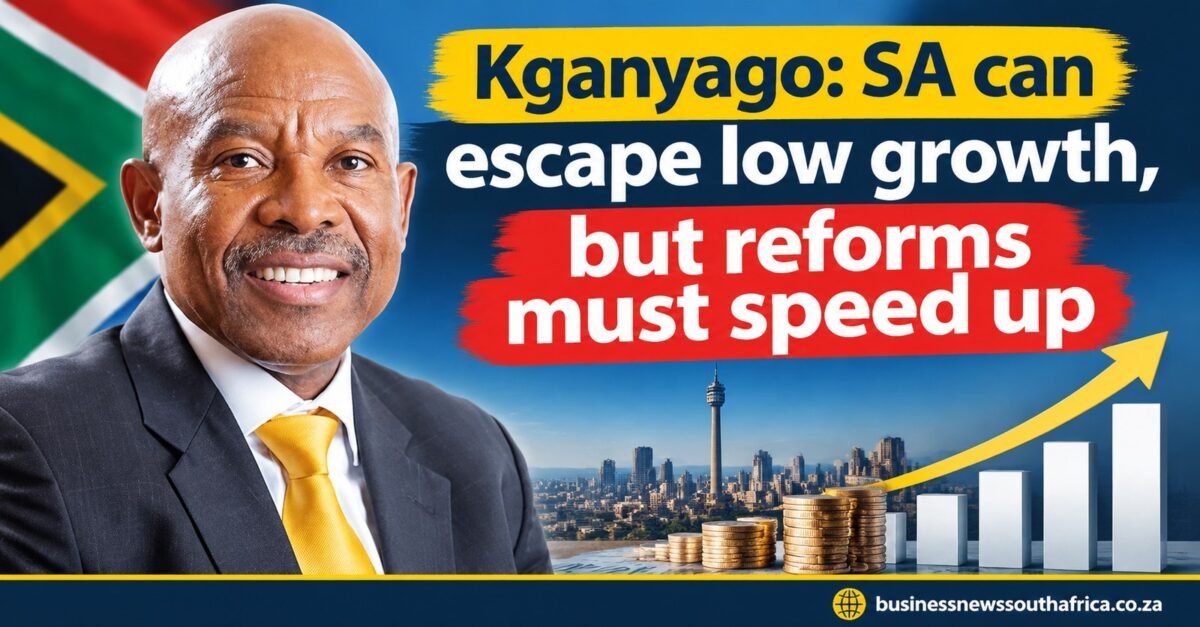
Reserve Bank Governor Lesetja Kganyago says South Africa can escape low growth, but only if reforms already under way are implemented faster. In a speech on 29 October 2026, published on the SARB’s website, he argued that the low-growth trend was mostly caused by domestic factors and “can be reversed by domestic reforms”. Days later, a radio interview repeated the message: do the hard reforms now, because the benefits take years to arrive.
What it means for your business
The governor is not promising a quick rebound. The Reserve Bank’s own projection is growth of 2% by 2029, so plan for modest demand rather than a boom. What can change sooner is your cost of doing business: reliable electricity, working ports and rail, and functioning municipal services. Those are the areas he named, and they are where your supply chain and operating costs are most exposed.
What the speech said
Kganyago spoke at a dinner of the Italian-South African Chamber of Trade and Industries in Johannesburg. According to the SARB’s published text, growth averaged just 0.8% between 2015 and 2025, after averaging 4.3% a year from 2000 to 2007. Per capita income declined over the past decade. He said this cannot be blamed on the global environment, because it happened despite a broadly supportive world economy.
He pointed to domestic constraints. The SARB’s estimates indicate that load-shedding alone subtracted about 1.7 percentage points from GDP growth in 2023. Load-shedding days rose from 35 in 2020 to 300 in 2023. Investment fell from about 20% of national output in 2008 to around 14% today. He said the problem is not a shortage of capital but weak productivity, red tape and other institutional barriers that have raised the hurdle rate on productive investment.
The governor said the Minister of Finance’s 2026 Medium Term Budget Policy Statement identified three pillars for faster growth: macroeconomic stability, structural reform and state capacity. He described the structural reform priorities as reliable and affordable electricity, efficient transport and logistics, and clear, predictable policies that support investment, productivity and competition. “Progress is encouraging but implementation must accelerate,” he said.
The interview: act now
According to a report published on 2 November 2026, Kganyago told Johannesburg radio station PowerFM on Sunday that reforms such as those targeted by Operation Vulindlela “need to be put in place, executed effectively, so that you can actually get the economy growing,” and create jobs. On timing, the same report quotes him: “The thing about structural change is that the effects of structural change get felt a year, two, sometimes even three or five years down the line. But you’ve got to make those difficult decisions now. If you don’t, you are postponing the problem, and it catches up with you.” We have not heard the broadcast ourselves and rely on that report for the interview wording.
Operation Vulindlela is a unit in the Presidency, working jointly with National Treasury, that was formed in 2020 to tackle constraints in areas such as logistics, electricity transmission, water infrastructure and municipal governance.
Where the reforms stand
The programme’s 2026 second-quarter progress report was released on 30 October. SAnews reported that the report cites key decisions on the vertical separation of Eskom and Transnet, steady progress towards a competitive wholesale electricity market, and Cabinet approval of an independent National Ports Authority separate from Transnet. It also notes a Transnet profit of R4.6 billion for the year ended 31 March 2026, against a R1.9 billion net loss the year before. In local government, the report says the Metro Trading Services Reform Programme has progressed to full implementation, with incentive allocations to participating metros to be made in 2027/28.
The governor’s own list of positives is shorter. He said electricity supply has improved significantly, with the energy availability factor at levels last seen about a decade ago, that Operation Vulindlela is advancing reforms in electricity, logistics and municipal services, and that fiscal credibility has improved, with credit ratings moving from downgrades to upgrades. He added that the “real economy changes are not so clear cut yet”.
What monetary policy cannot do
Kganyago was blunt about the limits of his own institution. He said monetary policy “cannot substitute for structural reform” and that the SARB does not have the instruments to fix infrastructure, logistics, skills, institutional capacity or productivity.
On rates, he said that since March 2026 the SARB has raised the policy rate by a cumulative 50 basis points in response to the Middle East fuel shock. He said the bank’s modelling indicates current policy settings are sufficient to return inflation to the 3% target once the initial shock passes, and that the bank “will act as needed” to prevent higher inflation becoming entrenched. We covered the debate on the next move in our report on economists’ expectations of a November SARB hike.
What to do
- Budget on slow demand growth. The SARB’s own projection is 2% by 2029, not 3%.
- Track the reform items that hit your costs: electricity market and transmission changes, port and rail access, and municipal trading services.
- Read the data behind the new GDP base year in our report on the Stats SA rebasing before using older growth figures in forecasts.