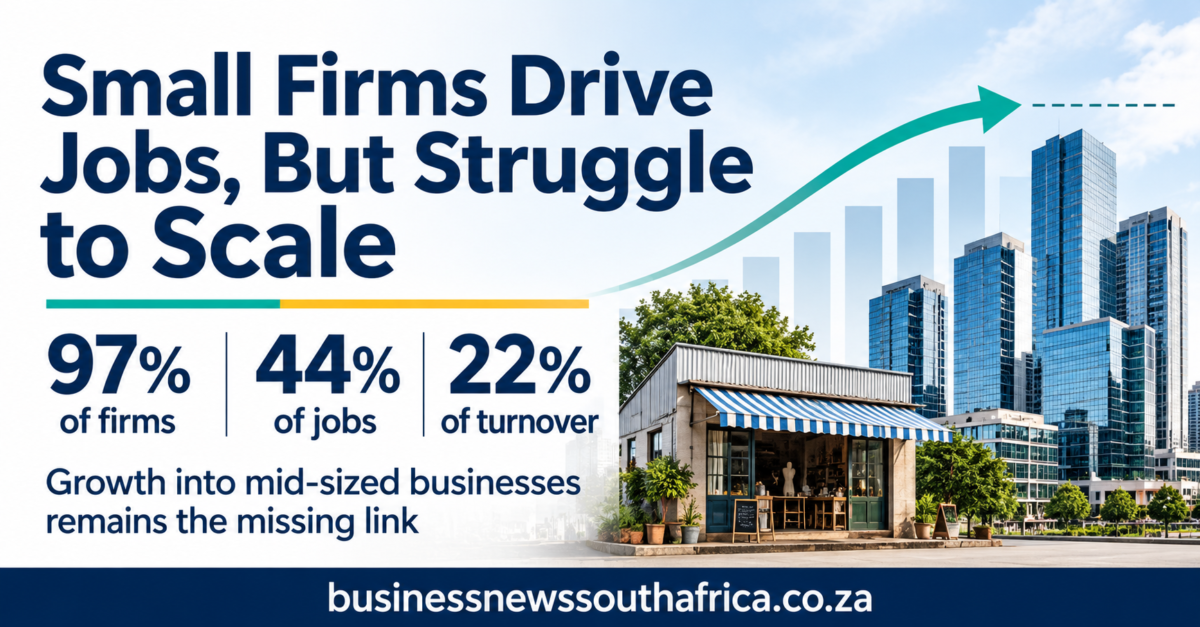
South Africa’s micro, small and medium enterprises are 97% of firms and 44% of employment among tax-paying firms, but only about 22% of turnover, according to the Competition Commission’s Concentration Tracker Report 2026. The report, which draws on 2021 data, says the single largest bottleneck for these firms is barriers to expansion, not barriers to entry. The finding was repeated at the closing session of the B-BBEE policy conference in Johannesburg, SAnews reports, and it matters to any owner whose business is stuck between being small and being big enough to win large contracts.
The numbers in the report
- Share of firms: MSMEs were 97% of firms in 2021, and most of them (80%) were micro firms.
- Share of jobs: MSMEs accounted for 44% of employment among tax-paying firms in 2021, up slightly from 43% in 2017. The report says their employment share is twice their turnover share, so they are about twice as employment intensive as large firms.
- Share of turnover: 22% in 2021, down from 24% in 2017. The report sets that against more than 50% for OECD countries.
- Where MSMEs matter most for jobs: construction (75% of employment), catering and accommodation (60%) and wholesale (58%).
The report’s sample is firms that pay tax, so informal businesses outside the tax net are not in these shares. It analysed 228 sub-sectors; the share that were highly concentrated fell from 21.5% in 2017 to 17% in 2021, while the share that were moderately concentrated rose from 11% to 16.7%.
Expansion is the bottleneck, not entry
The study’s headline conclusion is that barriers to expansion rather than entry remain the single largest bottleneck for MSME participation. It says both government policy and competition law should focus on growing successful entrepreneurs by removing barriers to expansion and securing market access, “including through public procurement”. At the B-BBEE conference, the Commission’s James Hodge told delegates that the report recommends more funding and stronger enforcement to support medium-sized and larger challengers that have shown they can compete.
What the B-BBEE conference added
Acting Deputy Director-General Dr Susan Mangole said in her closing remarks that government’s approach to B-BBEE should be informed by reliable data, that the department will work with Statistics South Africa and other stakeholders on the future framework, and that consultations will continue across the country. A policy brief goes to the dtic and the Presidency within 30 days. Former Statistician-General Dr Pali Lehohla argued that economic power remains concentrated in mining and financial services and called for evidence-based, geographically targeted investment in local supply chains. Our earlier reports cover the minister’s opening speech and the draft B-BBEE regulations open for comment.
What it means for small and township businesses
- Procurement is the named route. If government is meant to help firms grow through public procurement, tenders are where small suppliers can test it. Our Tender Finder lists what is open and closing, and the Kasi & Hustle hub filters for requests for quotation that small suppliers can win.
- Funding for the next stage matters as much as start-up money. Our guide to township business funding maps the routes from R100 000 grants to R3 million loans.
- Know the rules at each size. Moving from informal to a business with staff changes your tax and employment duties; see the rules at each stage of a kasi business.
This article reports a published report and a government statement and is general information, not financial advice.